
Thousand CubesSet of 10 for Large Quantity Recognition
The first photo is the maker's own. The other shots are illustrative.
Inv. no. NIE-007510
- Maker
- Nienhuis Montessori, since 1929
- Approval
- AMI
- Primary Material
- Solid wood construction
- Surface Treatment
- Printed grid pattern on all faces
- EAN
- 8719924004385
Final price incl. VAT. Delivery €5.90, €75.10 to go for free delivery.
Advice, warranty and returns are handled by us.
Why it costs €73.90
Behind the price of the original are things you can check yourself.
AMI approval
The material is approved by the Association Montessori Internationale (AMI). Nienhuis has made Montessori materials since 1929.
A verifiable original
The EAN 8719924004385 is on the box. It is the maker's number, not ours.
Thousand Cubes in a child's hands
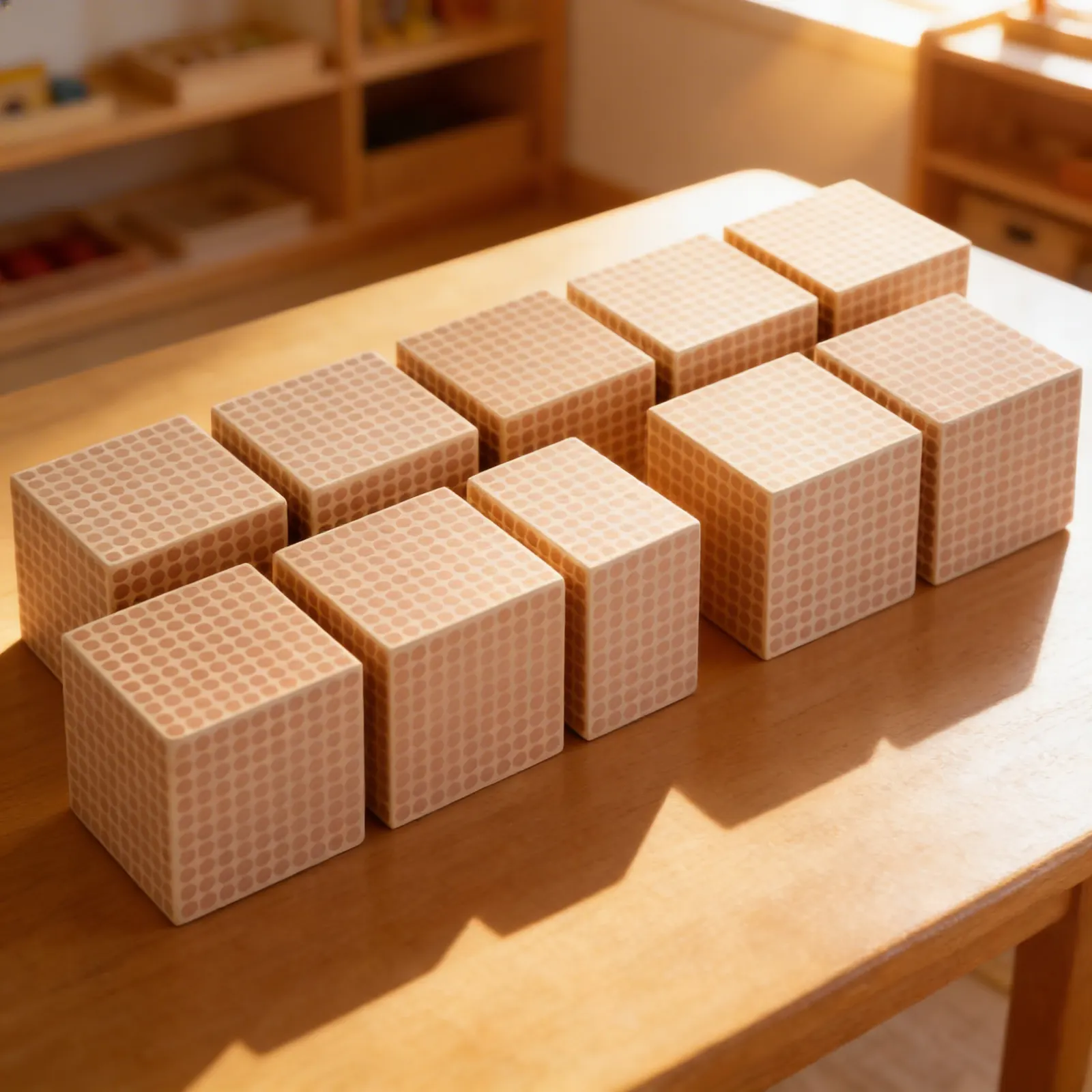
Ten wooden cubes, each standing for a thousand, which together make ten thousand sitting on a table. The golden bead cube of a thousand is the largest quantity a child can hold, and ten of them is the first honest picture of the next order up, since counting to ten thousand is not something anybody does. Wooden cubes also let a class work with the decimal system without a bead cube coming apart in a five year old's hands. Solid wood with a printed finish, for ages 3 to 12.
Mathematical Abstraction
Bridges concrete manipulation to abstract understanding of large numbers and place value through visual and tactile exploration.
Decimal System Mastery
Reinforces base-ten concepts and relationships between units, tens, hundreds, and thousands in the mathematical hierarchy.
Preparation for Operations
Provides concrete foundation for addition, subtraction, multiplication, and division with four-digit numbers.
How to present it
Place the wooden cubes on a mat or table. Have number cards 1000-10,000 available. Ensure child has worked extensively with Golden Beads and understands units, tens, and hundreds.
- 1Introduce one cube, inviting the child to feel its weight and examine the grid pattern
- 2Count the grid lines on one face: '10 lines going across, 10 lines going down'
- 3Build quantities using multiple cubes: 2000, 3000, up to 10,000
- 4Match quantity to number cards, reading 'two thousand, three thousand'
- 5Explore exchanges: 'Ten thousand cubes make ten thousand'
3 tips for parents
- At home, relate thousands to familiar contexts: 'There are about 2000 steps from our house to the park'
- When child shows interest, count collections in hundreds leading to thousands: 'We have 10 packs of 100 stickers, that's 1000!'
- Support mathematical language: use 'thousand' correctly rather than 'a lot' or 'tons'

If you are not sure it suits your child, we answer in person.
Norbert Kovalčín, founder of Faborino · write to him
There is no review here yet. We will ask you for one after you buy. Write the first review
What's in the Box
- Wooden Thousand Cubes: 10 identical cubes with grid pattern
Size and material
| Packaging | 38 × 16 × 8 cm |
| Primary Material | Solid wood construction |
| Surface Treatment | Printed grid pattern on all faces |
| Recommended Age | 3-6 years |
Care
Wipe with slightly damp cloth, dry immediately
Frequently Asked Questions
What are the dimensions of each thousand cube?
Each wooden thousand cube measures 10cm x 10cm x 10cm, representing 1,000 unit cubes (10x10x10). The printed grid lines on all six faces help children visualize the 1,000 individual units that make up the whole.
How does this material support the Montessori decimal system?
The thousand cubes provide concrete representation of place value, allowing children to physically manipulate and count in thousands. When combined with unit beads, ten bars, and hundred squares, children can build any number and perform operations like addition, subtraction, multiplication, and division.
Why does this set include 10 cubes instead of just one?
Having 10 thousand cubes enables children to work with numbers up to 10,000 and explore the concept of ten thousands. This supports advanced mathematical work including multi-digit operations, skip counting by thousands, and understanding the hierarchical nature of our number system.
At what point in the Montessori curriculum is this material introduced?
The thousand cubes are typically introduced after children have mastered the golden bead material and understand units, tens, and hundreds. Usually around ages 4-5, children begin working with thousands as they explore four-digit numbers and more complex mathematical operations.
How durable are these wooden cubes for classroom use?
These cubes are made from solid wood with printed grid patterns that resist wear. The substantial size and weight provide sensorial feedback while being manageable for young children. With proper care, they withstand years of daily classroom manipulation and stacking activities.
Product safety
Manufacturer: Nienhuis Montessori, Anders Celsiusstraat 15, 7442 PB Nijverdal, Netherlands
Thousand Cubes