
World Control MapUnlabeled
The first photo is the maker's own. The other shots are illustrative.
Inv. no. NIE-551200
- Maker
- Nienhuis Montessori, since 1929
- Approval
- AMI
- Base Material
- Paper
- Surface
- Laminate coating
- EAN
- 8719924029104
Final price incl. VAT. Delivery €5.90, €128.10 to go for free delivery.
Advice, warranty and returns are handled by us.
Why it costs €20.90
Behind the price of the original are things you can check yourself.
AMI approval
The material is approved by the Association Montessori Internationale (AMI). Nienhuis has made Montessori materials since 1929.
A verifiable original
The EAN 8719924029104 is on the box. It is the maker's number, not ours.
World Control Map in a child's hands
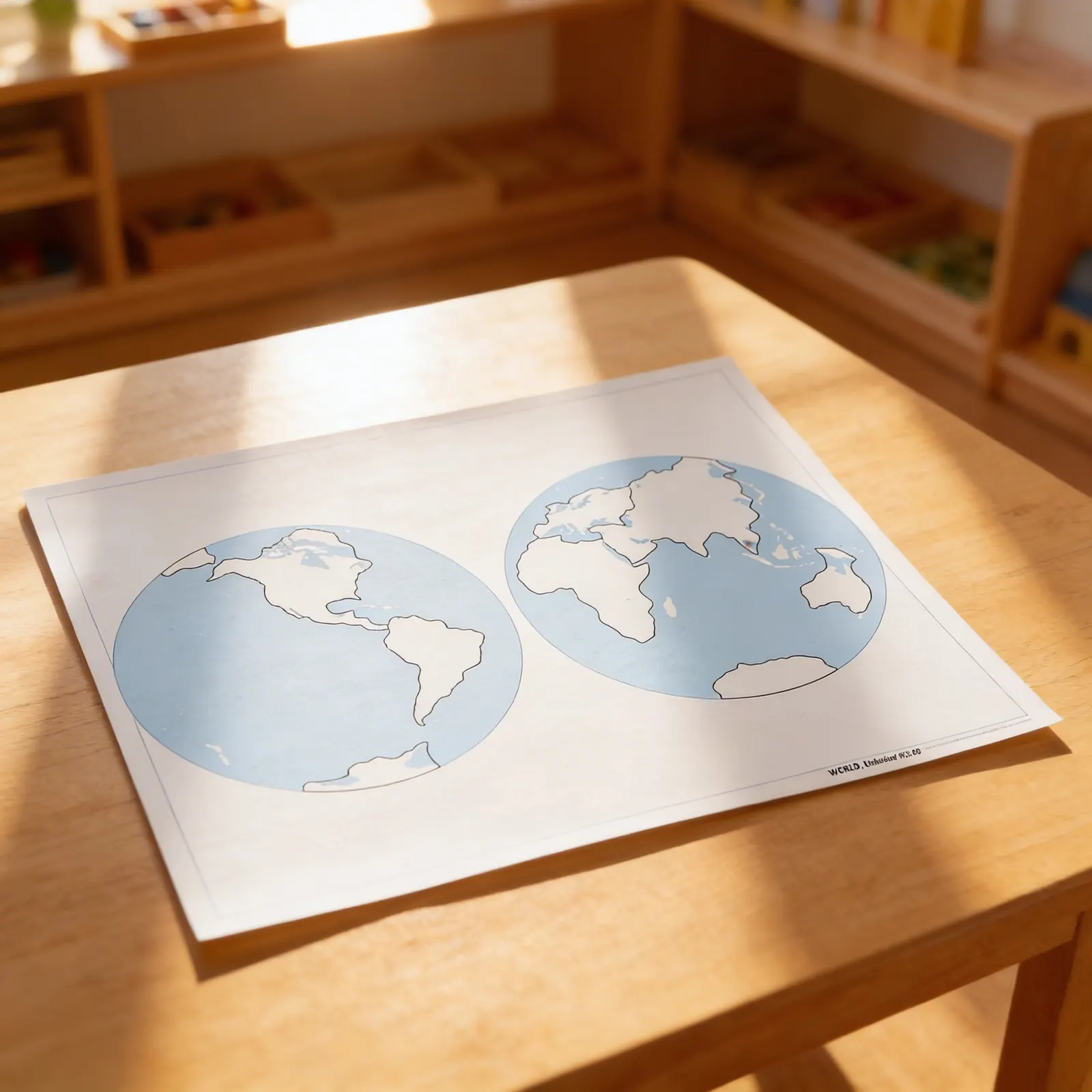
Two hemispheres, light blue water and white continents with a dark outline: that is the print on the World Control Map: Unlabeled, and no name is written anywhere on it. One hemisphere holds the Americas, the other Europe, Africa, Asia and Australia. Nienhuis lists paper as the material, blue and white as the colours and indoor use. The child can use the map to practise naming the continents and oceans by their outline and position. For ages 3 to 6.
Visual Discrimination
Children develop the ability to recognize continental shapes and their spatial relationships without text cues.
Geographic Awareness
Introduces fundamental concepts of Earth's land masses and their distribution across hemispheres.
Abstract Thinking
The hemisphere projection helps children understand that our spherical Earth can be represented on a flat surface.
Preparation for Reading
Working with unlabeled maps prepares children for later work with labeled materials and atlas reading.
How to present it
Mount the control map at child's eye level on a dedicated wall space. Place a small table or shelf nearby with pointing tools, continent puzzle pieces, or matching materials.
- 1Invite the child to observe the two circles, noting how they show different parts of Earth
- 2Trace continental outlines slowly with your finger, emphasizing unique shapes
- 3Connect the flat map to a globe by showing corresponding continents on both
- 4Introduce distance concepts by showing ocean spaces between continents
3 tips for parents
- Reference the map's continents when discussing family heritage or travel
- Create simple matching games using continental shapes cut from paper
- Connect map work to picture books showing children from different continents

If you are not sure it suits your child, we answer in person.
Norbert Kovalčín, founder of Faborino · write to him
There is no review here yet. We will ask you for one after you buy. Write the first review
What's in the Box
- Unlabeled World Map: Two hemisphere projections
Size and material
| Packaging | 43 × 56 × 0 cm |
| Base Material | Paper |
| Surface | Laminate coating |
| Recommended Age | 3-6 years |
Care
Wipe with slightly damp cloth, dry immediately
Frequently Asked Questions
What are the dimensions of this world control map?
This control map typically measures approximately 50cm x 40cm, providing a clear view of both hemispheres while remaining manageable for young children to handle and study.
How does this unlabeled map support Montessori geography learning?
The unlabeled design allows children to focus on the shapes and relationships of continents without text distractions, supporting visual discrimination skills and preparation for later work with labeled maps and continent puzzles.
What activities can children do with this control map?
Children can trace continents, match with puzzle pieces, create their own labels, color corresponding continents on blank maps, and use it as a reference for continent boxes and cultural studies.
Why is the map shown as two circular hemispheres?
The dual hemisphere projection helps children understand that Earth is a sphere and shows how continents relate to each other globally, providing a more accurate representation than flat rectangular maps.
How durable is the laminated paper construction?
The lamination protects the map from spills, fingerprints, and general wear, allowing for daily classroom use. It can be cleaned with a damp cloth and should last several years with proper care.
Product safety
Manufacturer: Nienhuis Montessori, Anders Celsiusstraat 15, 7442 PB Nijverdal, Netherlands
World Control Map