
WorldPolitical With Lakes (50)
The first photo is the maker's own. The other shots are illustrative.
Inv. no. NIE-551000
- Maker
- Nienhuis Montessori, since 1929
- Approval
- AMI
- Primary Material
- Paper
- Finish
- Matte surface
- EAN
- 8719924029081
Final price incl. VAT. Delivery €5.90, €125.10 to go for free delivery.
Advice, warranty and returns are handled by us.
Why it costs €23.90
Behind the price of the original are things you can check yourself.
AMI approval
The material is approved by the Association Montessori Internationale (AMI). Nienhuis has made Montessori materials since 1929.
A verifiable original
The EAN 8719924029081 is on the box. It is the maker's number, not ours.
World in a child's hands
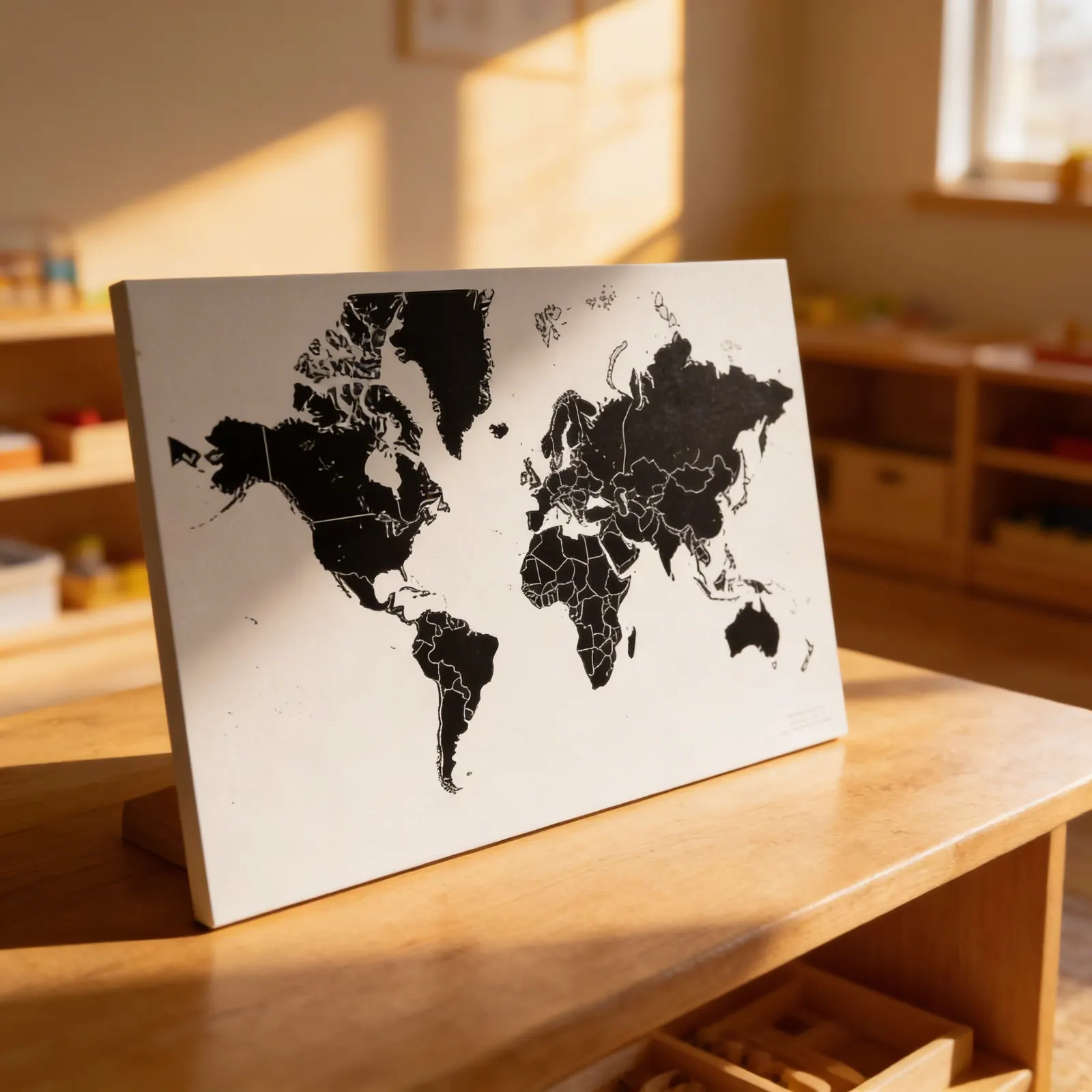
World: Political With Lakes (50) is a pack of 50 copies of a political map of the world with the lakes marked on it. A political map shows the countries and their borders, so the child can look at the states and lakes of the world on one sheet. The maps are printed on white paper, and all 50 sheets are alike. Nienhuis lists them in the geography area, under topography. Packed, the pack measures 43 × 28 × 1 cm and weighs 510 g. The maps are meant for children from the age of three. The manufacturer's number is 551000.
Geographic Awareness
Builds understanding of political boundaries, countries, and continents while developing spatial reasoning skills.
Cultural Understanding
Supports exploration of world cultures by providing a visual framework for studying different countries and regions.
Fine Motor Skills
Enhances precision through activities like placing pins, tracing boundaries, or labeling countries.
Abstract Thinking
Develops ability to understand symbolic representation as children connect the map to real-world geography.
How to present it
Place the political world map on a table at child height. Prepare a basket with colored push pins, small flags, or markers. Have reference materials like a globe or atlas nearby.
- 1Invite the child to explore the map freely, tracing country borders with their finger
- 2Select one country and place a pin in it, naming the country aloud
- 3Add pins to neighboring countries, discussing how they share borders
- 4Identify major lakes and place blue pins to mark them
3 tips for parents
- Point out countries mentioned in books or conversations, helping your child locate them on the map
- Share family heritage by marking countries of origin with special pins or stickers
- Use meal times to discuss food origins and find those countries together on the map

If you are not sure it suits your child, we answer in person.
Norbert Kovalčín, founder of Faborino · write to him
There is no review here yet. We will ask you for one after you buy. Write the first review
What's in the Box
- Political World Map: With lakes marked (50 copies)
Size and material
| Packaging | 43 × 28 × 1 cm |
| Primary Material | Paper |
| Finish | Matte surface |
| Recommended Age | 3-6 years |
Care
| Cleaning | Wipe gently with dry cloth |
| Storage | Store flat or rolled to prevent creasing |
Frequently Asked Questions
What makes this map suitable for ages 3-6?
The unlabeled design allows children to focus on visual recognition of shapes and boundaries without text distractions. The clear political borders and lakes provide concrete geographical features that young children can trace, color, and identify through hands-on activities appropriate for their developmental stage.
How is this map used in Montessori geography lessons?
Children use this map as a control chart for pin maps, matching country flags to locations, tracing borders, and identifying major water bodies. It serves as a reference for continent boxes, cultural folders, and extends into lessons about people, animals, and landmarks of different countries.
What does '(50)' in the product name mean?
The number 50 typically indicates the scale or size specification of the map, though specific dimensions should be confirmed with the manufacturer. This ensures the map is appropriately sized for classroom use and compatible with other Montessori geography materials.
Why is the map unlabeled?
Unlabeled maps follow the Montessori principle of isolating difficulty. Children first learn to recognize shapes, borders, and geographical features visually before adding the complexity of reading names. This allows non-readers to engage with geography and supports the development of visual discrimination skills.
What activities can children do with this political map?
Children can create pin maps with colored flags, trace countries onto paper, match country puzzle pieces to the map, sort pictures or objects by continent, and use it as a reference for cultural studies about foods, animals, clothing, and celebrations from different nations.
Product safety
Manufacturer: Nienhuis Montessori, Anders Celsiusstraat 15, 7442 PB Nijverdal, Netherlands
World