
Yellow Triangles For Area
The first photo is the maker's own. The other shots are illustrative.
Inv. no. NIE-012700
- Maker
- Nienhuis Montessori, since 1929
- Approval
- AMI
- Shapes
- Painted or laminated cardboard
- Storage Tray
- Natural wood construction
- EAN
- 8719924006952
Final price incl. VAT. Free delivery.
Advice, warranty and returns are handled by us.
Why it costs €166.90
Behind the price of the original are things you can check yourself.
AMI approval
The material is approved by the Association Montessori Internationale (AMI). Nienhuis has made Montessori materials since 1929.
A verifiable original
The EAN 8719924006952 is on the box. It is the maker's number, not ours.
Yellow Triangles For Area in a child's hands
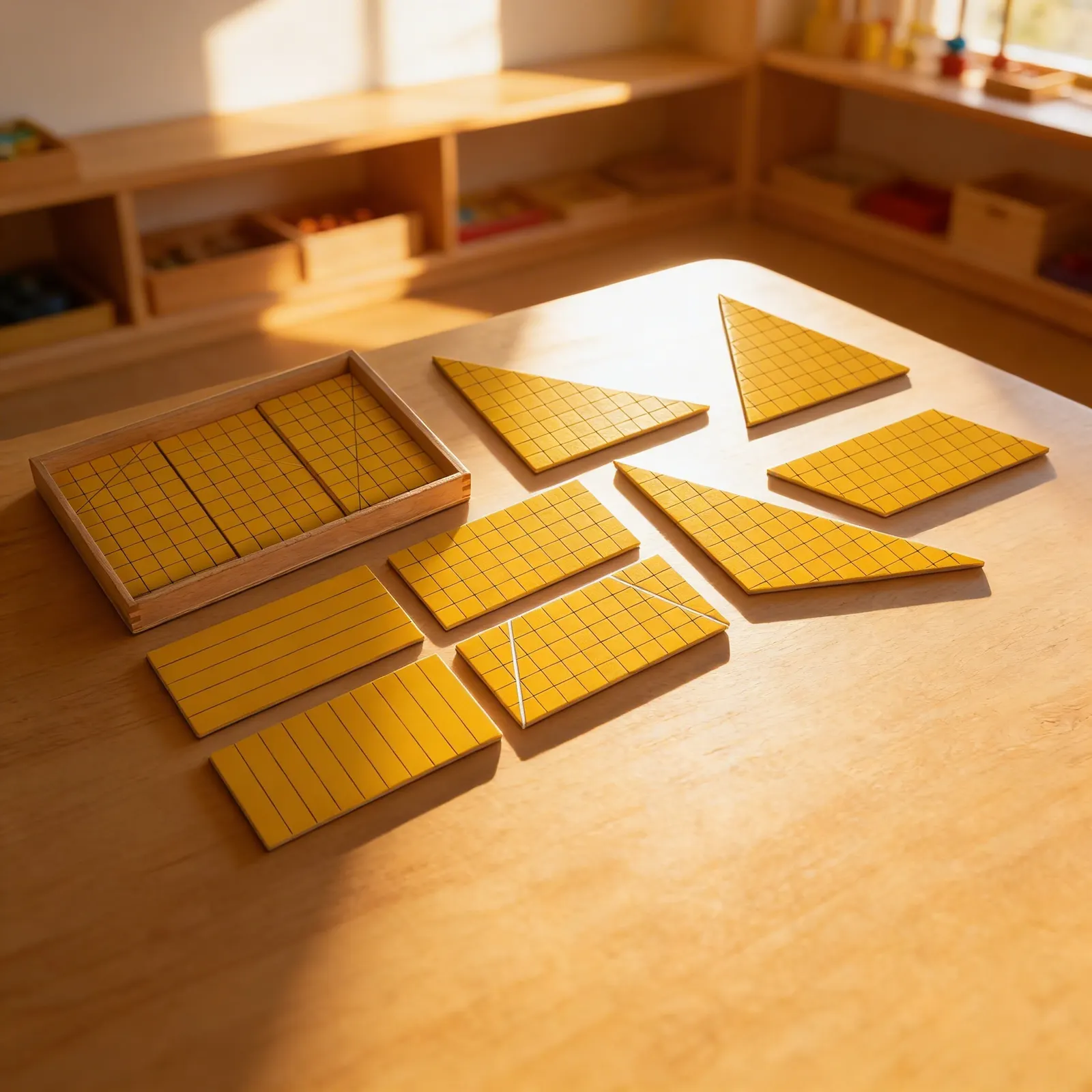
For hands-on mathematics, this Yellow Triangles For Area set provides direct experience of geometric area concepts through precisely crafted shapes with grid patterns. The material allows children to physically manipulate and compare different triangular and rectangular forms while developing spatial reasoning and mathematical understanding. Stored in a dedicated wooden tray, these yellow geometric pieces support the concrete exploration of area calculations essential to elementary mathematics work.
Mathematical Reasoning
Grid patterns enable concrete understanding of area calculation through visual and tactile exploration.
Geometric Relationships
Comparing different triangle and rectangle configurations develops spatial intelligence and geometric thinking.
Abstract Thinking
Transitions from concrete manipulation to abstract mathematical concepts through hands-on experimentation.
Problem-Solving Skills
Exploring area relationships through physical pieces builds logical reasoning and analytical abilities.
How to present it
Place the wooden tray on a work mat. Lay out yellow triangles and rectangles separately. Ensure grid patterns are clearly visible.
- 1Select two identical yellow triangles and place them together to form a rectangle
- 2Count grid squares within a single triangle, then within the formed rectangle
- 3Explore different triangle orientations while maintaining the same area
- 4Compare areas of different triangles by overlaying or arranging side by side
- 5Create area equivalencies using multiple shapes
3 tips for parents
- Notice area concepts at home - tiles, rugs, windows - and relate to the yellow triangles work
- Avoid rushing to formulas; let your child discover patterns through repeated manipulation
- Ask open-ended questions like 'How many triangles would cover this rectangle?'

If you are not sure it suits your child, we answer in person.
Norbert Kovalčín, founder of Faborino · write to him
There is no review here yet. We will ask you for one after you buy. Write the first review
What's in the Box
- Yellow geometric shapes: Approx. 9 pieces with grid patterns
- Wooden storage tray: With fitted compartments
Size and material
| Packaging | 32 × 22 × 3 cm |
| Shapes | Painted or laminated cardboard |
| Storage Tray | Natural wood construction |
| Recommended Age | 6-12 years |
Care
Wipe shapes with dry cloth; clean tray with damp cloth
Frequently Asked Questions
What specific area concepts does this material teach?
The Yellow Triangles For Area material teaches children to calculate and compare areas of triangles and rectangles through hands-on manipulation. Children learn that the area of a triangle is half that of a rectangle with the same base and height, developing understanding of area formulas through concrete exploration before moving to abstract calculations.
How do the grid patterns support learning?
The grid patterns on each piece allow children to count unit squares to determine area concretely. This visual and tactile approach helps children understand that area represents the amount of surface covered, making abstract mathematical concepts tangible and measurable through direct comparison and counting.
What is the recommended presentation sequence for this material?
Begin by exploring rectangles and counting grid squares to establish area concepts. Then introduce triangles, demonstrating how they relate to rectangles by overlaying pieces. Progress to comparing different triangular forms, calculating areas, and eventually deriving the formula for triangular area through hands-on discovery.
How does this material connect to other Montessori geometry work?
This material builds upon earlier work with geometric shapes and extends into advanced geometry studies. It connects directly to the geometric cabinet, constructive triangles, and later work with the theorem of Pythagoras. The concrete understanding developed here supports future abstract work with area formulas and geometric proofs.
What skills should children have before using this material?
Children should be comfortable with basic multiplication, understand the concept of square units, and have experience with geometric shapes from earlier Montessori materials. Familiarity with rectangles and triangles from the geometric cabinet and constructive triangles provides an ideal foundation for this more advanced area work.
Product safety
Manufacturer: Nienhuis Montessori, Anders Celsiusstraat 15, 7442 PB Nijverdal, Netherlands
Yellow Triangles For Area