Why Montessori Children "Get" Math Intuitively
Visit a Montessori classroom during the math hour and you may witness something strange. A five-year-old is sitting on a rug, sliding a small cube across the floor toward a friend. "I'm carrying a thousand," they announce. They are not pretending. They are literally carrying a thousand — a cube made of 1,000 golden beads, heavy enough to require both hands. A few minutes later they will exchange ten of these cubes for the next quantity in the sequence and discover, on their own, that 10 × 1,000 = 10,000.
This is the moment that explains why Montessori children so often appear to understand mathematics from the inside out. Most of us learned math the other way around. We were handed an abstract symbol — the numeral 7, say — and asked to memorise what it meant before we had ever held seven of anything. We memorised the multiplication table before we understood why 6 × 4 produces a rectangle. We memorised long division before we ever physically distributed a quantity into equal groups. The notation came first, the meaning later — if it came at all.
Maria Montessori reversed this sequence. In her classrooms, the hand teaches the mind. A child meets the concept of "ten" not as a written digit but as a bar of ten beads strung on a wire — something to lift, to count, to exchange. By the time the symbolic notation arrives, the child already knows in their muscles and bones what a ten *is*. This principle — concrete before abstract — is the foundation of every Montessori mathematics material. And no material expresses it more completely than the Golden Bead Material.
What the Golden Bead Material Actually Is
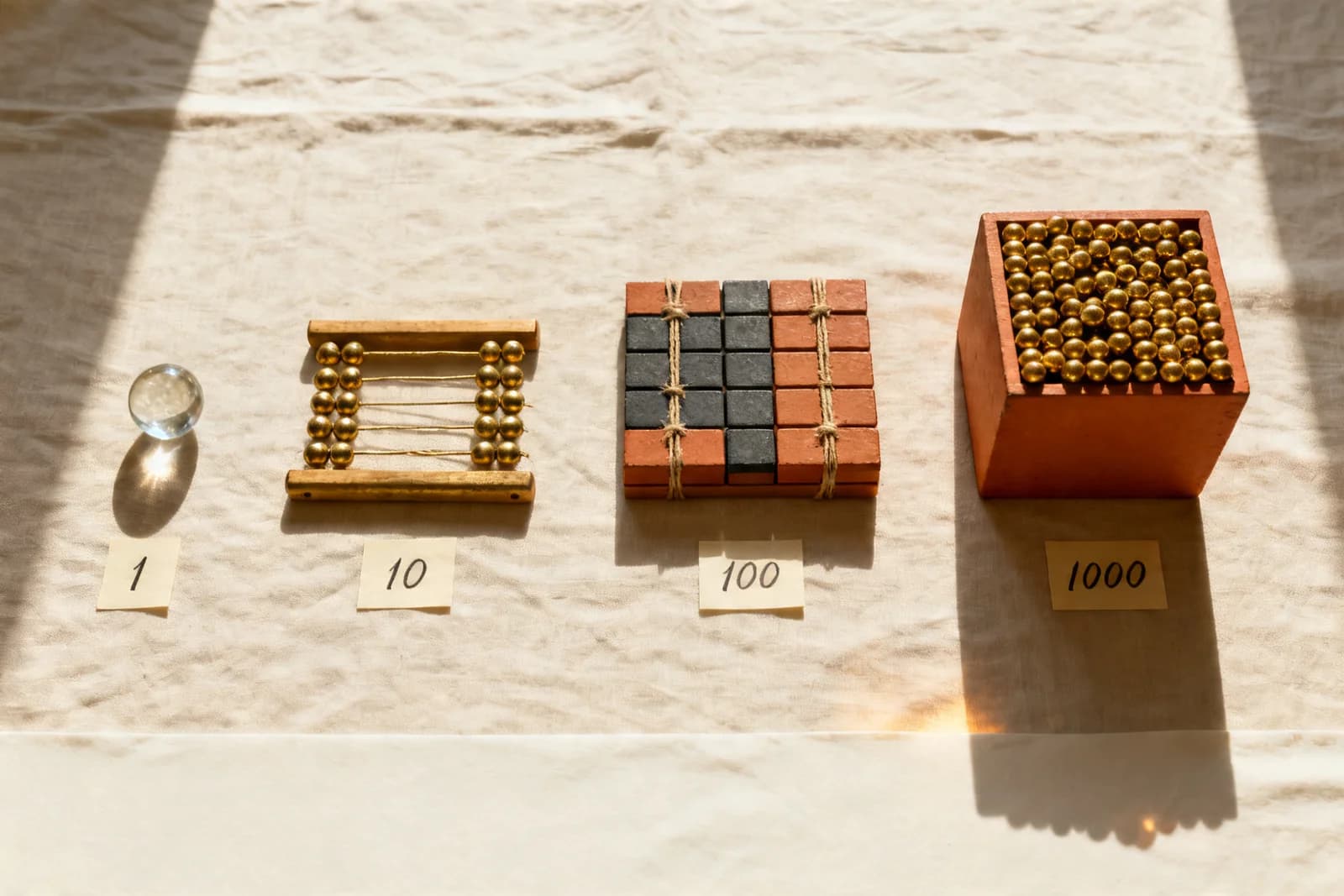
The Golden Bead Material is the four hierarchies of the decimal system, made physical. Every quantity from one to nine thousand is built from the same component — a single golden bead — repeated in four geometric configurations that mirror the structure of place value itself.
The unit is one bead. A single sphere about the size of a small pearl, glowing yellow in the child's palm. The ten is ten of those beads, strung on a stiff wire so they cannot slide apart — a straight line, a single dimension. The hundred is ten ten-bars wired together side by side, forming a square — two dimensions. The thousand is ten hundred-squares stacked on top of each other and bound, forming a cube — three dimensions. The decimal system is not just arithmetic. It is geometry. And the child sees this with their eyes the moment they hold the material for the first time.
Look closely and the relationship reveals itself. The hundred-square is exactly ten ten-bars wide. The thousand-cube is exactly ten hundred-squares tall. A child does not need to be told that 10 × 10 = 100 or that 10 × 100 = 1,000. They see it. They can lay the bars side by side and watch them become a square. They can stack the squares and watch them become a cube. The geometry of the decimal system is not something they will study in middle school after years of memorisation — it is the first thing they learn about numbers, before they have written a single digit.
Glass Beads or Nylon? Choosing Your Set
Authentic Montessori manufacturers offer the Golden Bead Material in two forms, and the choice between them matters more than it first appears. Glass beads are the original form. They are heavier — significantly so. A thousand-cube of glass beads has real, surprising weight in a child's hands. Children feel the difference between a unit and a ten and a hundred not just visually but physically. The cube is hard to hold. It demands attention. This weight is not incidental: it carries information. A thousand is a *lot*, and the body knows it before the mind does.
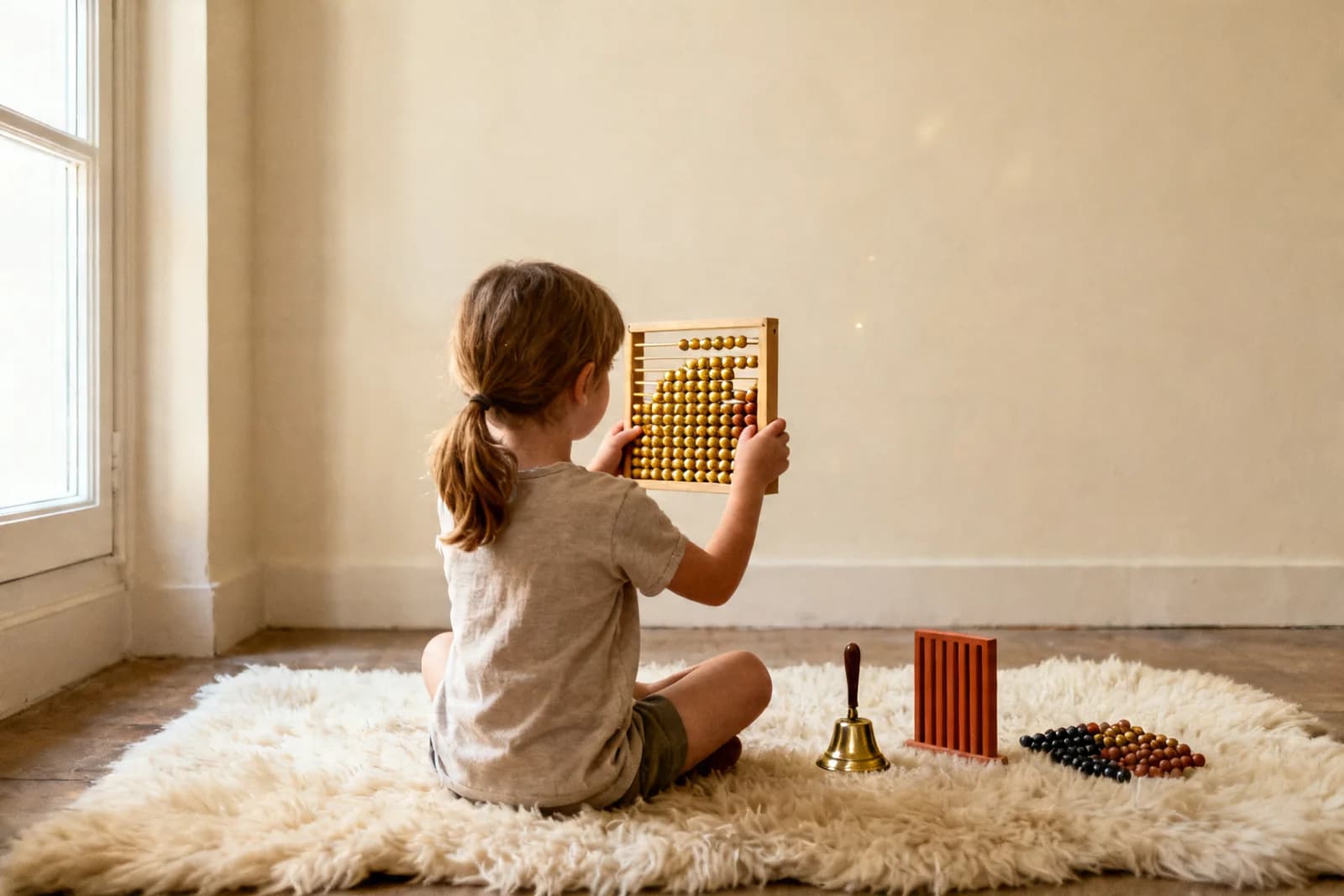
Nylon beads are lighter, more durable, and resistant to chipping. For very young children who may drop the material, for large group classrooms where the same set will be used by dozens of children over many years, or for budget-conscious homes, nylon is a perfectly serviceable choice. The pedagogical principle survives intact — it is still ten beads to a bar, ten bars to a square, ten squares to a cube. Only the sensorial richness is slightly diminished.
At Faborino we offer the premium version: the Golden Bead Material — Individual Glass Beads, produced by Nienhuis Montessori to AMI specification. If you can afford the glass set and your child will treat it with care, choose it. The weight in their hands is teaching something the lighter version cannot.
The Presentation Sequence — How a Child Meets the Material
Maria Montessori designed an exact, ordered introduction to the Golden Bead Material. Each step builds on the last; skipping a step means the child arrives at later work without the foundation it requires. The sequence is worth following, whether you are a trained Montessori guide or a parent at home.
Step 1 — Introduction of quantities (sensorial). Before any numerals appear, the child is invited simply to feel the four hierarchies. The guide places one bead in their hand: "This is one." Then a ten-bar: "This is ten." Then a hundred-square: "This is one hundred." Then a thousand-cube: "This is one thousand." The child is asked to fetch them, count them, line them up, exchange them. There are no symbols yet. The names of the quantities are learned through the body.
Step 2 — Introduction of number cards. Once the quantities are familiar, the child meets the symbolic side: a set of cards on which the digits 1, 10, 100, and 1,000 are written. The cards are colour-coded to match an internal Montessori convention — units in green, tens in blue, hundreds in red, thousands in green again (the pattern repeats every three places, mirroring how we group large numbers).
Step 3 — Association of quantity with symbol. Now the two are brought together. The guide lays out three hundred-squares on the rug. "Here are three hundreds. And here is the card that says three hundred." The child handles both — the beads and the card — until the connection is automatic. They are learning that the written symbol "300" *is* this — these three squares of beads here.
Step 4 — Formation of large numbers. The child is asked to build a four-digit number. "Bring me 3,247." They go to the bank — a tray containing units, ten-bars, hundred-squares, and thousand-cubes — and gather three thousand-cubes, two hundred-squares, four ten-bars, and seven units. They lay these out in their proper places on the rug. They then build the matching number from the cards. They have constructed three thousand two hundred forty-seven both as a quantity and as a symbol. The two are now one thing in the child's mind.
Step 5 — Operations begin. Only now, with quantity and symbol fully integrated, does the child meet the four operations. And here the material reveals what it has been preparing them for all along.
The Bank Game — Four-Digit Addition with Carrying
Imagine a six-year-old performing four-digit addition. Most adults picture worksheets, columns of numbers, frowning concentration, the labour of memorised algorithms. The Bank Game looks nothing like this. The child is on the floor with a friend, surrounded by trays of golden beads. Two large numbers — say 3,486 and 2,759 — have been built physically out of the material. Each child contributes their number to a shared pile in the centre of the rug.
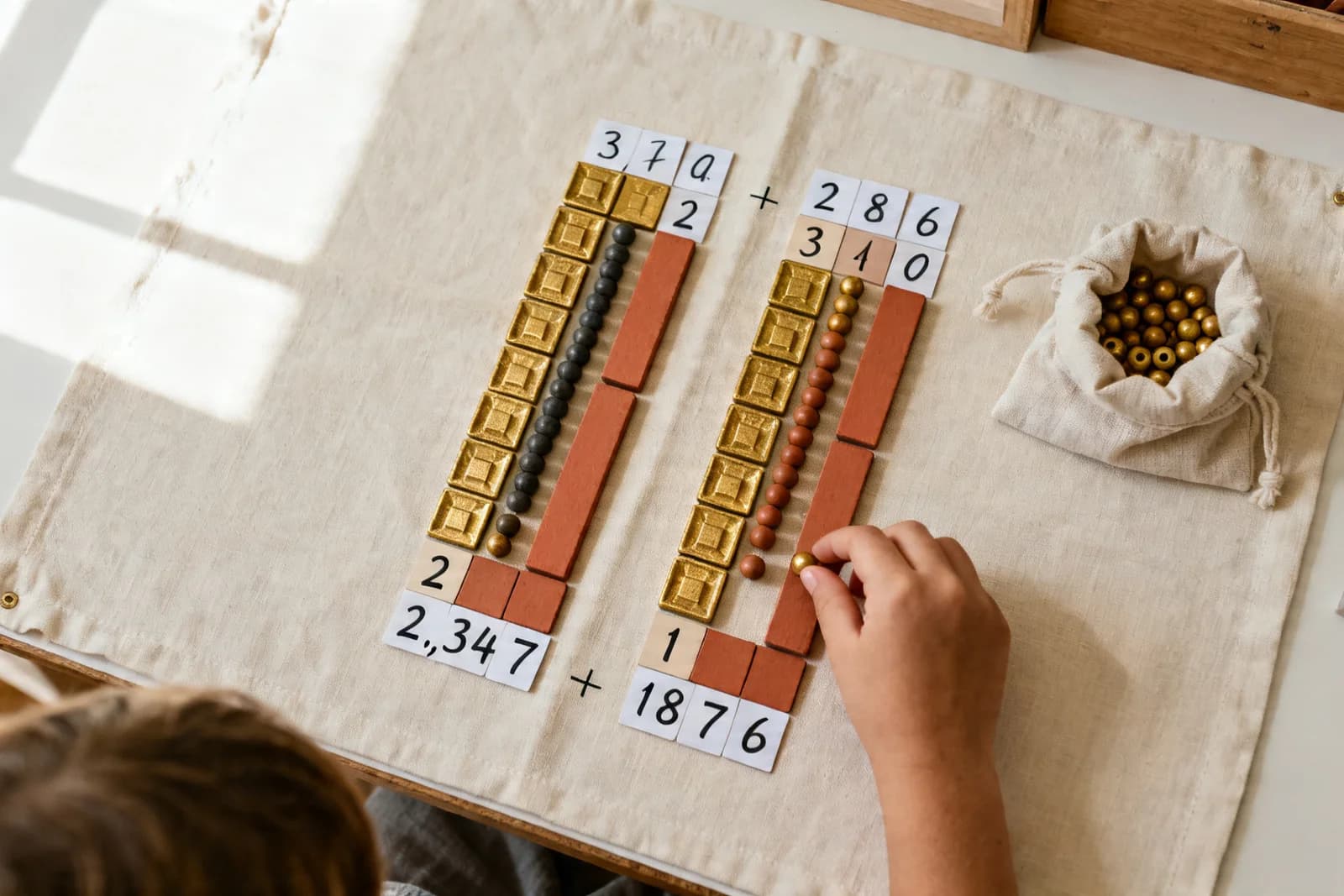
Now the addition happens. The children gather all the units together and count: 6 + 9 = 15. Fifteen units. But the rule of the bank is that you cannot keep more than nine of any quantity. So the children take ten of the unit beads, walk to the bank, and exchange them for one ten-bar. They have just carried the digit — except they have not carried a digit. They have carried a *bead*. The action is the same as the algorithm, but it is made of cause and effect, not of memorisation. The "1 you carry" in written addition is no longer a mysterious mark above the next column. It is a real ten that arrived because ten ones became too many.
They repeat the process for the tens, then the hundreds, then the thousands. Whenever they have ten of something, they exchange it for one of the next quantity. At the end they look at what is left on the rug: 6 thousands, 2 hundreds, 4 tens, 5 units. They build the matching card number — 6,245 — and lay it next to the beads. They have just performed 3,486 + 2,759 = 6,245. They have not memorised an algorithm. They have *experienced* one.
Subtraction works the same way in reverse — when you do not have enough units to take from, you go to the bank and exchange a ten-bar for ten loose units. You are not "borrowing"; you are exchanging, just as in real life. Multiplication is repeated addition, performed by laying out the same number multiple times and combining. Division is sharing — distributing the beads equally between dolls or friends and seeing how much each one gets. The same material, the same gestures of exchange, support all four operations.
From Concrete to Abstract — The Long Path Down
The Golden Bead Material is not the end of the Montessori mathematics journey. It is the beginning. Maria Montessori designed an entire sequence of materials that gradually shrink the concrete reality of beads down toward the pure abstraction of written calculation, in steps small enough that the child never loses contact with what the numbers actually mean.
After the Golden Beads comes the Stamp Game. The same operations are performed, but now the units, tens, hundreds, and thousands are represented by small coloured tiles — "stamps" — printed with the digit. The thousand-cube has become a green tile printed with "1000". The same bank-style exchange still happens (ten unit-stamps for one ten-stamp), but the material is smaller, lighter, and more symbolic. The child no longer carries a real cube; they carry a tile that represents one. They are halfway from quantity to symbol.
After the Stamp Game comes the Bead Frame — a wire abacus with bead-counters arranged in columns of ten. Now there is no exchange at all; the bead simply moves up by one place. The child is doing arithmetic almost abstractly, but the physical beads are still there as a safety net. Finally comes pure written calculation on paper — and at this stage the child writes long-form addition, subtraction, multiplication, and division with full understanding, because every step of the algorithm corresponds to a gesture they have already performed hundreds of times with the beads.
This progression is one of Maria Montessori's most original contributions to education. It mirrors how the human mind itself moves from the concrete to the abstract over time. We do not need to choose between rigorous mathematics and embodied learning. The beads make rigorous mathematics possible.
Why It Works — The Pedagogy Behind the Material
Multiple senses are engaged at once. The child sees the geometry of the decimal system. They feel the weight of a thousand and the lightness of a unit. They hear themselves count and name each quantity. They speak the operations aloud as they perform them. This multisensory encoding creates memory that is robust in a way memorised tables can never be. A child who has carried a thousand-cube across a room cannot easily forget what a thousand is.
The material has built-in control of error. If a child miscounts ten unit beads as nine and tries to exchange them, the bank will not give them a ten-bar — they will look down and see the discrepancy themselves. If they place a ten-bar in the units column, the visual mismatch is immediate and obvious. The material itself corrects mistakes; the adult does not have to. This protects the child's developing autonomy and confidence.
Most importantly, the child experiences mathematics rather than reciting it. There is a profound difference between a child who has memorised that "carry the one" and a child who has physically taken ten units to the bank and received a ten in exchange. The first child is performing a ritual whose meaning may or may not become clear later. The second child is doing arithmetic with full understanding of why each step is necessary. When this child later sits down with paper and pencil, the algorithm is no longer mysterious. It is the written record of an action they have performed countless times.
Extensions — Where the Material Leads
The Golden Bead Material is the seed of an entire mathematical curriculum that unfolds across the elementary years. Dynamic operations — those involving carrying and borrowing — are introduced precisely because the material handles them so naturally. Word problems and story problems become tractable: the child reads the problem, gathers the corresponding quantities of beads, and the answer reveals itself as they perform the operation.
The connection to geometry is direct and lasting. A child who has held the thousand-cube understands volume not as an equation but as an object. They know in their hands that 10 × 10 × 10 = 1,000, because they can count the rows and columns and layers. When they later meet squaring and cubing in elementary mathematics, the language is already familiar — a square number really is a square, and a cube number really is a cube. The symbolic notation arrives as a name for something they have known physically for years.
From here the path opens to fractions (which Montessori introduces with another beautiful concrete material — the Fraction Insets), to decimals, to algebra. Every later material in the Montessori mathematics sequence builds on the place-value understanding established by the Golden Beads. This is why a Montessori-educated child often sails through high-school mathematics with apparent ease: the abstractions other students struggle with are, for them, simply the names of operations they have been performing with their hands since the age of four.
Bringing the Golden Bead Material Home
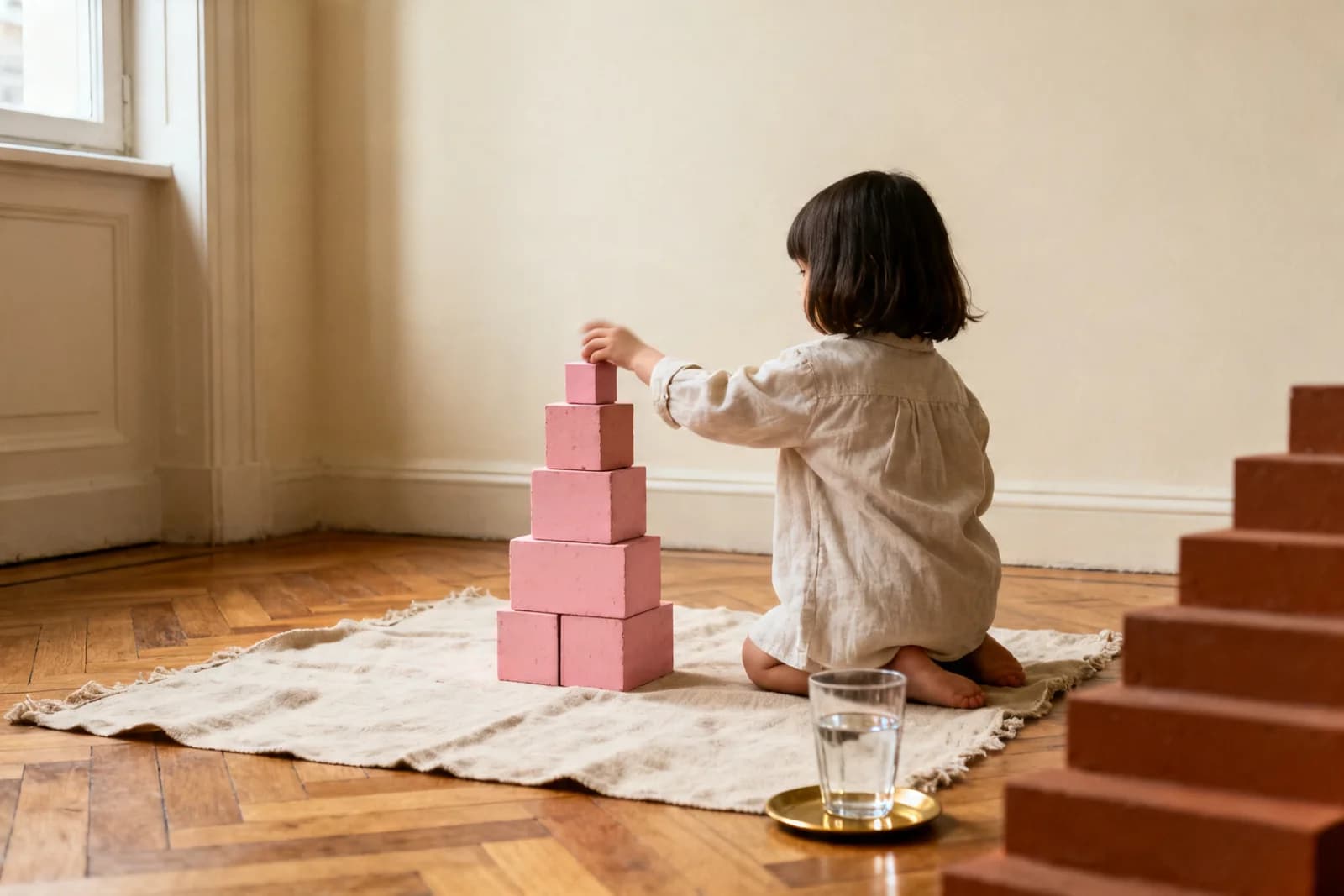
If you are setting up a Montessori environment at home and your child is approaching the age of four or five, the Golden Bead Material belongs near the top of your list. It is more expensive than a Sensorial material like the Pink Tower, and it requires more space — you will want a low shelf for the beads and a clear floor area for laying out problems on a rug. But no other single material delivers as much mathematical understanding for the investment.
Browse our complete Mathematics collection to see the full sequence — Number Rods, Spindle Boxes, the Golden Bead Material, the Stamp Game, the Bead Frames — and how each material builds on the one before. If this article is your introduction to Montessori, start with the Complete Guide to Montessori Materials, then explore which materials suit your child's age in the Toys by Age guide. And for the Sensorial precursor that prepares the hand and eye for mathematical thinking, see our deep dive into the Pink Tower.
When you are ready, the Golden Bead Material in glass is the version we recommend for any home or classroom committed to authentic Montessori education. It is heavy, it is beautiful, and it will teach your child more about mathematics than any worksheet ever will.
“The hand is the instrument of intelligence. The child needs to manipulate objects and to gain experience by touching and handling.”
Maria Montessori, The Discovery of the Child