Why the Pink Tower Became the Symbol of Montessori
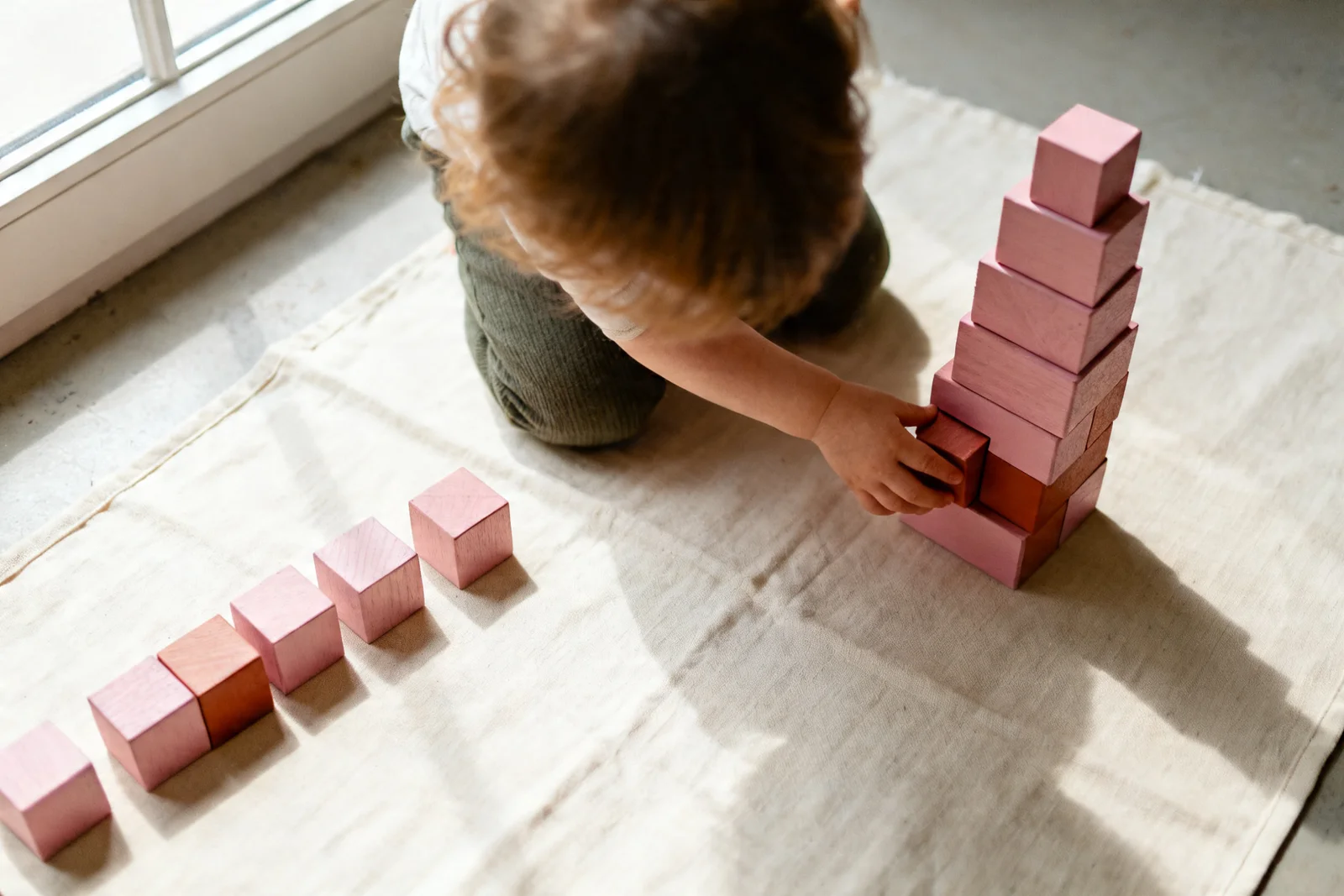
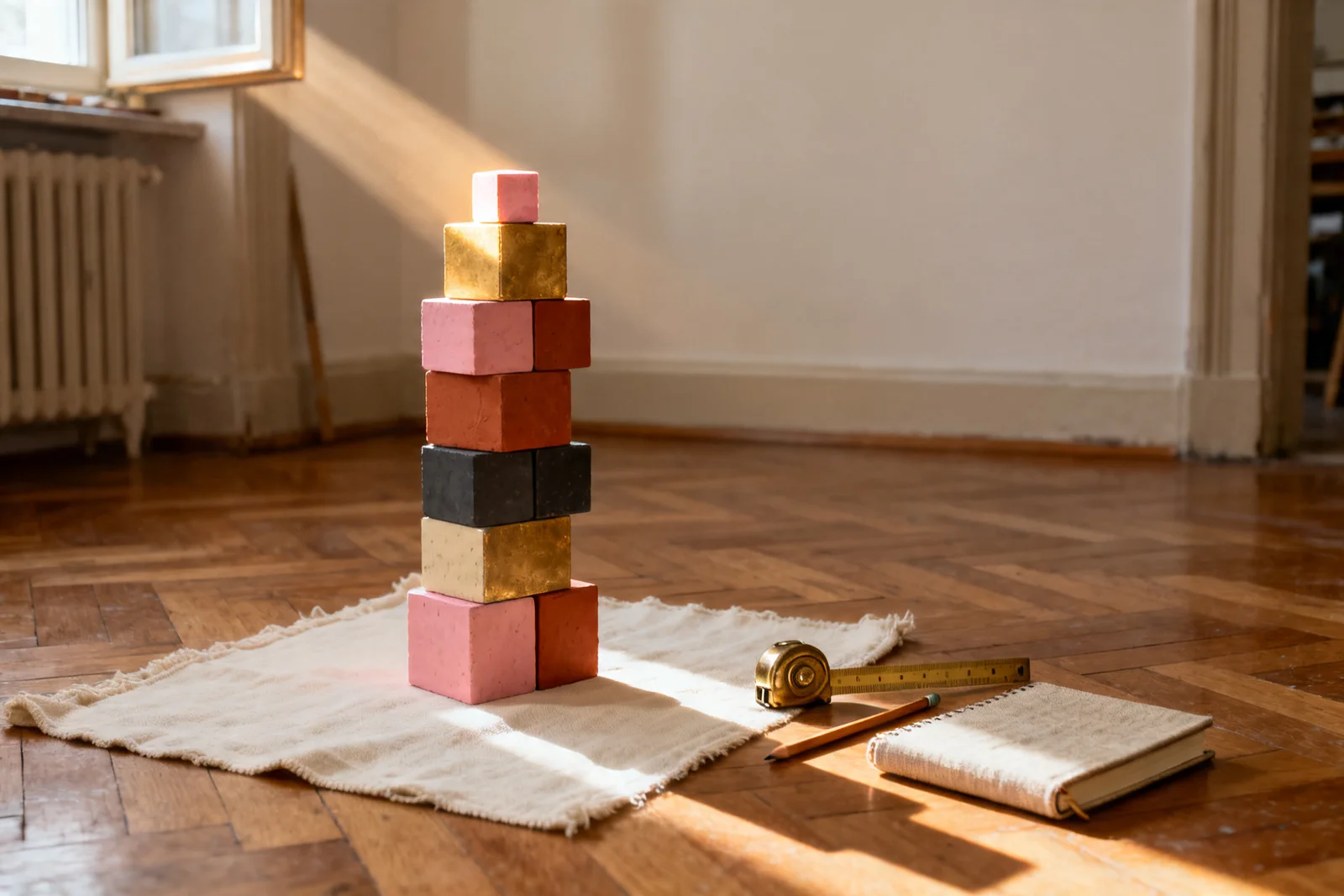
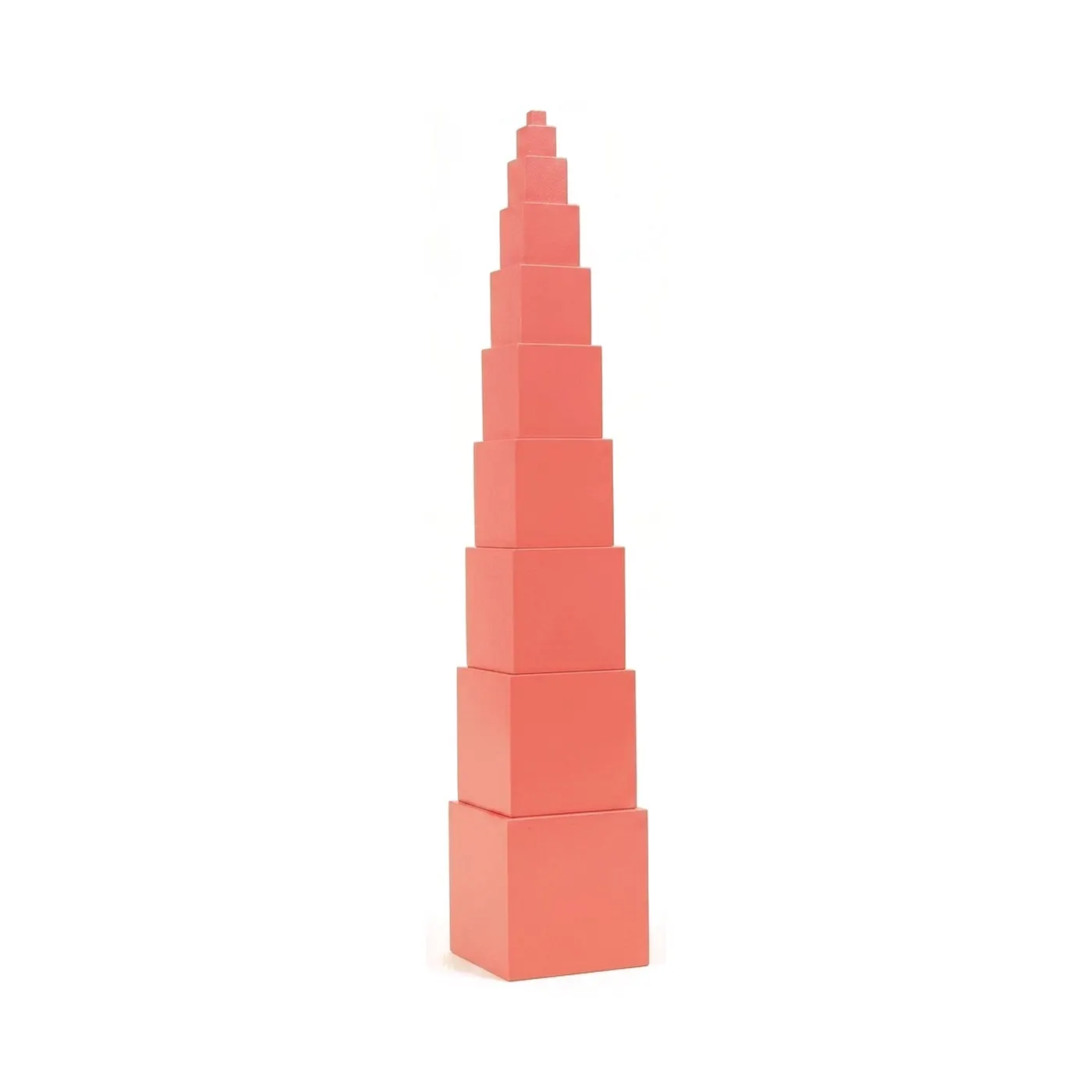
If you have ever seen a photograph of a Montessori classroom, you have almost certainly seen the Pink Tower. Ten pink cubes, stacked from largest to smallest, rising in a perfect pyramid from the floor. It is one of the most recognisable objects in the entire method, the material that appears on book covers, Instagram feeds, and parenting blogs whenever the word "Montessori" is mentioned. There is a reason for this visual dominance: the Pink Tower carries the soul of Maria Montessori's pedagogy in an almost impossibly simple form.
Maria Montessori first introduced the Pink Tower around 1907, in the original Casa dei Bambini in Rome. It is one of the oldest materials in the entire Montessori canon: older than the Sandpaper Letters, older than the Golden Beads, older than nearly everything else on the shelves of a modern classroom. More than a century later, it remains essentially unchanged. That permanence is itself a statement: when something works this well, you do not redesign it.
But the Pink Tower is also an often misunderstood Montessori material. Most parents see it as a stacking toy. It is not. A stacking toy is something a child plays with for ten minutes and abandons. The Pink Tower is a precision instrument that teaches a child to perceive dimension, to control their hands, to concentrate for long periods, and, most surprisingly of all, to prepare for the abstract mathematics they will encounter five years later. To understand why, you have to look past the colour and into the engineering.
What the Pink Tower Actually Teaches
On the surface, the Pink Tower trains visual discrimination of dimension. The cubes range from one centimetre on each side to ten centimetres on each side, increasing in steady one-centimetre increments. A child working with the tower has to perceive these differences with their eyes, compare cubes against each other, and arrange them in the correct sequence. This sounds trivial to an adult, but for a three-year-old, it is genuinely demanding work, and it sharpens visual perception.
Beneath the visual work, the Pink Tower is doing something far more profound: it is preparing the child for mathematics. The cubes are not simply ten different sizes; they are a perfect cubic progression. Each cube's volume is the cube of its side length. The smallest cube is one cubic centimetre. The next is eight. Then 27, 64, 125, 216, 343, 512, 729, and the largest cube is exactly 1,000 cubic centimetres. The child does not know this consciously. But their hands feel it. Their eyes see it. And years later, when they meet the Golden Bead Material and encounter a thousand-cube made of beads, the connection has already been laid down in their body.
The Pink Tower also builds vocabulary in a precise, sequential way. Once the child can build the tower confidently, the directress introduces the language: large, small. Then comparative forms: larger, smaller. Then superlative forms: largest, smallest. The vocabulary is taught through a Three-Period Lesson tied directly to the physical material; the child does not memorise words from a flashcard, they associate words with sensory experience.
And quietly, beneath all of this, the Pink Tower is doing the work that every Montessori material does: it is building concentration. A child who carries each cube one at a time across the room, places it carefully, steps back to assess, adjusts, and tries again is practising the fundamental skill that underpins all later learning. This sustained, voluntary attention is what Montessori called "the work of the child."
Anatomy of the Material
An authentic Pink Tower consists of exactly ten cubes with sides from 1 cm to 10 cm. They are made from solid hardwood, traditionally beech, and finished with a smooth, durable pink lacquer. The colour matters: pink isolates the dimension. By making all cubes the same colour and texture, the material removes every variable except size. The child's eye and hand can focus on one quality alone. This is what Montessori called "isolation of the difficulty", a foundational design principle that runs through every sensorial material.
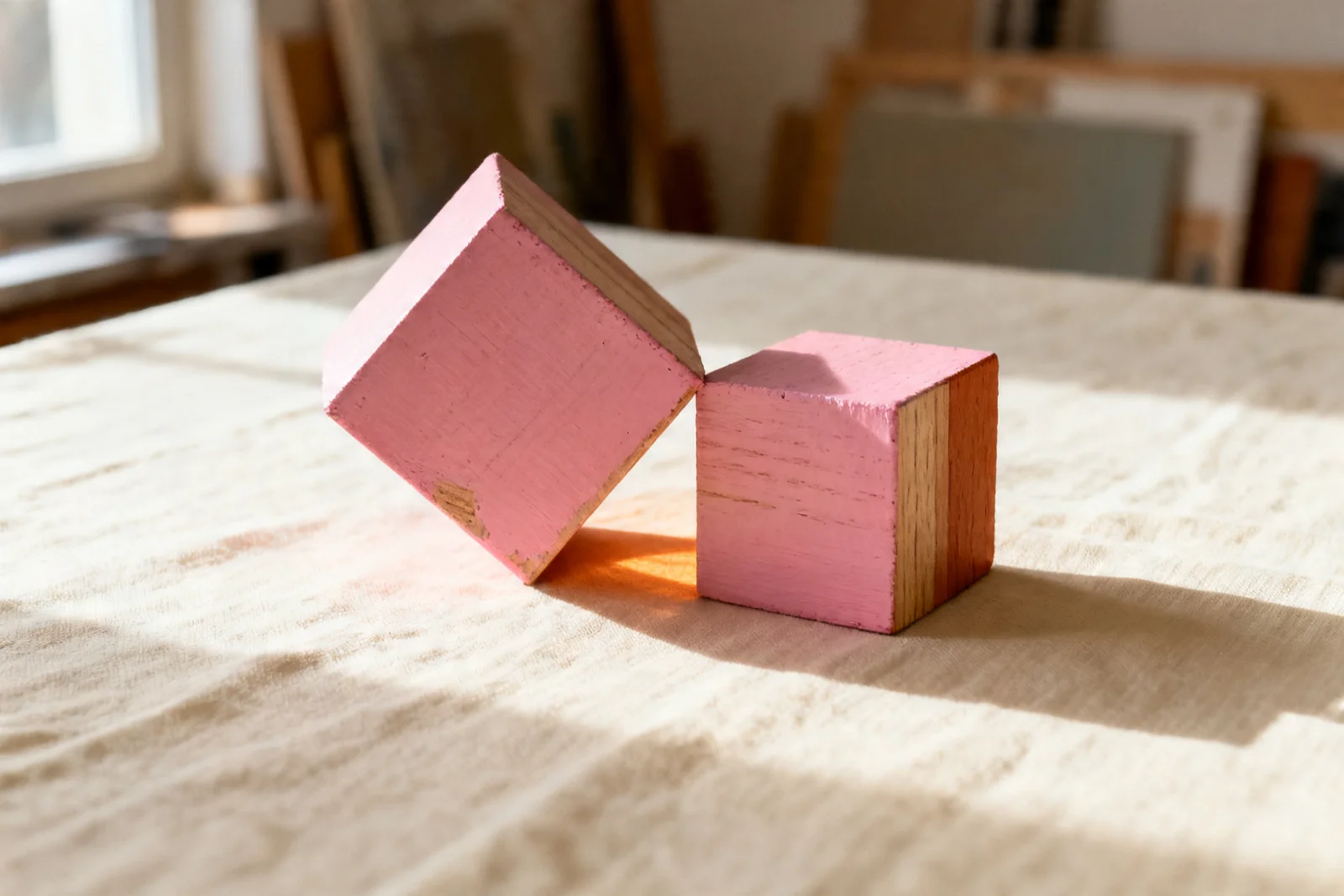
The precision of the cubes is non-negotiable. Authentic Pink Towers (like those produced by Nienhuis Montessori) are manufactured with high precision. This precision is what gives the material its built-in "control of error." When a child places a smaller cube beneath a larger one, the mistake is visible at a glance. The child does not need an adult to correct them; the material itself shows what is wrong. This self-correcting quality is fundamental to the entire Montessori philosophy of independent learning.
This is also where most cheap imitations fail. A Pink Tower from an unbranded online seller might look identical in a photograph. But the cubes are often manufactured to a lower precision. The colour is uneven. The wood is soft pine that dents and chips. The largest cube is too light because the wood is hollow or composite. None of this is visible from a thumbnail image, but a child working with such a tower receives confused, contradictory feedback. The control of error is broken. The material no longer teaches what it is supposed to teach.
How to Present the Pink Tower
The Montessori presentation of the Pink Tower is a precise sequence. The directress first invites the child: "Would you like me to show you how to work with the Pink Tower?" If the child agrees, an adult-sized work mat is unrolled on the floor: the tower is built on a mat, not on a hard floor, both to protect the cubes and to define the work space.
The cubes are then carried, one at a time, from the shelf to the mat. This is essential. Each cube is held with two hands, fingers spread to feel its full dimension. The child is not allowed to carry several cubes at once or to slide them across the floor. The largest cube alone is heavy enough (solid wood) that two hands are required, and the child experiences the weight as part of the lesson. Carrying the cubes one at a time is itself a movement exercise: it builds the child's awareness of their own body and their relationship to space.
Once all ten cubes are on the mat, the directress mixes them randomly. Then she builds the tower silently: slowly, deliberately, choosing the largest cube first, placing it precisely in the centre, then the next-largest, centring each one on the cube below. There is no talking during the demonstration. The child watches, absorbing the sequence with their eyes. When the tower is complete, the directress disassembles it and invites the child to try.
After the child has built the tower, the adult steps back. They do not correct. They do not suggest. They observe. If the child makes a mistake, the material itself shows it: a smaller cube placed beneath a larger one creates a visible, tactile asymmetry that the child can feel. The child may take the tower apart and rebuild it many times in a single session. This repetition is not failure. It is the work itself.
Extensions and Variations
Once the child has mastered the basic vertical tower, a wealth of extensions opens up. The first is the horizontal tower: the cubes are laid in a line on the mat, largest to smallest, and the child explores the same dimensional progression in a new spatial arrangement. The horizontal layout makes the cubic progression visible in a different way; the child can see the staircase-like difference in heights.
The Pink Tower combines beautifully with the Brown Stair, its sister material, which isolates a different dimension (thickness) using ten brown rectangular prisms. The two materials can be combined in dozens of patterns: tower built on top of stair, stair wrapped around tower, parallel arrangements that compare the two progressions side by side. Children typically discover these combinations themselves once both materials have been individually mastered.
Distance games extend the work into the larger environment. The directress places the largest cube at one end of the room and asks the child to bring "the cube that is just a little bit smaller." The child must hold the size in memory as they walk across the room and choose the correct cube from the shelf. This memory-of-dimension work is surprisingly difficult and deeply absorbing. Older children can work with control cards that show different valid arrangements of the cubes: pyramids, spirals, and patterns that go beyond the basic tower. Around the age of five or six, blindfold work can be introduced: the child builds the tower with their eyes closed, relying purely on the tactile sense.
The Pink Tower also pairs naturally with the Knobless Cylinders, the next material in the sensorial sequence. The Knobless Cylinders introduce graduation in three dimensions across four different colour-coded sets, building on the dimensional vocabulary that the Pink Tower has already established.
Common Mistakes
The most common mistake adults make with the Pink Tower is correcting the child verbally. "No, the bigger one goes on the bottom." This single sentence undermines the entire purpose of the material. The Pink Tower is designed so that the child discovers the correct arrangement through their own perception. Verbal correction shifts the child's attention from the material to the adult: they stop looking at the cubes and start looking for approval. The control of error built into the material is broken.
A second common mistake is letting the child carry several cubes at once, or carry them in a basket. This skips one of the most valuable parts of the work. Each trip from shelf to mat is a movement exercise, a moment of judgement about weight and balance, a small act of concentration. Bundling all ten cubes into a single trip turns a deep work cycle into a logistical chore.
A third mistake, particularly common in homes where the material has been bought as a "toy", is encouraging the child to build with the tower rather than work with it. The Pink Tower is not a building block set. It is not meant to be combined with toy cars and dollhouses. Used this way, it loses its precision and its meaning. There is nothing wrong with creative play, but it should happen with toys designed for that purpose, not with sensorial materials.
Finally, parents often rush to "finish" the activity. A child may take twenty minutes to build the tower once. They may rebuild it five times in a row. They may sit and stare at it for several minutes between attempts. None of this is wasted time. This is the deep absorption that Montessori observed and named, the state in which real learning happens. Interrupting it to move on to the next activity teaches the child that focused work is not valuable.
Age and Readiness
The Pink Tower is traditionally introduced between two and a half and three years of age, although this varies by child. In a classic Montessori environment, it sits at the start of the sensorial sequence in the Casa dei Bambini (3 to 6 years). For most home environments, the tower works best from around the third birthday onward. Earlier introduction is possible, but the heaviest cubes can be a frustration for very small hands: a child who cannot lift the largest cube with two hands is not yet ready.
The signs that a child is ready for the Pink Tower are concrete and observable. They can carry small objects with two hands without dropping them. They can sit at a defined work space (a mat or table) for at least ten minutes of focused activity. They show interest in stacking, sequencing, and arranging objects by size. They can follow a simple multi-step demonstration without needing constant redirection. And they show signs of what Montessori called "the sensitive period for order": a strong preference for things being in their proper place.
A child who is not yet ready will lose interest within minutes, scatter the cubes, or use them to bang on other surfaces. This is not a failure; it simply means the material has been introduced too early. Put the tower away on a high shelf and try again in three or four months. When the child is ready, the engagement is unmistakable: they will return to the tower again and again, often spontaneously, sometimes for weeks or months at a time.
Authentic vs. Imitation
The market is saturated with cheap imitations of the Pink Tower. From a thumbnail, they all look similar. In a child's hands, they are not. Authentic Pink Towers from manufacturers like Nienhuis Montessori or GAM are precision-engineered, made from solid beech hardwood, finished with a uniform lacquer and weighted correctly so that the largest cube genuinely requires two hands to carry.
When evaluating a Pink Tower before purchase, look for these markers: the manufacturer is named and has a documented relationship with one of the major Montessori training organisations; the material is described as solid hardwood, not "wood composite" or "wood-effect"; the dimensions are specified precisely (1 cm to 10 cm); the product is sold by an actual Montessori specialist, not a generic toy retailer.
The price difference is real but it is not arbitrary. An authentic Pink Tower will last a long time. It will pass through multiple children. A cheap tower can warp and lose its precision over time.
Bringing the Pink Tower Home
At Faborino, our Pink Tower is sourced directly from Nienhuis Montessori, the original manufacturer, building Montessori materials to the same standards since the 1920s. Each tower is precision-manufactured from solid hardwood, finished with a durable pink lacquer. Browse the complete Sensorial collection to see how the Pink Tower fits within the broader curriculum, alongside the Brown Stair, Red Rods, Knobless Cylinders, and Colour Tablets.
If you are new to Montessori, the Pink Tower is a wonderful place to begin. To understand where it fits in the larger picture, read our complete guide to Montessori materials, which explains the five curriculum areas and how authentic materials differ from imitations. If you are choosing materials for a specific age, our guide to Montessori toys by age will help you select what matches your child's developmental stage.
„The first essential for the child's development is concentration. The child who concentrates is immensely happy.“
Faborino Journal
We will send you the next article by email
First four short letters for your child’s age, then new articles from the Journal once a month.
We will send you the Faborino Journal from STENVARD s. r. o.: after you confirm, four short letters with tips for your child’s age, then once a month new articles and a selection of materials. You can unsubscribe at any time with one click in every email. More in our privacy policy.