
Number Hierarchy Cube: 50mm Wooden Thousand Representation
Made by Nienhuis Montessori · shipped by Heutink International (Netherlands) About the maker
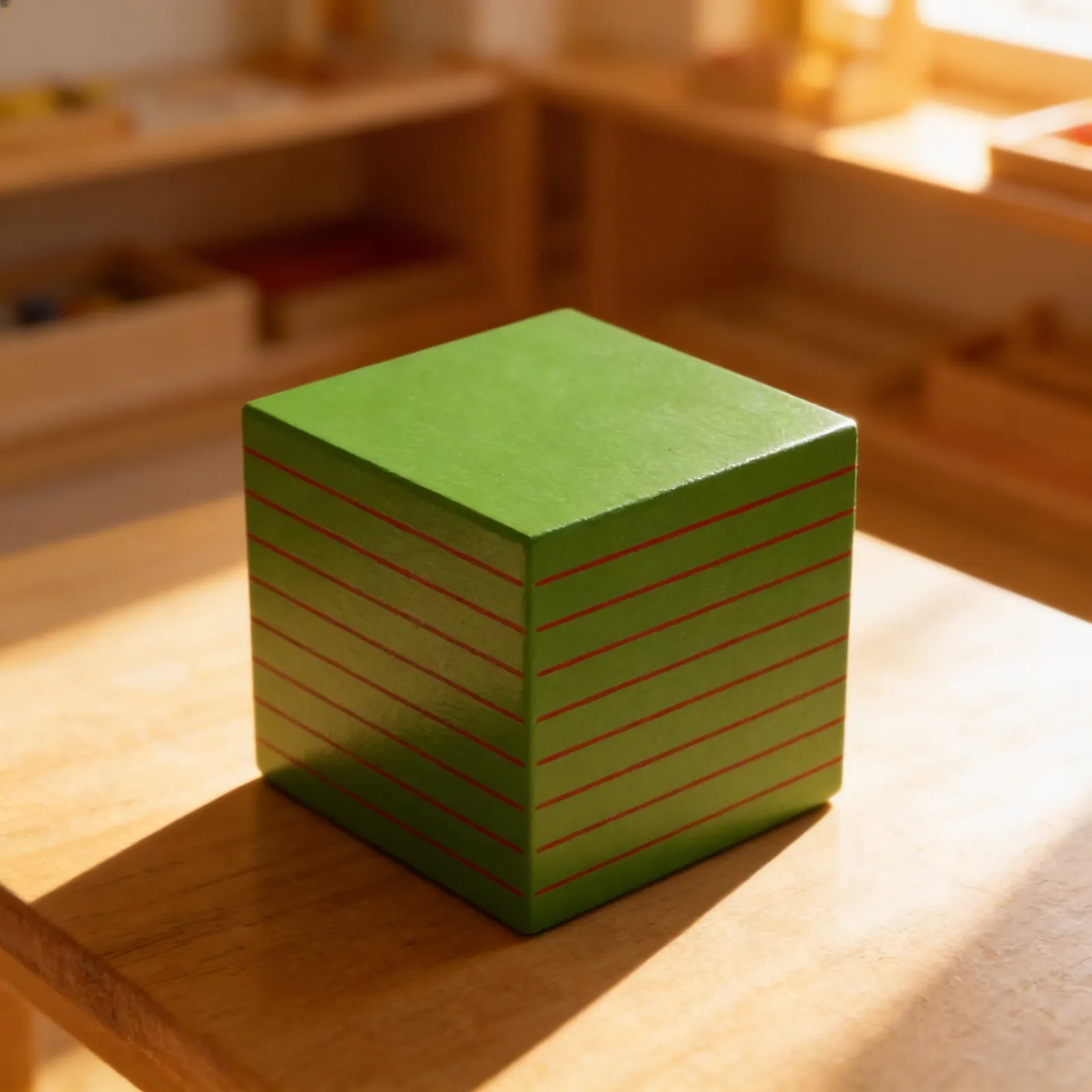
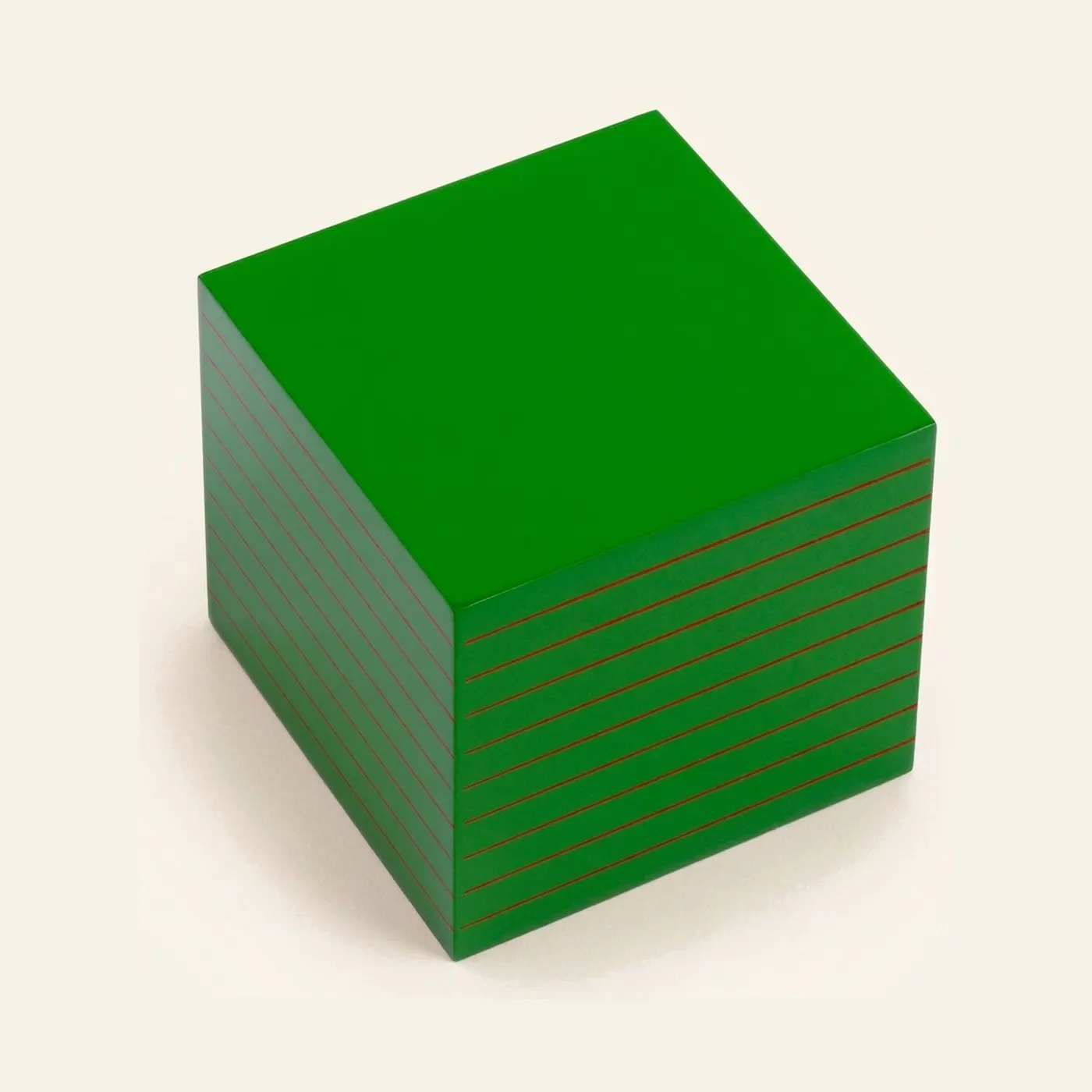
The 50 mm wooden cube from the geometric hierarchy of number, available separately. In that material each power of ten is a shape rather than a written figure: a point, a line, a square, then a cube, and then the whole sequence again ten times larger. The cube is the piece that gets handled most because it is the one a child can pick up in one hand, and it is therefore the one most often replaced. Hardwood, for ages 3 to 12.
“Free the child's potential, and you will transform him into the world.”
The Hierarchy of Number Cube embodies Dr. Montessori's principle of making abstract mathematical concepts concrete through sensorial experience.
- Understanding the physical representation of 1000 as a concrete quantity
- Recognizing the relationship between units, tens, hundreds, and thousands
- Developing spatial awareness through three-dimensional number exploration
- Building foundation for place value and the decimal system
Read More
This material bridges the gap between the child's sensorial explorations and mathematical understanding, allowing them to physically manipulate and visually perceive the quantity of 1000. The ten distinct layers marked with red lines provide a clear visual representation of how ten hundreds create one thousand, supporting the child's natural mathematical mind. Through repeated handling and exploration, children internalize the hierarchical nature of our decimal system, moving from concrete to abstract understanding. This material respects the child's need to learn through movement and touch, transforming the abstract concept of large numbers into something tangible and comprehensible for the absorbent mind.
How to present it
Follow the Montessori method of presentation for optimal child development.
Place the cube on a mat at the child's workspace. Ensure the red dividing lines are clearly visible. Have the golden bead thousand cube available for comparison if the child has worked with it.
- 1
Invite the child to carry the cube with both hands to the mat
This emphasizes the weight and significance of the quantity - 2
Show how to count the layers from bottom to top, touching each red line
Count slowly and deliberately: 'one hundred, two hundred...' up to one thousand - 3
Rotate the cube to show all faces have ten layers
Let the child discover that each face shows the same pattern - 4
Compare with golden bead thousand cube if available
This connects sensorial and mathematical materials - 5
Invite the child to trace the red lines with their finger
This reinforces the tactile understanding of ten groups
Every Child Is a Little Creator

Heritage
Since 1929

In classrooms
Around the world

European brands
Nienhuis, GAM, Educo
Number Hierarchy Cube: 50mm Wooden Thousand Representation
