
Individual Glass Bead Cube Of 2Green
The first photo is the maker's own. The other shots are illustrative.
Inv. no. NIE-0086G032
- Maker
- Nienhuis Montessori, since 1929
- Approval
- AMI
- Beads
- Glass with green finish
- Frame
- Metal wire (brass-colored)
- EAN
- 8719924004927
Final price incl. VAT. Delivery €5.90, €141.40 to go for free delivery.
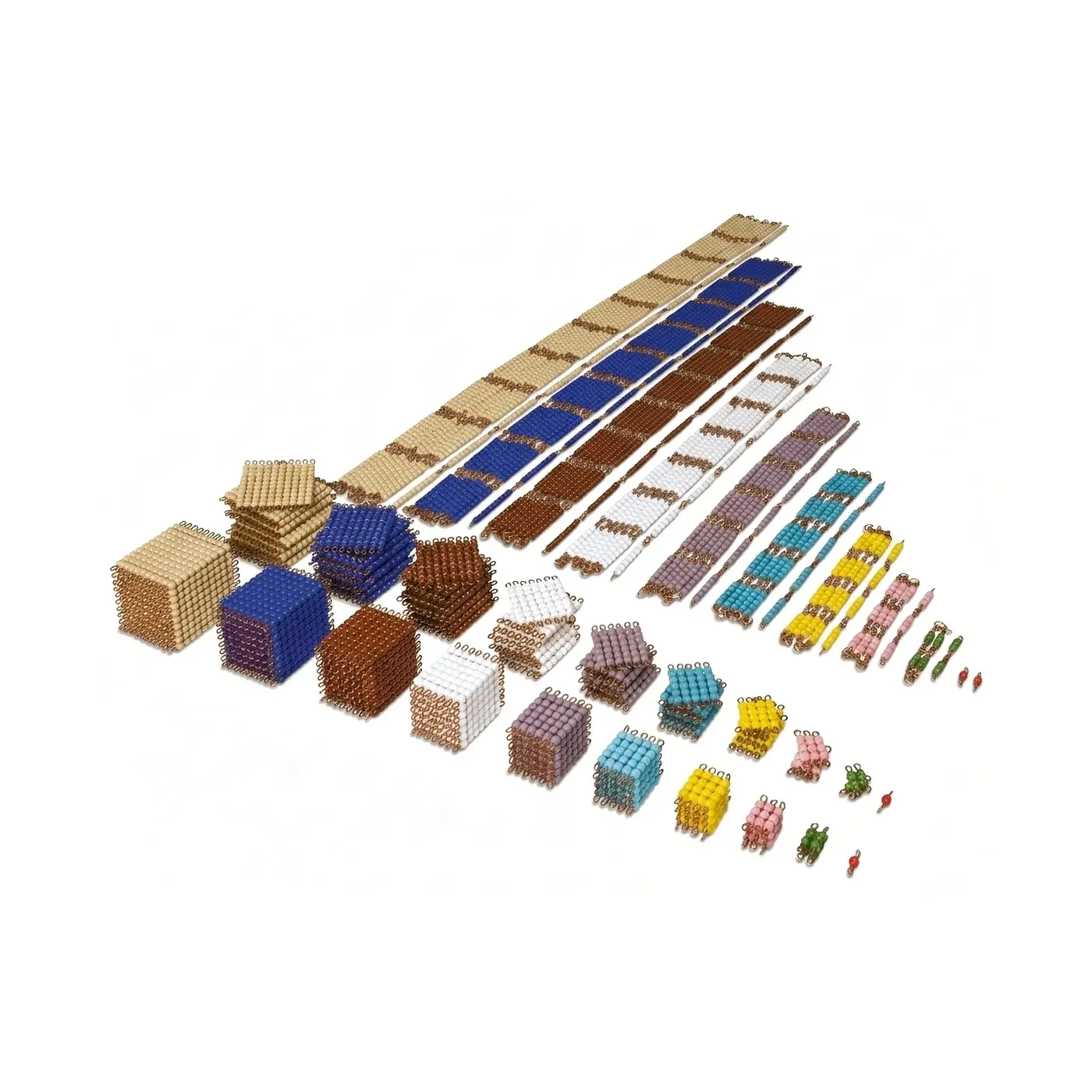 Individual Glass Beads €2,012.90
Advice, warranty and returns are handled by us.
Why it costs €7.60
Behind the price of the original are things you can check yourself.
AMI approval
The material is approved by the Association Montessori Internationale (AMI). Nienhuis has made Montessori materials since 1929.
A verifiable original
The EAN 8719924004927 is on the box. It is the maker's number, not ours.
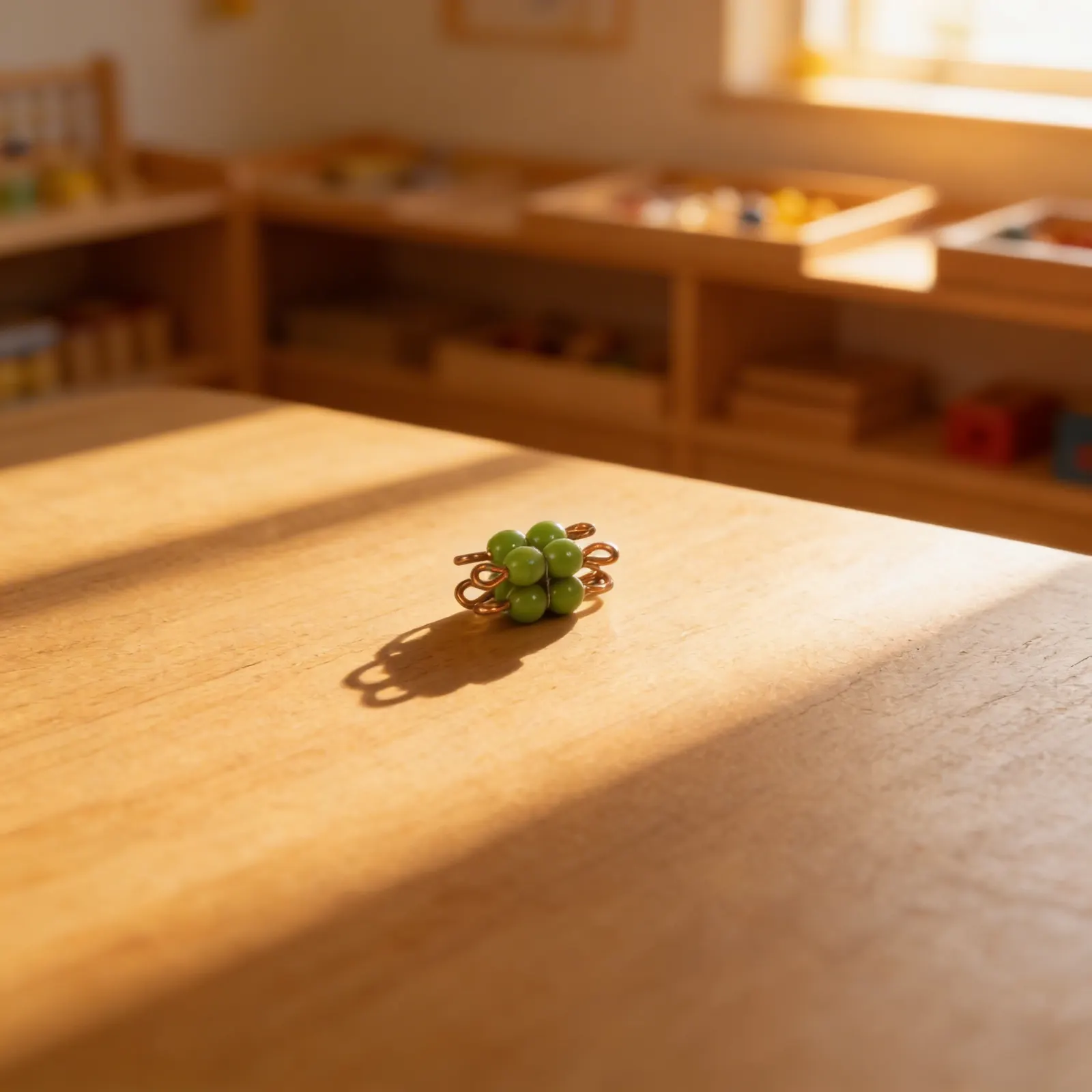
Individual Glass Bead Cube Of 2 in a child's hands
The cube of two in green, a single glass bead cube sold on its own. Eight beads, the smallest cube in the whole bead material, and the only one a child can take in at a glance: two along each edge, two layers, done. That is what makes it the cube to start with, because the child can check the claim that a cube is a square stacked as many times as its side without counting past ten. Green is two throughout. The nylon version is a separate item.
Mathematical Abstraction
Bridges concrete manipulation to abstract understanding of exponential concepts and cube numbers.
Spatial Reasoning
Three-dimensional cube structure develops geometric visualization and spatial intelligence.
Sequential Learning
Part of systematic progression from linear counting to squared and cubed number concepts.
Sensorial Mathematics
Tactile experience of holding and examining the cube reinforces mathematical relationships through the senses.
How to present it
Place the green glass bead cube on a plain mat or tray. Have paper and pencil available for optional notation work.
- 1Invite the child to count each glass bead by gently touching through the wire framework, establishing the total of 8
- 2Show how the cube has 2 beads along each edge: length, width, and height
- 3Demonstrate the multiplication: '2 beads long, times 2 beads wide, times 2 beads high equals 8 beads total'
- 4Introduce the notation 2³ and explain it means 2×2×2
- 5Let the child verify by counting in groups: first layer of 4, second layer of 4
3 tips for parents
- Look for cubic arrangements in everyday life: dice, building blocks, or stacked items in 2×2×2 patterns
- Practice skip counting by 2s to reinforce the base number of this cube
- Create simple drawings showing 2×2×2 arrangements using dots or squares

If you are not sure it suits your child, we answer in person.
Norbert Kovalčín, founder of Faborino · write to him
There is no review here yet. We will ask you for one after you buy. Write the first review
What's in the Box
- Glass Bead Cube: Green, representing 2³
Size and material
| Packaging | 13 × 9 × 1 cm |
| Beads | Glass with green finish |
| Frame | Metal wire (brass-colored) |
| Recommended Age | 3-6 years |
Care
Wipe gently with dry cloth; avoid moisture
Frequently Asked Questions
What does the Individual Glass Bead Cube of 2 represent mathematically?
This green cube represents 2³ (2×2×2=8), containing exactly 8 glass beads arranged in a three-dimensional cube formation. It provides a concrete, visual representation of the mathematical concept of cubing the number 2.
How is this bead cube used in Montessori mathematics lessons?
Children use this cube to explore powers of numbers, understand three-dimensional concepts, and transition from concrete to abstract mathematical thinking. It's typically introduced after children master linear and square bead materials, helping them visualize how 2×2×2 creates a cube of 8 beads.
What is the significance of the green color in this Montessori material?
In the Montessori color-coding system, green represents units. This green cube specifically represents the cube of 2 (a unit value), helping children associate the color with the mathematical concept and maintain consistency across Montessori mathematics materials.
At what age should children begin working with the bead cube materials?
While suitable for ages 3-6, most children are introduced to cube materials around age 4-5, after they've mastered linear counting and square formations. The child should have experience with the golden bead material and understand basic multiplication concepts before working with cubes.
How durable are the glass beads and wire construction?
The glass beads are made from high-quality, smooth glass that resists chipping with normal classroom use. The wire construction is sturdy and maintains the cube's shape while allowing children to feel the individual beads. With proper handling and storage, this material can last many years in a Montessori environment.
Product safety
Manufacturer: Nienhuis Montessori, Anders Celsiusstraat 15, 7442 PB Nijverdal, Netherlands
Individual Glass Bead Cube Of 2