
Individual Glass Beads: Complete Decimal System Material Set
Made by Nienhuis Montessori · shipped by Heutink International (Netherlands) About the maker
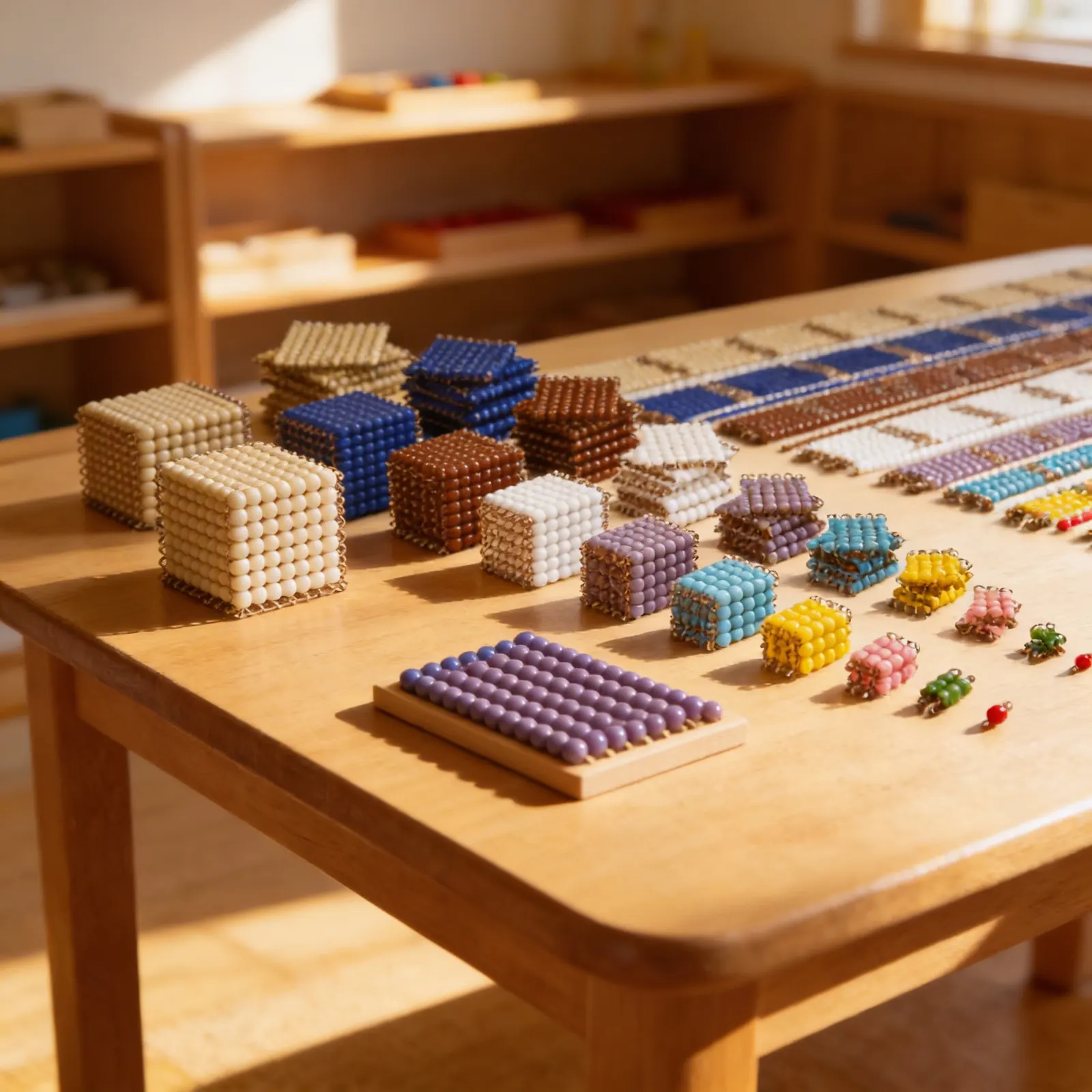
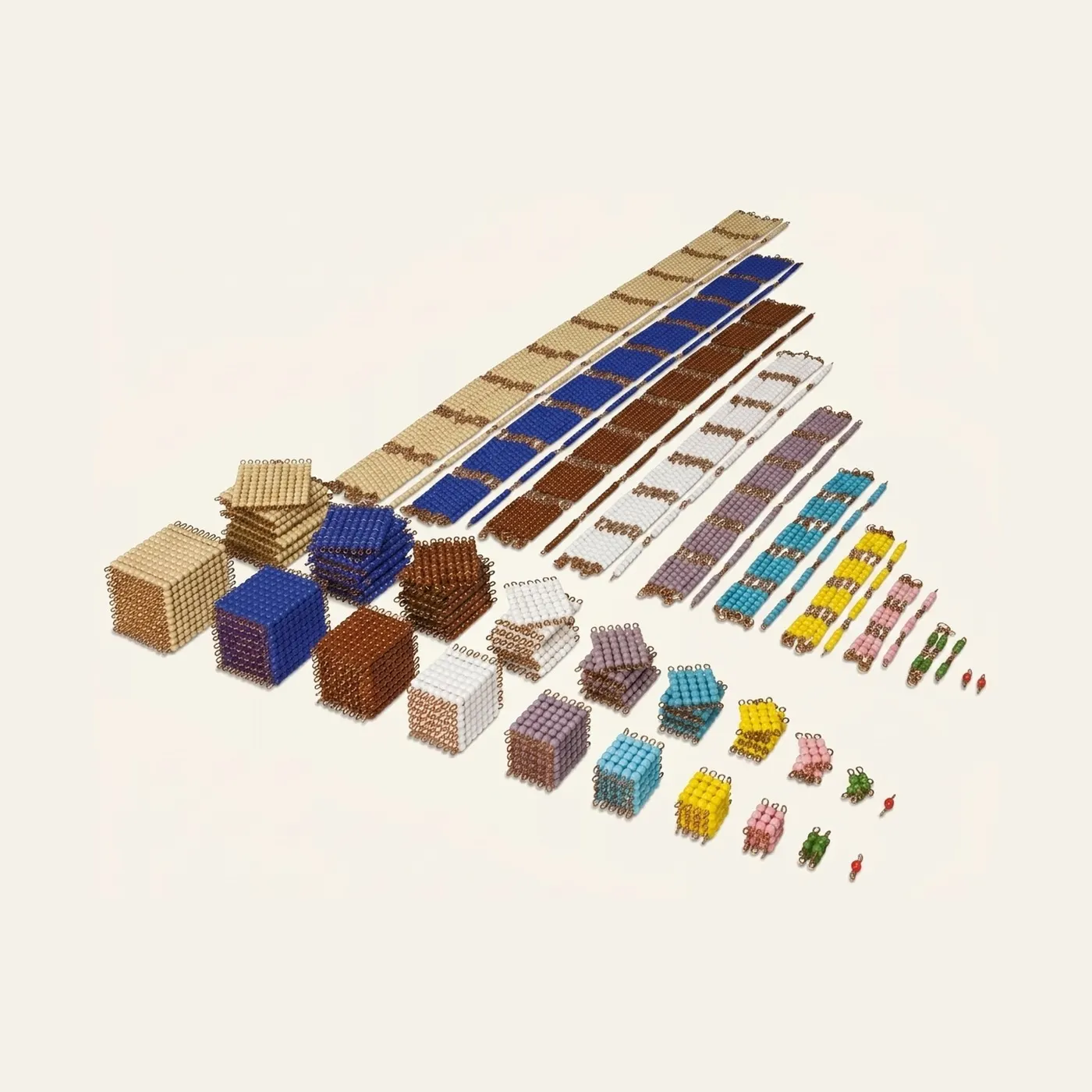
The decimal system in glass: a single bead for one, a wired bar of ten, a square of a hundred, a cube of a thousand. A child asked to fetch one thousand carries a cube in both hands and comes back knowing something a written number cannot teach. Because the beads are loose rather than fixed, the same material carries the child from first counting through the four operations, laying out a four digit quantity, exchanging ten of one category for one of the next, and arriving at carrying as a physical act. Glass beads on metal wire, for ages 3 to 6.
“The senses, being explorers of the world, open the way to knowledge.”
The Glass Bead Material exemplifies Montessori's fundamental principle of moving from concrete to abstract understanding.
- Understanding place value and decimal system hierarchy
- Developing visual and tactile number sense
- Recognizing quantity relationships and mathematical patterns
- Building foundation for addition, subtraction, multiplication, and division
Read More
Dr. Montessori recognized that young children must physically manipulate materials to internalize mathematical concepts. This material provides tangible representation of our decimal system, allowing children to see, touch, and feel mathematical relationships. The color-coded hierarchy and progressive sizing create visual order that appeals to the child's innate need for classification and organization. By isolating the concept of place value through individual manipulation, children develop deep number sense naturally. The material's self-correcting nature allows independent exploration, fostering concentration and intrinsic motivation. Each bead represents a unit of mathematical truth, building the foundation for all future arithmetic operations through concrete experience rather than abstract memorization.
How to present it
Follow the Montessori method of presentation for optimal child development.
Arrange materials on a large floor mat in order: units, tens, hundreds, thousands. Ensure adequate space for child movement and material manipulation.
- 1
Begin with the unit bead, allowing the child to hold and examine it, introducing the concept 'this represents one'
Let the child feel the weight and texture of each bead to establish sensory memory - 2
Progress to the ten-bar, showing how ten unit beads create this single bar, emphasizing the transformation
Count slowly together, touching each bead in the bar to reinforce the ten-unit relationship - 3
Introduce the hundred-square, demonstrating how ten bars form this flat square shape
Use directional language like 'across' and 'down' to help visualize the square formation - 4
Present the thousand-cube, showing the three-dimensional progression from flat to solid
Allow time for exploration and discovery; children often want to feel all surfaces of the cube
Every Child Is a Little Creator

Heritage
Since 1929

In classrooms
Around the world

European brands
Nienhuis, GAM, Educo

AMI approved
To the association standard
Individual Glass Beads: Complete Decimal System Material Set
