
Individual Glass Bead Square Of 6Purple
The first photo is the maker's own. The other shots are illustrative.
Inv. no. NIE-0086G026
- Maker
- Nienhuis Montessori, since 1929
- Approval
- AMI
- Beads
- Purple glass
- Connectors
- Gold-colored metal rings
- EAN
- 8719924004880
Final price incl. VAT. Delivery €5.90, €135.20 to go for free delivery.
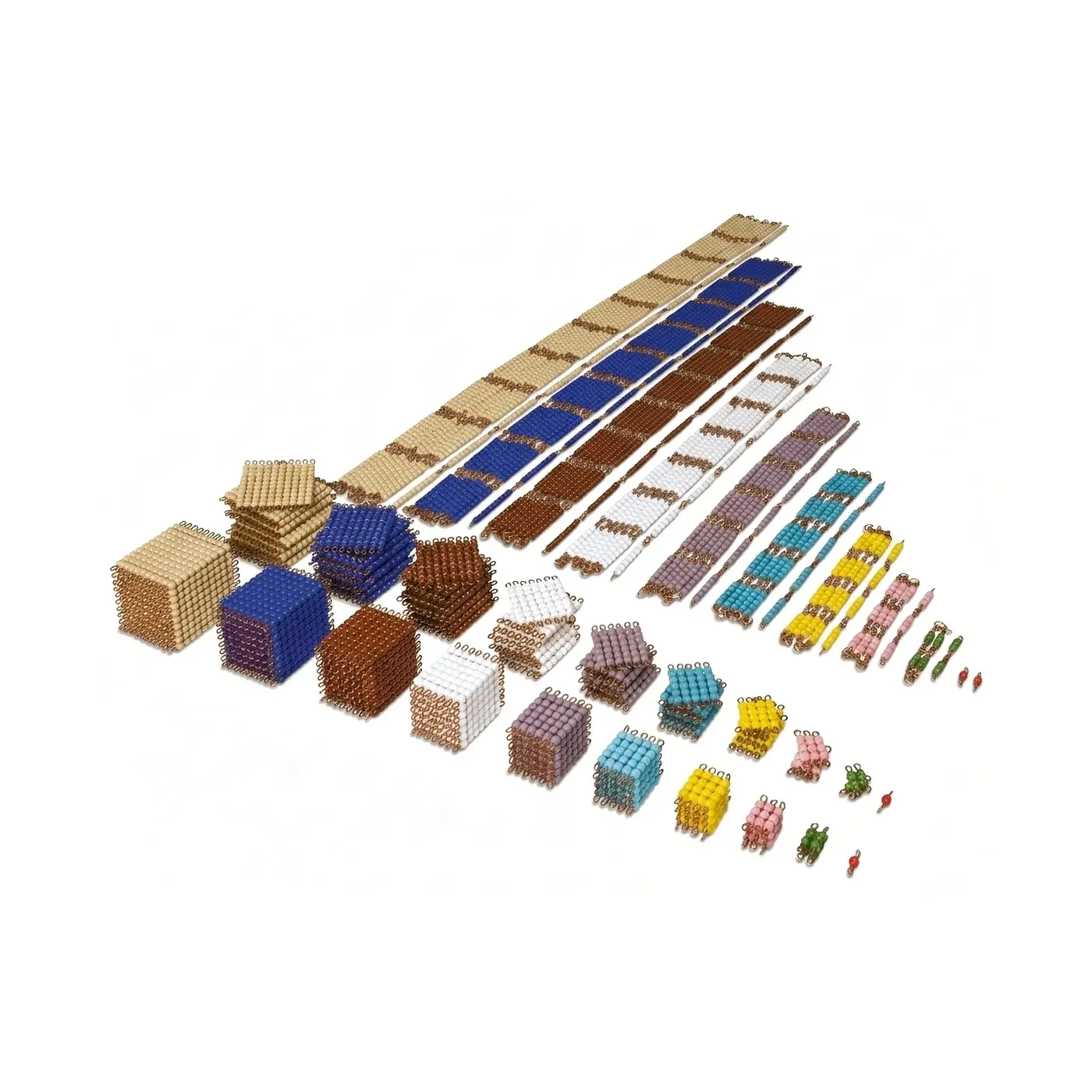 Individual Glass Beads €2,012.90
Advice, warranty and returns are handled by us.
Why it costs €13.80
Behind the price of the original are things you can check yourself.
AMI approval
The material is approved by the Association Montessori Internationale (AMI). Nienhuis has made Montessori materials since 1929.
A verifiable original
The EAN 8719924004880 is on the box. It is the maker's number, not ours.
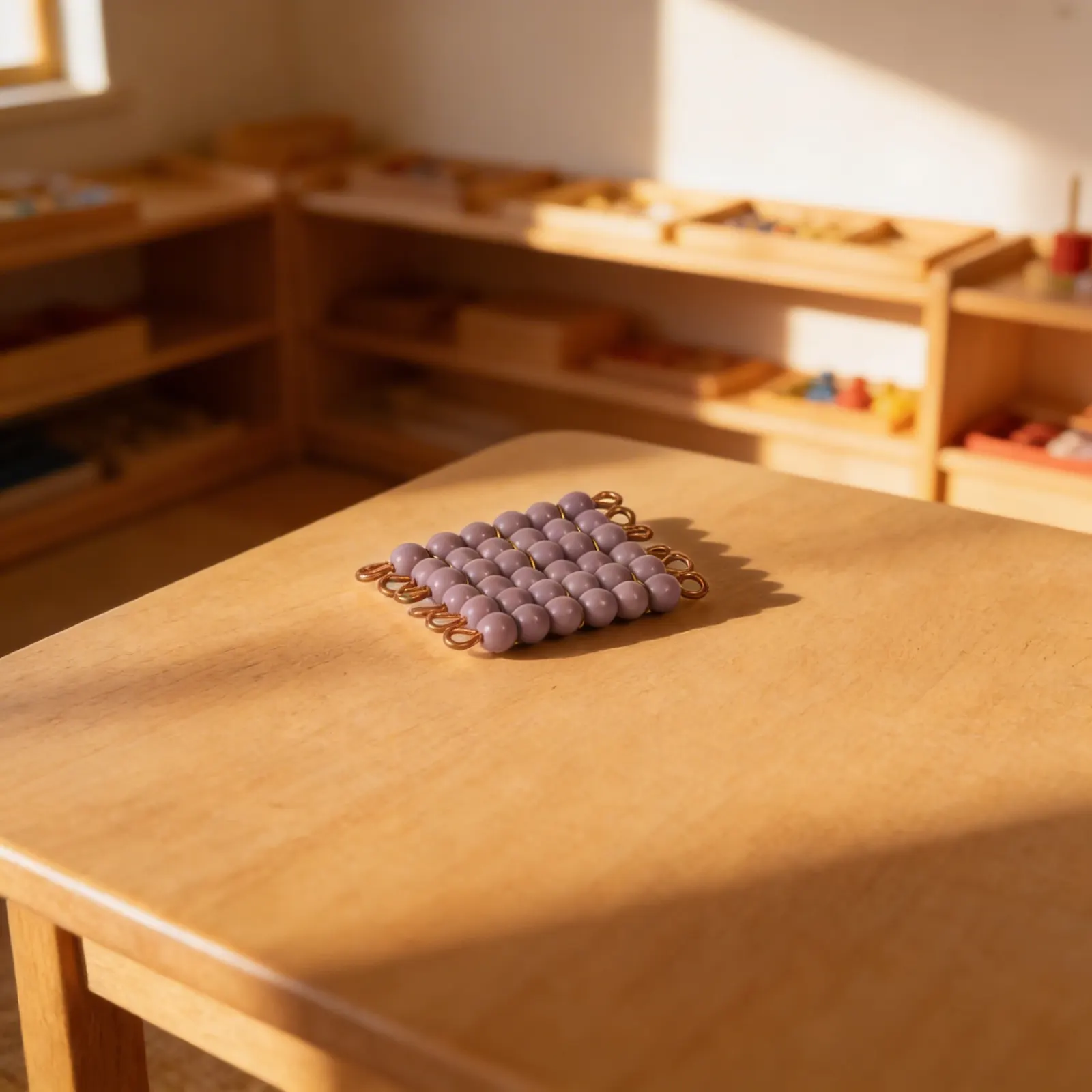
Individual Glass Bead Square Of 6 in a child's hands
A single square of six: six bead bars of six wired flat into thirty six beads, in the purple that stands for six throughout the bead material. Six is where counting one by one starts costing more than it is worth. Thirty six is too many to check bead by bead in a reasonable time and small enough that the child can still see the whole square at once, so it is the point at which counting in sixes becomes the easier option and gets adopted. Glass beads on wire.
Mathematical Understanding
Visualizes square numbers and multiplication concepts through concrete manipulation.
Skip Counting
Supports learning to count by 6s through the organized bead arrangement.
Pattern Recognition
Develops understanding of mathematical patterns and relationships in square formations.
Fine Motor Skills
Enhances dexterity through careful handling and counting of individual beads.
How to present it
Place the bead square on a mat. Have paper and colored pencils available for recording discoveries.
- 1Invite the child to count all beads in the square, touching each one
- 2Count one row of 6 beads, then show how there are 6 rows total
- 3Demonstrate skip counting by 6s while pointing to each row: 6, 12, 18, 24, 30, 36
- 4Gently curve the bead square to show it still contains 36 beads
- 5Have the child draw the square pattern on paper and label it '6 squared = 36'
3 tips for parents
- Look for square patterns in everyday life (floor tiles, windows) to reinforce the concept
- Practice skip counting by 6s during daily activities like setting the table
- If your child struggles with 36 beads, practice with smaller squares first (3×3 or 4×4)

If you are not sure it suits your child, we answer in person.
Norbert Kovalčín, founder of Faborino · write to him
There is no review here yet. We will ask you for one after you buy. Write the first review
What's in the Box
- Glass Bead Square: 6×6 configuration (36 beads total)
Size and material
| Packaging | 13 × 9 × 1 cm |
| Beads | Purple glass |
| Connectors | Gold-colored metal rings |
| Recommended Age | 3-6 years |
Care
Wipe gently with soft, damp cloth
Frequently Asked Questions
What mathematical concepts does this bead square teach?
This material introduces squared numbers (6²=36), skip counting by 6s, multiplication facts of 6, area concepts, and the relationship between linear and square measurements. It provides a concrete representation of abstract mathematical ideas.
How do children use this material in Montessori mathematics?
Children use the bead square to count individual beads, skip count rows or columns by 6s, explore the concept of 6×6=36, compare it with other bead squares, and transition from concrete to abstract understanding of square numbers.
Why are the beads purple and connected with gold rings?
In Montessori mathematics, purple represents the number 6 in the color-coded bead system. The gold-colored metal rings create a stable, interconnected grid that maintains the square shape while allowing flexibility for manipulation and exploration.
What activities can be done with this single bead square?
Children can count all 36 beads, trace the square's perimeter, compare linear counting (6) to area counting (36), use it with number cards for matching exercises, and combine it with other bead materials for advanced multiplication work.
At what stage in the Montessori math sequence is this used?
This material is typically introduced after children have worked with the bead chains and understand linear counting. It bridges the gap between concrete counting and abstract multiplication, usually around ages 4-6 when children are ready for squared number concepts.
Product safety
Manufacturer: Nienhuis Montessori, Anders Celsiusstraat 15, 7442 PB Nijverdal, Netherlands
Individual Glass Bead Square Of 6