
Bead Cube of 7White Nylon Thousand Unit (7³)
The first photo is the maker's own. The other shots are illustrative.
Inv. no. NIE-0086M037
- Maker
- Nienhuis Montessori, since 1929
- Approval
- AMI
- Beads
- White nylon
- Threading
- Copper wire
- EAN
- 8719924005146
Final price incl. VAT. Delivery €5.90, €88.10 to go for free delivery.
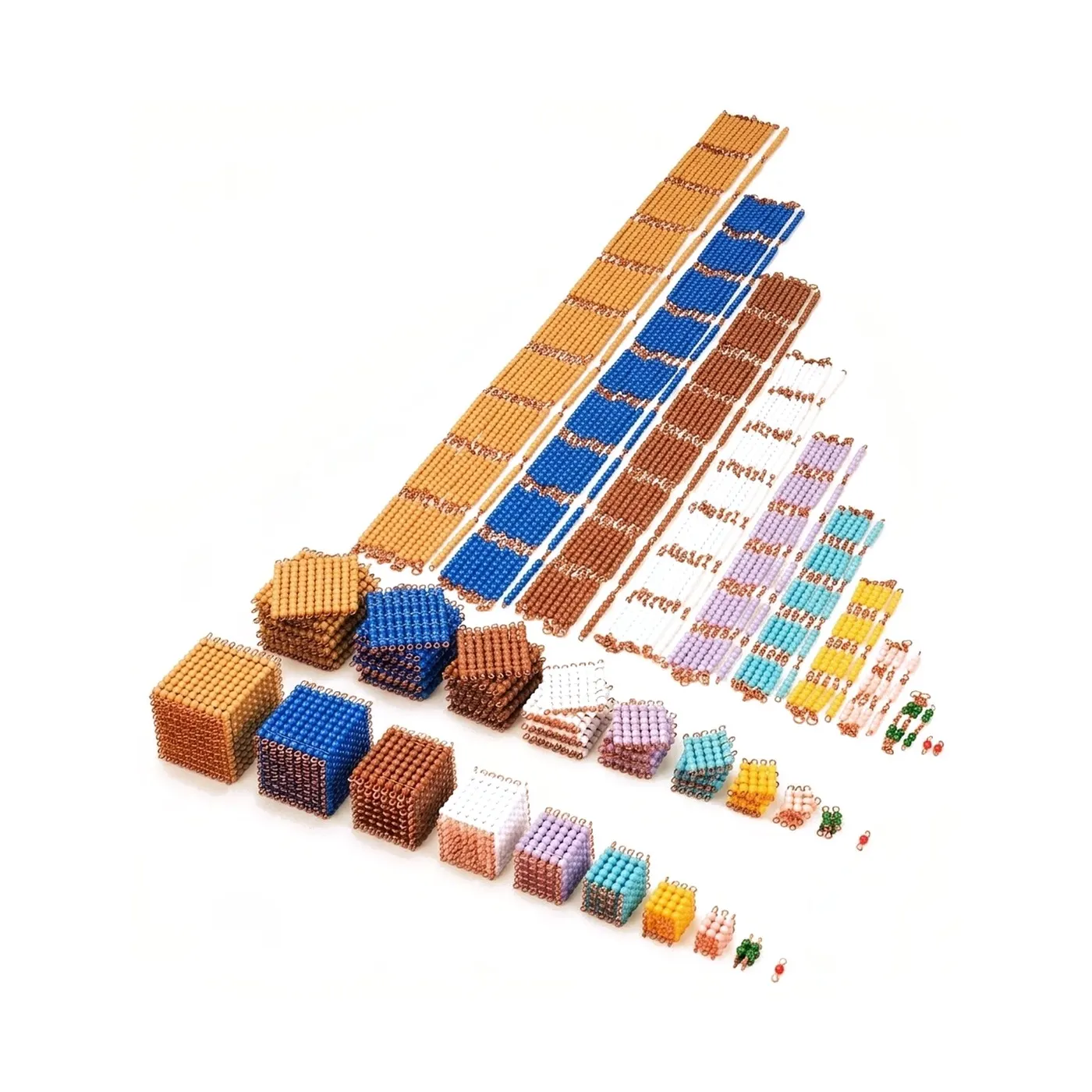 Individual Nylon Beads €1,223.90
Advice, warranty and returns are handled by us.
Why it costs €60.90
Behind the price of the original are things you can check yourself.
AMI approval
The material is approved by the Association Montessori Internationale (AMI). Nienhuis has made Montessori materials since 1929.
A verifiable original
The EAN 8719924005146 is on the box. It is the maker's number, not ours.
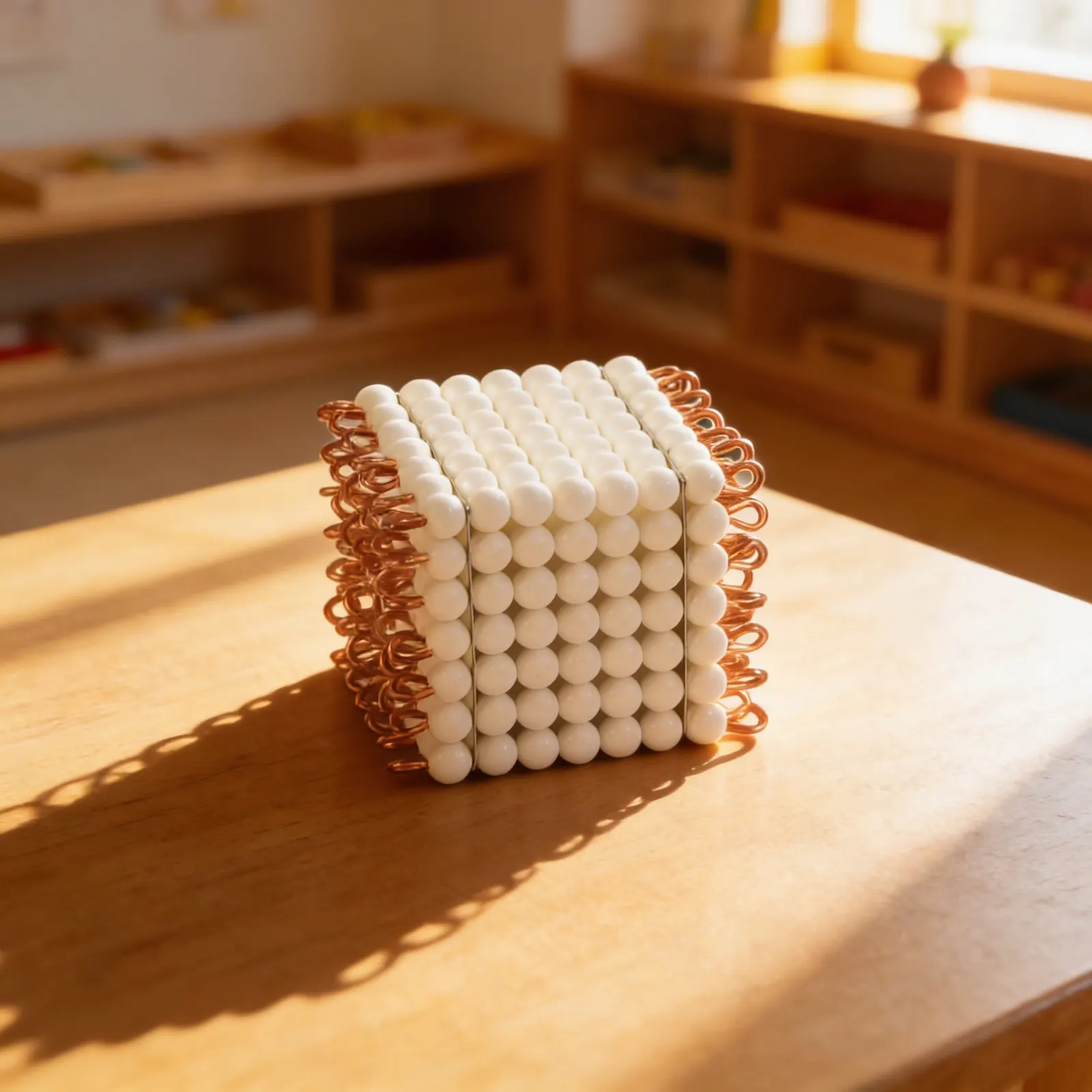
Bead Cube of 7 in a child's hands
Sold separately for flexible classroom setup, this individual Nylon Bead Cube of 7 represents a thousand unit (7³ = 343) in the Montessori decimal system hierarchy. Crafted from white nylon beads strung on flexible copper wire, this sensorial material provides tactile and visual experiences while introducing advanced mathematical concepts. The cube serves as a bridge between concrete manipulation and abstract numerical understanding in the 3-6 environment.
Mathematical Understanding
Introduces the concept of cubing and thousand as 10³ through concrete manipulation
Sensorial Refinement
Weight and size of cube provides muscular memory of quantity relationships
Preparation for Abstraction
Bridges concrete bead materials to abstract numerical concepts
How to present it
Place the cube on a mat at the child's workspace. Ensure hands are clean and dry. Have the thousand cube from the golden bead material available for comparison if previously introduced.
- 1Invite the child to carry the cube with two hands, feeling its weight
- 2Place the cube gently on the mat and invite exploration through touch
- 3Count one edge together: 1, 2, 3, 4, 5, 6, 7 beads
- 4Explore how 7 x 7 = 49 makes one face, demonstrating with finger tracing
- 5Discuss how 7 x 7 x 7 creates the cube of 343
3 tips for parents
- Support at home by noticing cubic shapes in the environment - dice, boxes, building blocks
- Avoid rushing to symbolic notation; let your child enjoy the sensorial experience first
- When your child is ready, explore cubing with everyday objects like arranging 3x3x3 blocks or stacking items

If you are not sure it suits your child, we answer in person.
Norbert Kovalčín, founder of Faborino · write to him
There is no review here yet. We will ask you for one after you buy. Write the first review
What's in the Box
- Nylon Bead Cube of 7: 343 white beads on copper wire
Size and material
| Packaging | 6 × 5 × 5 cm |
| Beads | White nylon |
| Threading | Copper wire |
| Recommended Age | 3-6 years |
Care
Wipe with damp cloth, air dry completely
Frequently Asked Questions
Why does this cube contain 343 beads instead of 1000?
This cube represents a 7x7x7 formation (343 beads) rather than the traditional 10x10x10 thousand cube. It's designed to help children explore different number bases and understand that cubing works with any number, not just base 10. This variation enriches mathematical understanding beyond the decimal system.
How does this white cube differ from the golden thousand cube?
While both are cube formations, this white nylon bead cube contains 343 beads (7³) compared to the golden thousand cube's 1,000 beads (10³). The white color and different quantity help children distinguish between base-10 and base-7 systems, promoting flexible mathematical thinking and deeper understanding of place value concepts.
What activities can children do with this cube of 7?
Children can explore skip counting by 7s, compare it with base-10 materials, investigate patterns in different number systems, practice cubing concepts, and use it for sensorial discrimination exercises. It's particularly valuable for advanced 5-6 year olds who have mastered decimal system basics and are ready for mathematical extensions.
Is the copper wire safe for children to handle?
Yes, the flexible copper wire is safely enclosed within the bead structure and designed for classroom use. The nylon beads are smooth and durable, while the wire maintains the cube's shape during manipulation. Always supervise initial use and check periodically for any wear that might expose wire ends.
How does this material support sensorial development?
The cube provides weight discrimination as children compare it to other bead materials, visual discrimination through its distinctive white color and cubic form, and tactile experiences through counting and handling individual beads. The flexible structure also allows slight movement, adding a kinesthetic dimension to mathematical exploration.
Product safety
Manufacturer: Nienhuis Montessori, Anders Celsiusstraat 15, 7442 PB Nijverdal, Netherlands
Bead Cube of 7