
Individual Nylon Beads: Complete Decimal System Material Set
Made by Nienhuis Montessori · shipped by Heutink International (Netherlands) About the maker
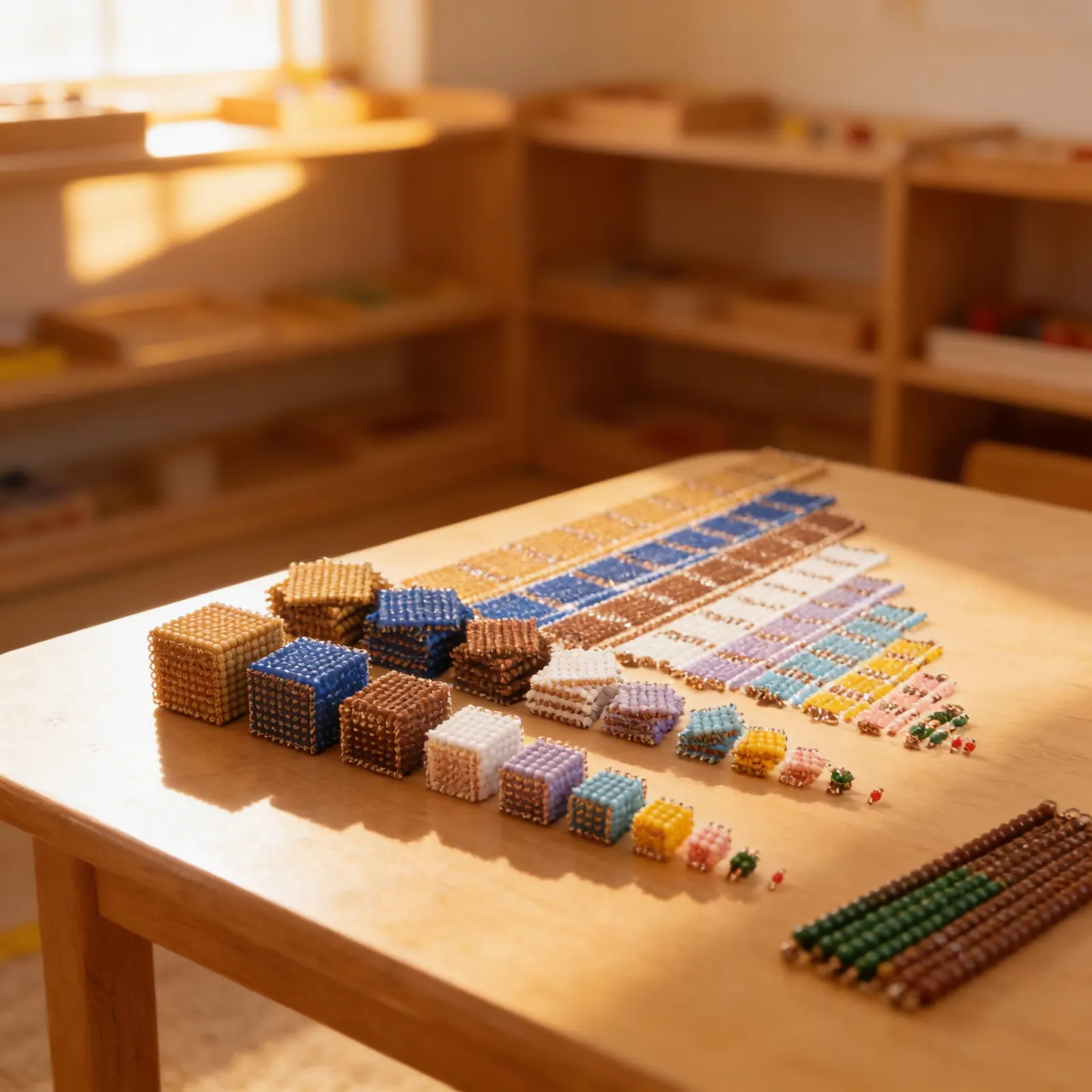
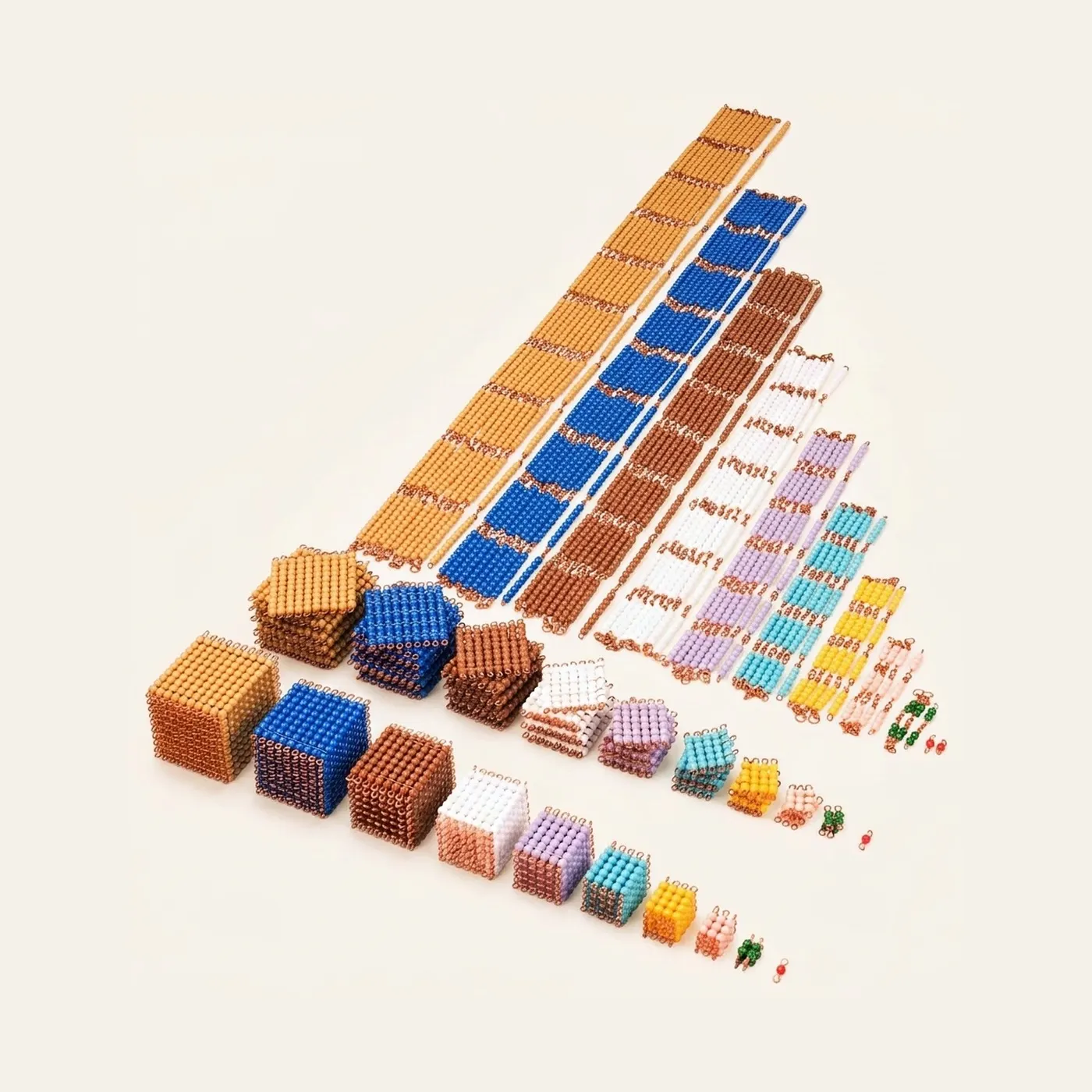
The same decimal hierarchy as the glass bead material, made up in nylon, which takes classroom handling without chipping. Children work with units, ten bars, hundred squares and thousand cubes, laying out quantities, exchanging ten of one for one of the next, and reading numbers they have built themselves. Because the pieces are individual rather than fixed into a frame, the material stretches from a first introduction to the decimal system all the way to four digit operations. For ages 3 to 6.
“The hands are the instruments of man's intelligence.”
The Individual Beads Nylon material exemplifies Montessori's fundamental principle that abstract mathematical concepts must first be experienced through concrete manipulation.
- Concrete understanding of decimal system hierarchy and place value relationships
- Development of number sense through physical manipulation and sensorial exploration
- Foundation for addition, subtraction, multiplication, and division operations
- Visual and tactile discrimination of mathematical quantities and their relationships
Read More
This beautiful golden bead system transforms the invisible decimal hierarchy into tangible reality, allowing children to literally hold mathematical relationships in their hands. The material's precise hierarchical progression, from individual unit beads to thousand cubes, mirrors the child's natural development from concrete to abstract thinking. Each quantity difference of ten is not merely explained but physically experienced through size, weight, and volume changes. The nylon construction ensures durability while maintaining the essential sensorial qualities that make mathematical concepts accessible to young minds. By engaging multiple senses simultaneously, this material builds genuine mathematical understanding rather than mere memorization, creating neural pathways that support lifelong mathematical thinking and establishing the foundation for all future arithmetic operations.
How to present it
Follow the Montessori method of presentation for optimal child development.
Arrange materials on a floor mat or large table with ample space. Have unit beads, ten bars, hundred squares, and thousand cube readily accessible. Ensure child can move freely around the material.
- 1
Introduce each hierarchy level individually, beginning with the unit bead, allowing the child to hold, examine, and count
Move slowly and deliberately, giving the child time to absorb each new concept before progressing - 2
Demonstrate the relationship between quantities by showing how ten units equal one ten-bar, using precise counting and clear transitions
Use consistent language: 'This is one unit, this is ten units, this is one ten-bar' - 3
Guide the child to build numbers using combinations of different hierarchies, starting with simple two-digit numbers
Let the child physically construct each number rather than simply observing your demonstration - 4
Introduce the concept of exchange by having the child trade ten units for one ten-bar, reinforcing the equivalency principle
Make exchanges ceremonial and significant, emphasizing the mathematical relationship being demonstrated
Every Child Is a Little Creator

Heritage
Since 1929

In classrooms
Around the world

European brands
Nienhuis, GAM, Educo

AMI approved
To the association standard
Individual Nylon Beads: Complete Decimal System Material Set
