
Individual Nylon Bead Square Of 2Green
The first photo is the maker's own. The other shots are illustrative.
Inv. no. NIE-0086M022
- Maker
- Nienhuis Montessori, since 1929
- Approval
- AMI
- Beads
- Nylon, green color
- Wire
- Metal with end loops
- EAN
- 8719924005016
Final price incl. VAT. Delivery €5.90, €145.80 to go for free delivery.
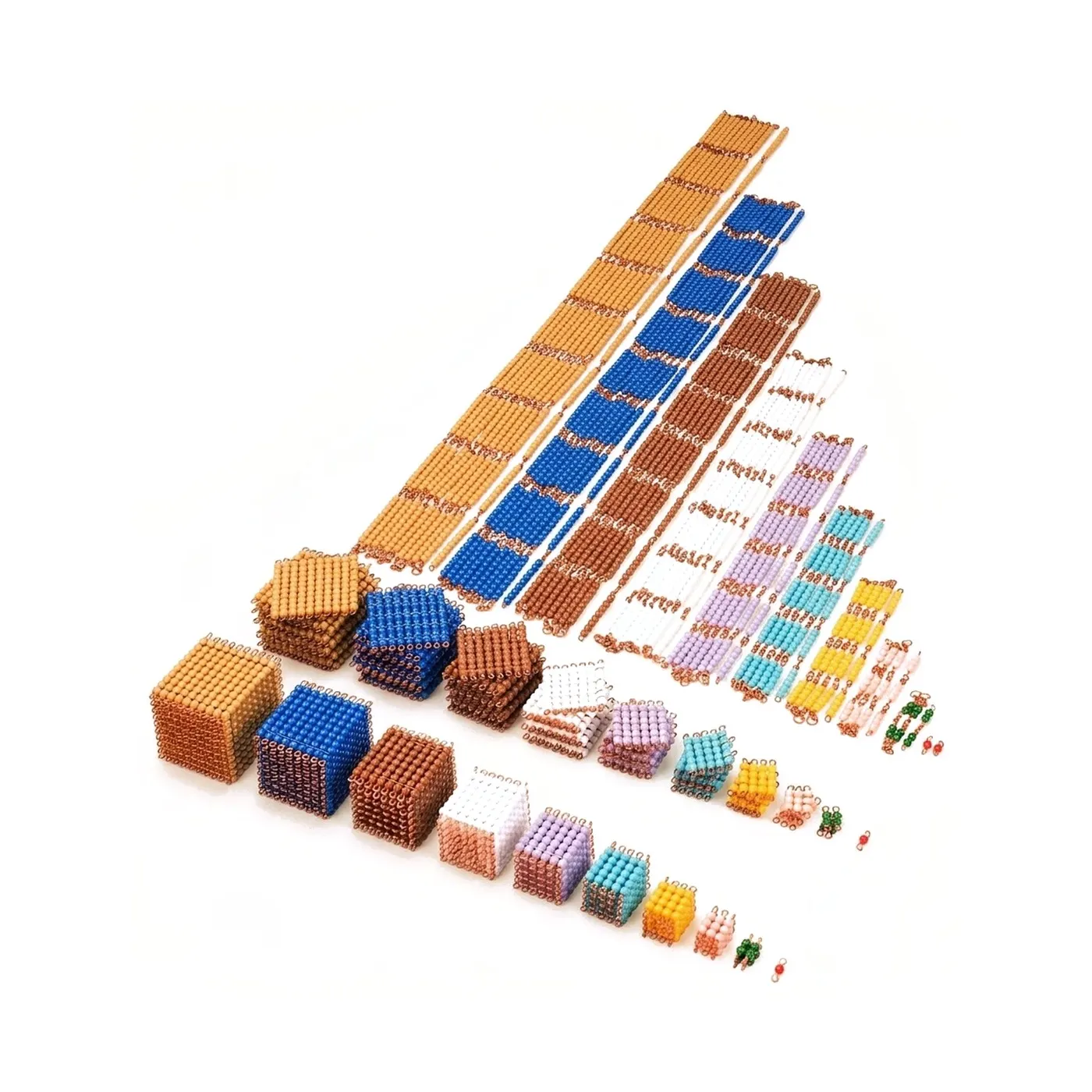 Individual Nylon Beads €1,223.90
Advice, warranty and returns are handled by us.
Why it costs €3.20
Behind the price of the original are things you can check yourself.
AMI approval
The material is approved by the Association Montessori Internationale (AMI). Nienhuis has made Montessori materials since 1929.
A verifiable original
The EAN 8719924005016 is on the box. It is the maker's number, not ours.
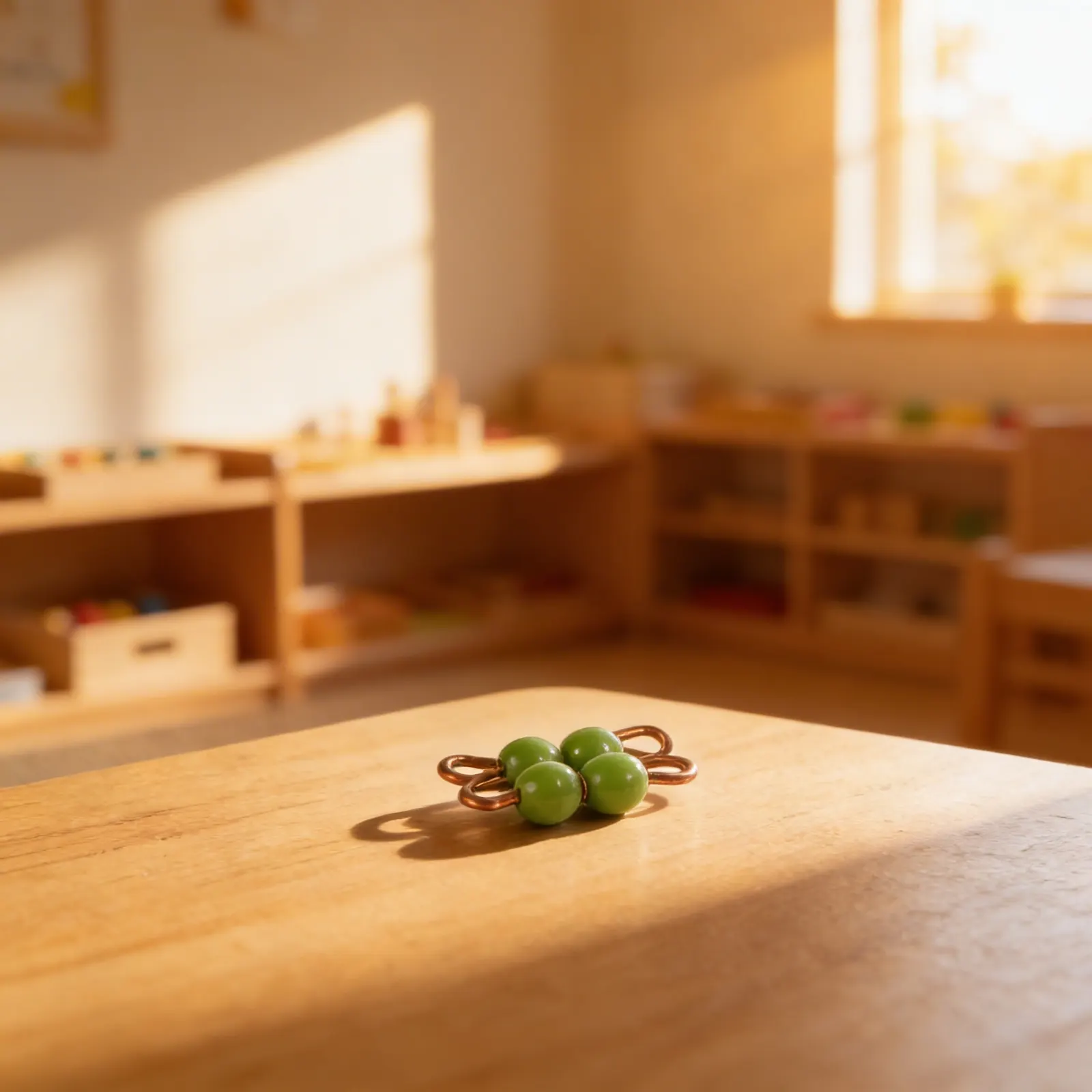
Individual Nylon Bead Square Of 2 in a child's hands
The square of two in green, a single nylon bead square sold on its own. Four beads in a two by two block, the smallest square in the material, and the one a child uses to check that a square really is a row repeated as many times as the row is long. Nylon rather than glass: lighter, quieter and the usual choice where the squares are handled every day. Green is two throughout. The glass version is a separate item.
Mathematical Understanding
Provides concrete representation of 2², helping children visualize and internalize the concept of squared numbers through tactile experience.
Sequential Learning
Builds foundation for understanding multiplication and powers, preparing for work with larger squares and cubes.
Visual-Spatial Skills
Develops spatial reasoning as children recognize the square pattern and relate it to numerical concepts.
How to present it
Place the green bead square on a small tray or mat. Have a separate container with loose green beads nearby for comparison.
- 1Invite the child to feel the bead square, noting its square shape
- 2Count the beads together: 'One, two' across the top, then 'One, two' down the side
- 3Count all four beads: 'One, two, three, four'
- 4Explain: 'This is the square of 2. Two rows of two makes four'
- 5Compare with loose beads by making the same 2×2 pattern
3 tips for parents
- Practice making squares with everyday objects like crackers or toy blocks at home
- When you see square patterns (floor tiles, windows), count them in rows and columns
- Keep mathematical language simple: 'two rows of two' rather than complex terminology

If you are not sure it suits your child, we answer in person.
Norbert Kovalčín, founder of Faborino · write to him
There is no review here yet. We will ask you for one after you buy. Write the first review
What's in the Box
- Bead Square of 2: 4 green beads on wire
Size and material
| Packaging | 13 × 9 × 1 cm |
| Beads | Nylon, green color |
| Wire | Metal with end loops |
| Recommended Age | 3-6 years |
Care
Wipe with damp cloth, air dry
Frequently Asked Questions
What is the purpose of the green bead square of 2?
This material introduces children to the concept of squared numbers by showing 2² (2x2=4) in a visual, concrete form. It helps children understand that squaring means multiplying a number by itself, laying groundwork for future mathematical concepts.
How do I present this material to my child?
Start by showing the square formation of 4 beads arranged as 2x2. Count the beads together, then explain that this represents 'two squared.' You can trace around the square shape with your finger and compare it to linear bead bars to show the difference between 2 and 2².
Why are the beads green in color?
In the Montessori color-coding system, green represents the number 2. This consistent color coding helps children recognize and remember number values across different mathematical materials, creating visual associations that support learning.
What other materials work well with this bead square?
This square pairs excellently with the bead cabinet, other bead squares (1-10), bead chains, and the hundred board. It's also useful alongside the multiplication board and when introducing the concept of area in geometry.
Is this suitable for a 3-year-old?
While labeled for ages 3-6, most children benefit from this material around age 4-5 when they have experience with linear counting and are ready for more abstract concepts. Ensure your child can count to 10 and understands one-to-one correspondence before introducing squared numbers.
Product safety
Manufacturer: Nienhuis Montessori, Anders Celsiusstraat 15, 7442 PB Nijverdal, Netherlands
Individual Nylon Bead Square Of 2