
Individual Nylon Bead Square Of 3Pink
The first photo is the maker's own. The other shots are illustrative.
Inv. no. NIE-0086M023
- Maker
- Nienhuis Montessori, since 1929
- Approval
- AMI
- Beads
- Pink nylon
- Framework
- Metal wire
- EAN
- 8719924005023
Final price incl. VAT. Delivery €5.90, €144.20 to go for free delivery.
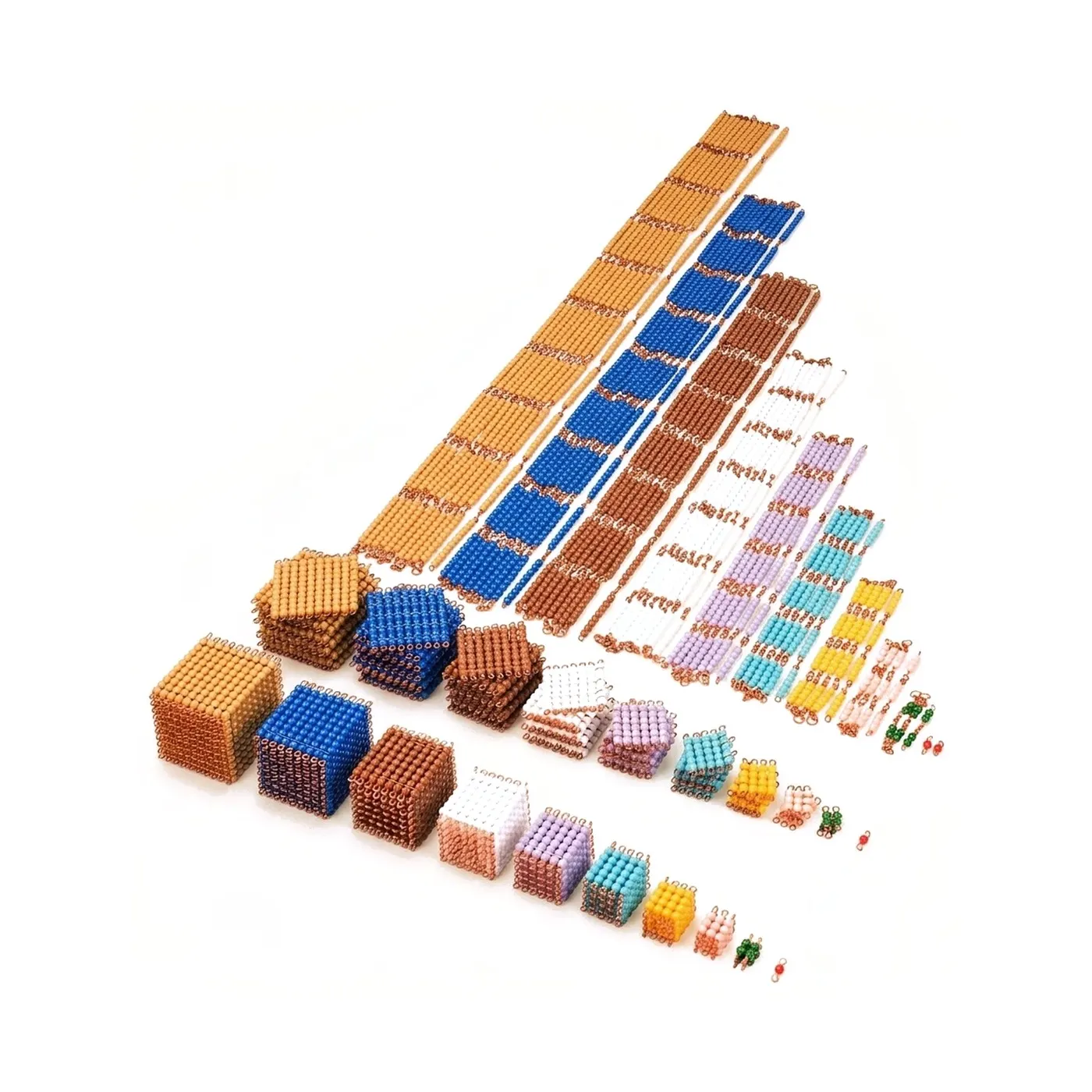 Individual Nylon Beads €1,223.90
Advice, warranty and returns are handled by us.
Why it costs €4.80
Behind the price of the original are things you can check yourself.
AMI approval
The material is approved by the Association Montessori Internationale (AMI). Nienhuis has made Montessori materials since 1929.
A verifiable original
The EAN 8719924005023 is on the box. It is the maker's number, not ours.
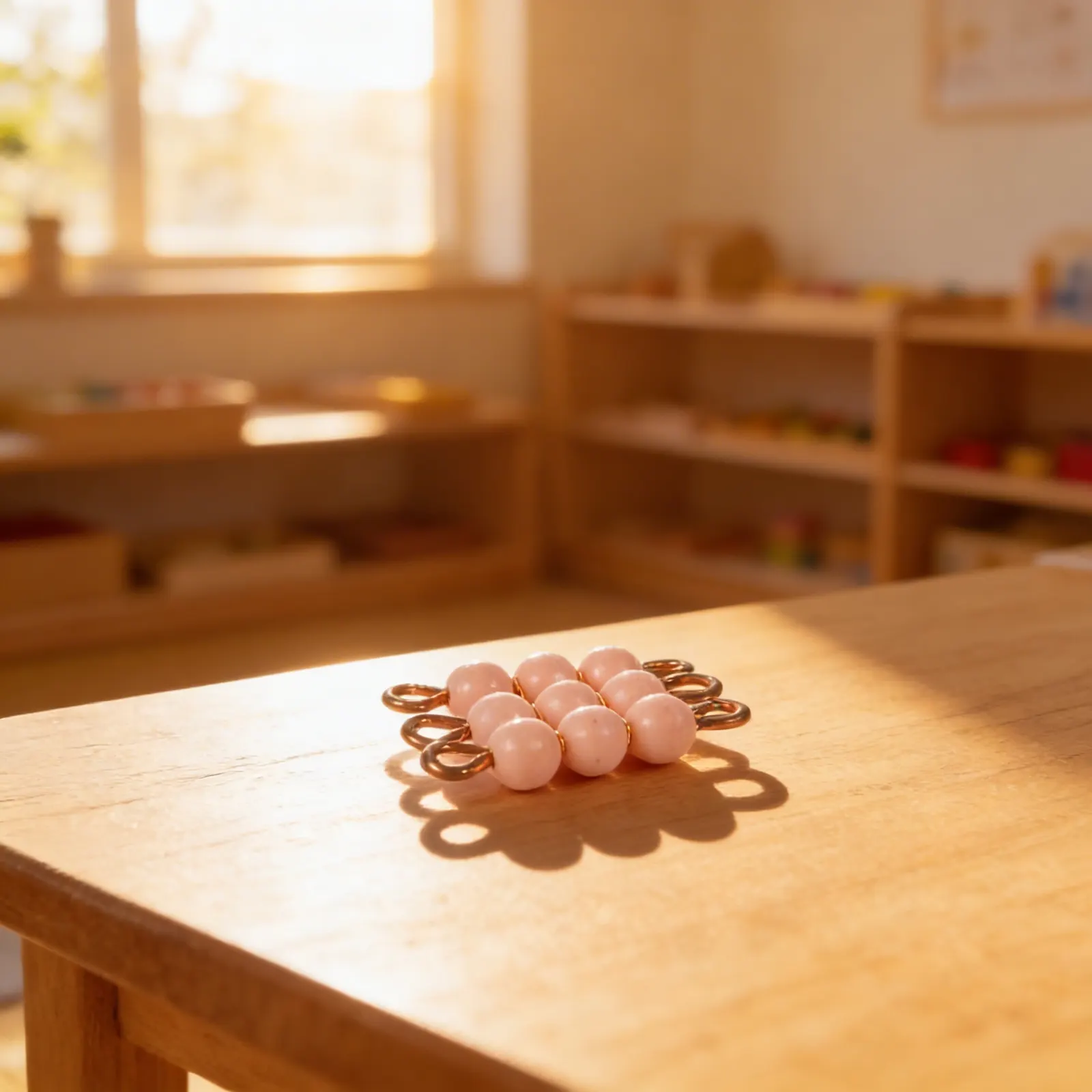
Individual Nylon Bead Square Of 3 in a child's hands
Sold separately for flexible classroom setup, this individual nylon bead square represents the mathematical concept of 3², featuring nine pink beads arranged in a precise 3x3 formation on metal wires. Essential for the Montessori bead cabinet work, this manipulative allows children to physically explore squared numbers, supporting the transition from hands-on to minds-on mathematical understanding through tactile exploration and visual representation.
Mathematical Concept Formation
Physically represents 3² = 9, allowing children to see and touch the square number relationship.
Visual Discrimination
Develops ability to recognize square formations and relate them to numerical values.
Preparation for Multiplication
Introduces squaring as repeated addition (3+3+3) through concrete manipulation.
Abstract Thinking
Bridges concrete bead work to abstract understanding of exponential notation.
How to present it
Place the pink bead square on a neutral-colored mat. Have a small tray nearby for organizing work. Ensure the child has previously worked with bead bars 1-9.
- 1Invite the child to feel the bead square, running fingers along each row
- 2Count the beads in the first row together: 'One, two, three'
- 3Ask: 'How many beads in the second row?' Count together again
- 4Count all nine beads, touching each one systematically
- 5Introduce language: 'This is the square of three. Three rows of three makes nine'
3 tips for parents
- At home, arrange objects in square patterns (3×3 cookies, blocks) to reinforce the concept
- When your child mentions 'nine,' ask if they can arrange nine items as a square
- Avoid rushing to written notation, physical understanding must come first

If you are not sure it suits your child, we answer in person.
Norbert Kovalčín, founder of Faborino · write to him
There is no review here yet. We will ask you for one after you buy. Write the first review
What's in the Box
- Bead Square of 3: 9 pink beads on wire frame
Size and material
| Packaging | 13 × 9 × 0 cm |
| Beads | Pink nylon |
| Framework | Metal wire |
| Recommended Age | 3-6 years |
Care
Wipe with damp cloth, avoid soaking
Frequently Asked Questions
What is the purpose of the pink bead square of 3 in Montessori mathematics?
The pink bead square of 3 visually and tactilely demonstrates the concept of 3² (3 squared = 9), helping children understand that squaring means multiplying a number by itself. It provides a concrete representation of abstract mathematical concepts, essential for building a strong foundation in algebra and geometry.
How do children use this bead square in Montessori activities?
Children use the bead square to explore squared numbers through hands-on manipulation. They can count the beads, trace the square formation with their fingers, compare it with other bead squares and cubes, and use it alongside the bead chains to understand the relationship between linear counting and squared numbers.
Is this bead square durable enough for classroom use?
Yes, the nylon beads are specifically chosen for their durability and resistance to wear. The beads are securely strung on metal wires in a rigid square formation, making them suitable for repeated handling by young children in both classroom and home environments.
What other materials work together with the pink bead square of 3?
This bead square is part of the complete Montessori bead cabinet system. It works alongside the pink bead chain of 9, the cube of 3 (27 beads), other colored bead squares (1-10), and number labels. Together, these materials create a comprehensive system for exploring powers of numbers.
At what age should children begin working with this material?
Children typically begin working with bead squares around age 4-5, after they have mastered linear counting with bead chains and have a solid understanding of numbers 1-10. The material remains useful through age 6 and beyond as children explore more complex mathematical relationships and prepare for abstract multiplication.
Product safety
Manufacturer: Nienhuis Montessori, Anders Celsiusstraat 15, 7442 PB Nijverdal, Netherlands
Individual Nylon Bead Square Of 3