
Individual Nylon Bead Square Of 4Yellow
The first photo is the maker's own. The other shots are illustrative.
Inv. no. NIE-0086M024
- Maker
- Nienhuis Montessori, since 1929
- Approval
- AMI
- Beads
- Nylon
- Structure
- Metal wire with loops
- EAN
- 8719924005030
Final price incl. VAT. Delivery €5.90, €142.90 to go for free delivery.
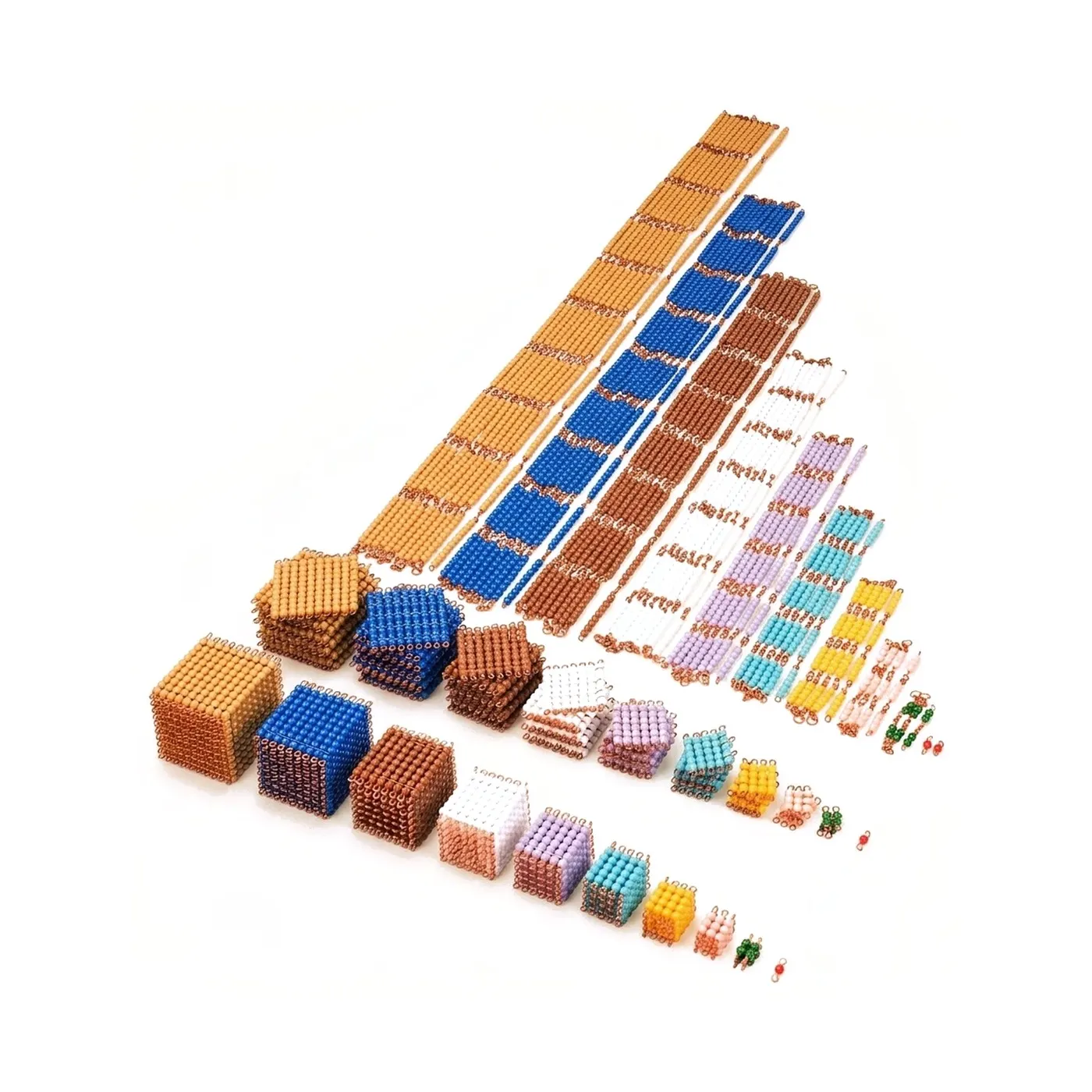 Individual Nylon Beads €1,223.90
Advice, warranty and returns are handled by us.
Why it costs €6.10
Behind the price of the original are things you can check yourself.
AMI approval
The material is approved by the Association Montessori Internationale (AMI). Nienhuis has made Montessori materials since 1929.
A verifiable original
The EAN 8719924005030 is on the box. It is the maker's number, not ours.
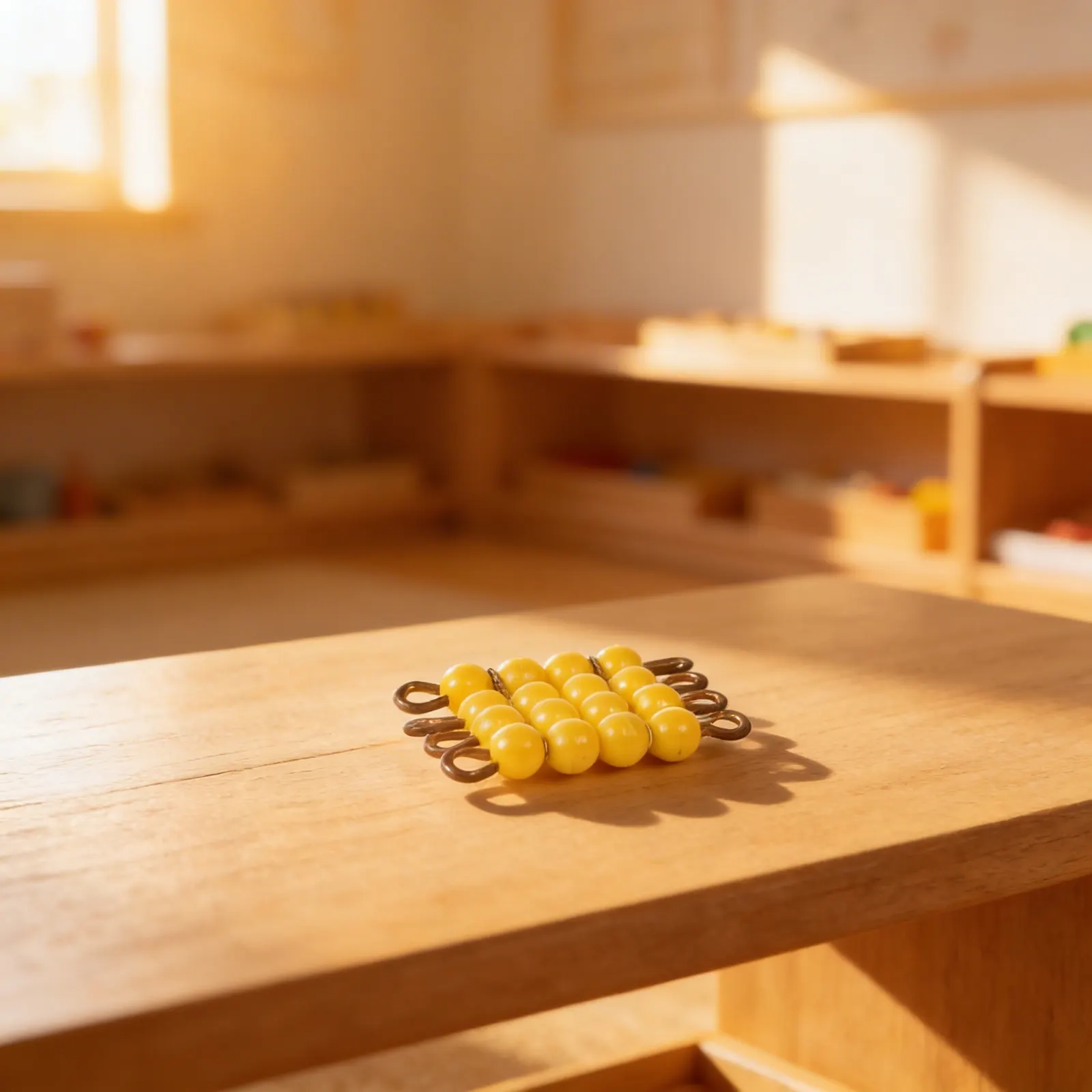
Individual Nylon Bead Square Of 4 in a child's hands
The square of four in yellow, a single nylon bead square sold on its own. Sixteen beads is the size where counting one at a time starts to feel long and counting in fours does not, which is the moment skip counting sells itself without a lesson. Nylon is the lighter range, worth choosing if the squares are going to be carried across a room by a five year old. Yellow is four throughout the bead material. The glass version is a separate item.
Mathematical Understanding
Provides concrete representation of squared numbers and helps children visualize that 4² equals 16 through tactile exploration.
Algebraic Preparation
Introduces early algebraic concepts by showing the relationship between linear and squared quantities in physical form.
Geometric Reasoning
Develops understanding of area, perimeter, and square properties through hands-on manipulation of the bead square.
Sequential Learning
Builds systematic understanding as part of the complete bead square series from 1² through 10².
How to present it
Place the yellow bead square on a neutral-colored mat. Have a tray ready with loose golden ten bars and unit beads for comparison activities.
- 1Introduce the bead square by tracing its outline with two fingers, emphasizing the square shape
- 2Count the beads by touching each one individually, moving systematically row by row
- 3Demonstrate counting by columns, showing that both methods yield sixteen
- 4Compare the bead square to four separate four-bars, showing how they create the same shape
- 5Introduce the language: 'This is four squared' while indicating the complete square
3 tips for parents
- Point out square patterns in everyday life: floor tiles, window panes, or crackers arranged in 4×4
- Use building blocks at home to create 4×4 squares, connecting to the classroom bead square
- Practice skip counting by fours during daily routines to reinforce the square's value

If you are not sure it suits your child, we answer in person.
Norbert Kovalčín, founder of Faborino · write to him
There is no review here yet. We will ask you for one after you buy. Write the first review
What's in the Box
- Bead Square of 4: 16 yellow beads in 4×4 arrangement
Size and material
| Packaging | 13 × 9 × 0 cm |
| Beads | Nylon |
| Structure | Metal wire with loops |
| Recommended Age | 3-6 years |
Care
Wipe with damp cloth, air dry completely
Frequently Asked Questions
What specific mathematical concepts does this bead square teach?
This bead square introduces squared numbers (4²=16), area concepts, multiplication facts, and serves as a foundation for algebraic thinking. Children physically experience that 4×4 equals 16 by counting and manipulating the beads.
How does this material fit into the complete Montessori bead system?
The bead square of 4 is part of the color-coded bead material hierarchy where yellow represents 4. It progresses from individual beads to bead bars, then squares, and eventually cubes, building a concrete understanding of powers and dimensions.
What activities can children do with this single bead square?
Children can trace the square's outline, count beads individually or by rows, compare it to linear bead bars of 4, use it in skip counting exercises, and incorporate it into multiplication and area lessons with other bead materials.
Why is the square made of nylon beads instead of glass?
Nylon beads offer durability for frequent classroom use, are lighter for small hands to manipulate, safer than glass alternatives, and maintain the traditional Montessori color-coding while being more affordable and practical for everyday learning.
At what point in the Montessori sequence should this material be introduced?
This material is typically introduced after children master linear counting with bead bars and understand the concept of 4. It bridges the gap between concrete counting and abstract multiplication, usually around ages 4-5 when children show readiness for squared number concepts.
Product safety
Manufacturer: Nienhuis Montessori, Anders Celsiusstraat 15, 7442 PB Nijverdal, Netherlands
Individual Nylon Bead Square Of 4