
Individual Nylon Bead Square Of 5Light Blue
The first photo is the maker's own. The other shots are illustrative.
Inv. no. NIE-0086M025
- Maker
- Nienhuis Montessori, since 1929
- Approval
- AMI
- Beads
- High-quality nylon
- Structure
- Metal wire with loop ends
- EAN
- 8719924005047
Final price incl. VAT. Delivery €5.90, €141.40 to go for free delivery.
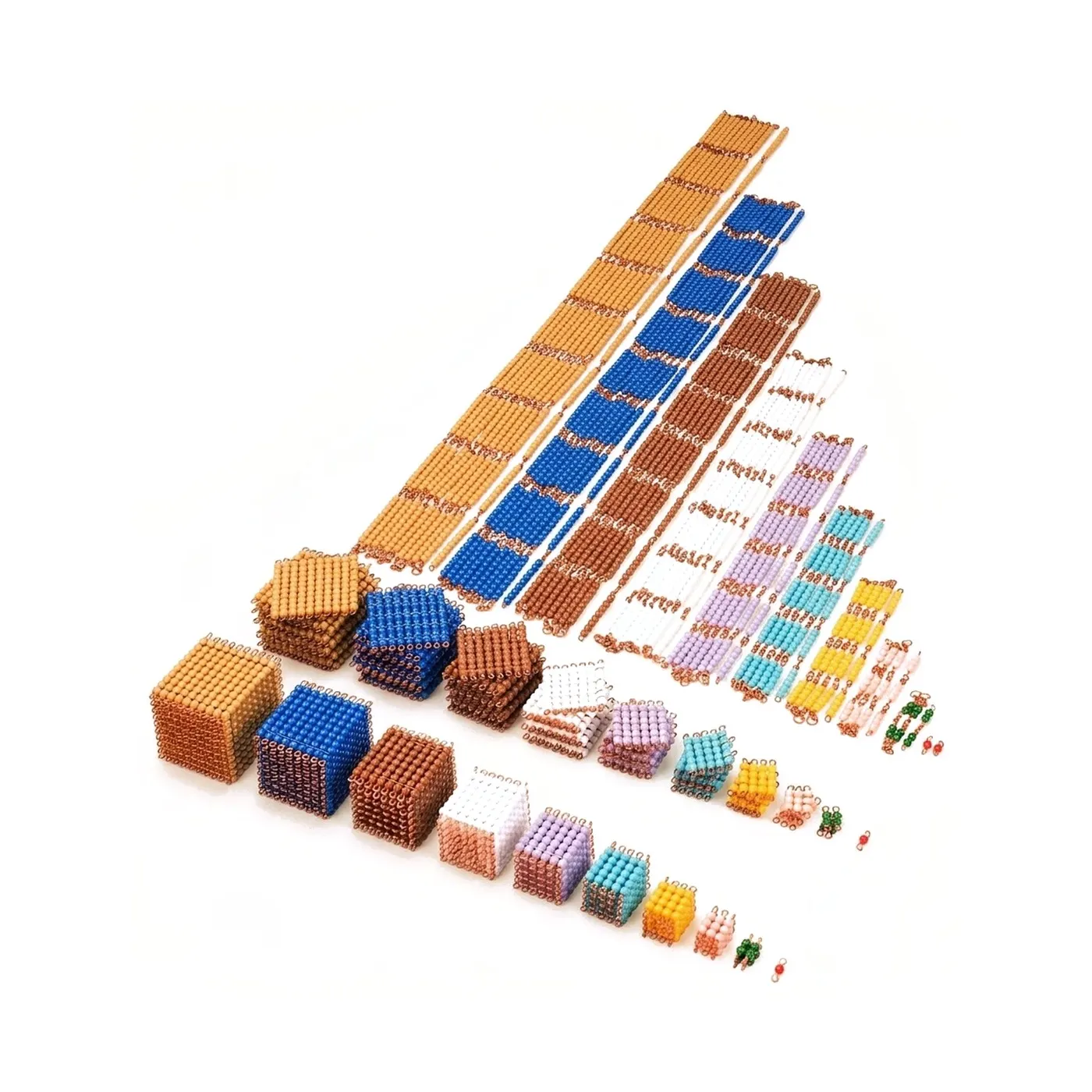 Individual Nylon Beads €1,223.90
Advice, warranty and returns are handled by us.
Why it costs €7.60
Behind the price of the original are things you can check yourself.
AMI approval
The material is approved by the Association Montessori Internationale (AMI). Nienhuis has made Montessori materials since 1929.
A verifiable original
The EAN 8719924005047 is on the box. It is the maker's number, not ours.
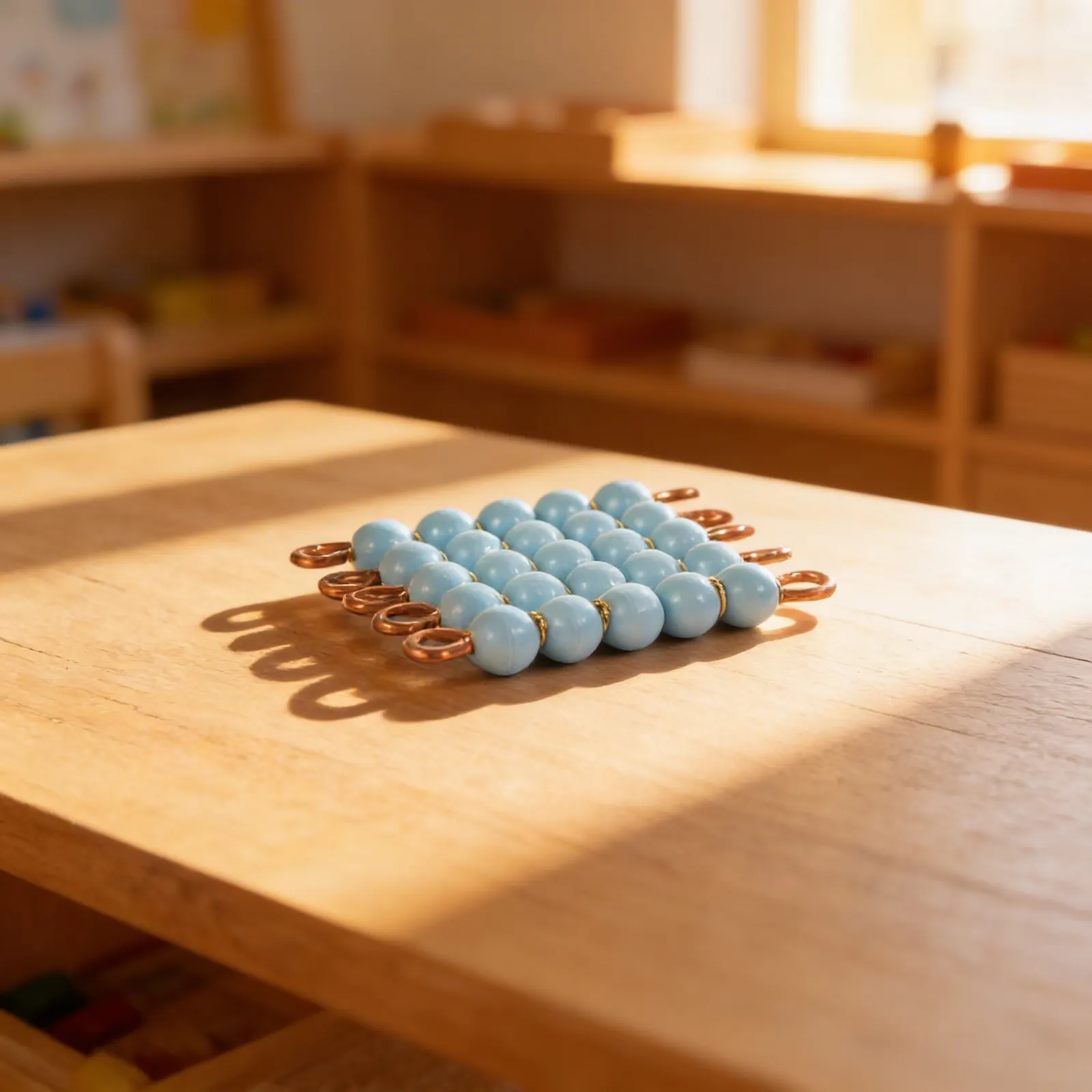
Individual Nylon Bead Square Of 5 in a child's hands
The square of five in light blue, a single nylon bead square sold on its own. Twenty five beads, and five is the number that pays off later: four squares of five lay out exactly one hundred, which a child can discover on the table long before anyone writes it down. Nylon rather than glass, so it is the lighter and quieter of the two ranges, and the one a classroom usually buys in quantity. The glass version and the cube of five are separate items.
Mathematical Understanding
Provides concrete representation of 5² = 25, supporting the transition from linear counting to understanding squared numbers.
Visual-Spatial Skills
The square formation helps children visualize geometric relationships and understand area concepts through tactile exploration.
Sequential Learning
Bridges the gap between counting individual beads and comprehending more complex mathematical operations.
Pattern Recognition
Supports understanding of mathematical patterns through the visual and tactile experience of squared number relationships.
How to present it
Place the light blue bead square on a work mat alongside the corresponding bead chain of 5. Have numeral cards 5 and 25 ready.
- 1Invite the child to count each bead in the square by touching them one at a time
- 2Count the beads by rows: 'One row of 5, two rows of 5...' up to five rows
- 3Fold the bead chain of 5 to show how it relates to the square formation
- 4Place the numeral card 25 next to the square and 5 at the corner
- 5Compare with other bead squares if available to see the pattern of growth
3 tips for parents
- At home, create paper squares with 25 stickers or stamps arranged in 5 rows of 5
- Practice skip counting by 5s during everyday activities like setting the table
- Point out square arrangements in daily life: floor tiles, window panes, or game boards

If you are not sure it suits your child, we answer in person.
Norbert Kovalčín, founder of Faborino · write to him
There is no review here yet. We will ask you for one after you buy. Write the first review
What's in the Box
- Bead Square of 5: 25 light blue beads in 5×5 formation
Size and material
| Packaging | 13 × 9 × 1 cm |
| Beads | High-quality nylon |
| Structure | Metal wire with loop ends |
| Recommended Age | 3-6 years |
Care
Wipe with damp cloth, air dry completely
Frequently Asked Questions
What is the purpose of this light blue bead square in Montessori mathematics?
This 5×5 bead square visually represents 25 (5²) and helps children understand the concept of squaring numbers through hands-on manipulation. It's used alongside bead chains to demonstrate the relationship between linear counting and squared numbers.
How does this bead square fit into the complete bead chain cabinet work?
This light blue square is part of the bead chain system where it marks the end of the 5-chain and represents 5². Children use it to see that counting five groups of five equals 25, making abstract mathematical concepts concrete and tangible.
What age is appropriate for introducing this bead square material?
Children typically begin working with bead squares around age 4-5, after they've mastered linear counting with bead chains. The material remains useful through age 6 as children explore skip counting, squaring, and early multiplication concepts.
Why are the beads light blue and what does this color represent?
In the Montessori color-coding system, light blue consistently represents the number 5. This color coordination helps children recognize patterns across different materials and reinforces number recognition through visual association.
Can this bead square be used independently or does it require other materials?
While it can be used for independent counting practice, this bead square is most effective when used with the complete bead chain materials, including the 5-chain, number arrows, and other squares and cubes from the bead cabinet system.
Product safety
Manufacturer: Nienhuis Montessori, Anders Celsiusstraat 15, 7442 PB Nijverdal, Netherlands
Individual Nylon Bead Square Of 5