
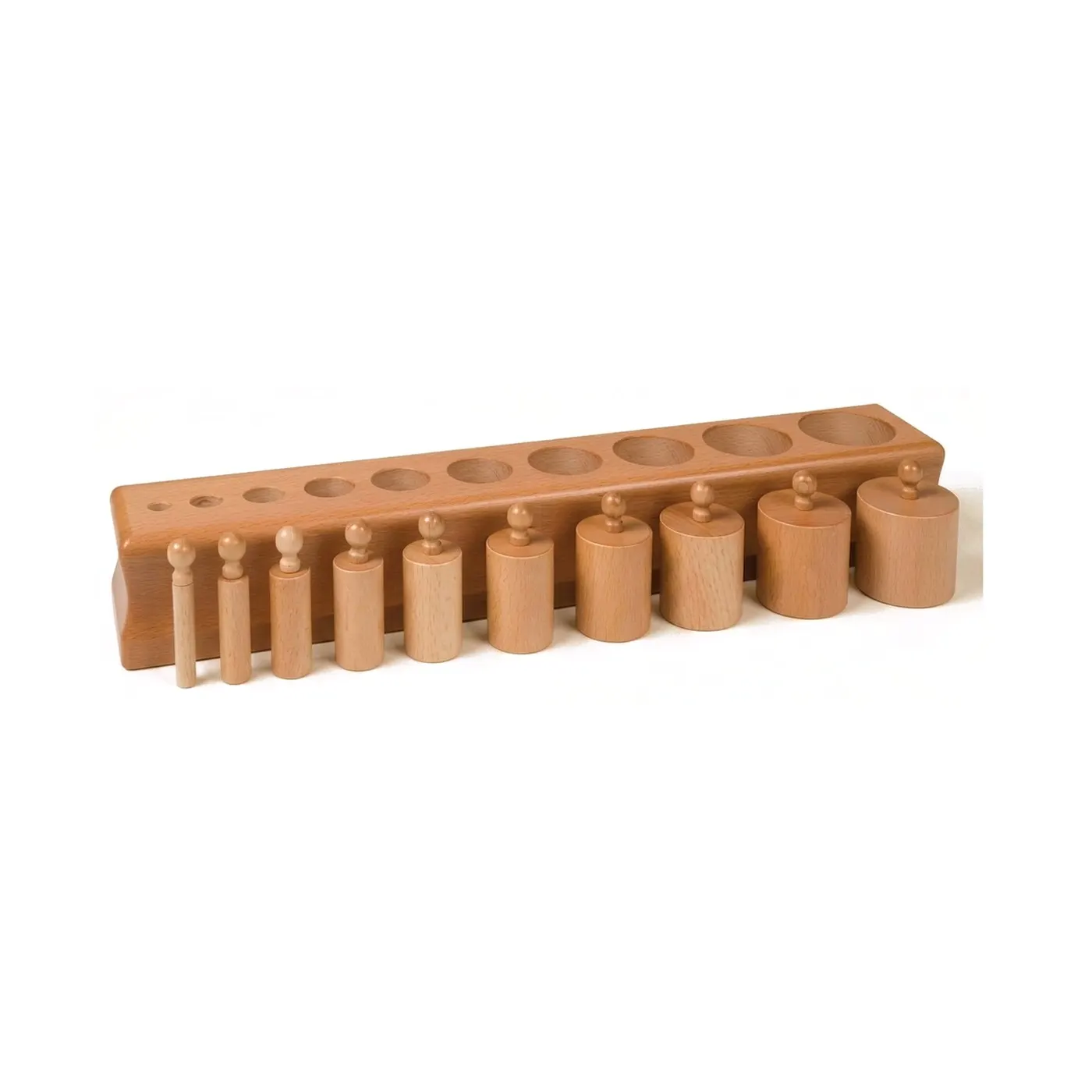
Knob For CylindersThin (1)
The first photo is the maker's own. The other shots are illustrative.
Inv. no. NIE-00200011
- Maker
- Nienhuis Montessori, since 1929
- Primary Material
- Solid wood
- Finish
- Smooth, natural
- EAN
- 8719924000554
Final price incl. VAT. Delivery €5.90, €146.10 to go for free delivery.
Advice, warranty and returns are handled by us.

Knob For Cylinders in a child's hands
One thin knob for the cylinder blocks, sold as a single piece. The thin knob asks for a finer grip than the thick one, which is the whole difference: the same three fingers, closer together, holding less. A block fitted with the wrong knob still works as a puzzle and stops working as preparation for a pencil, so match the knob to the block rather than to what is in the drawer. The cylinder blocks are separate items.
Fine Motor Development
The thin profile specifically develops pincer grip strength and precision required for writing preparation.
Sensorial Refinement
Smooth wooden texture provides tactile feedback while maintaining focus on dimensional discrimination.
Practical Life Skills
Replacing and maintaining materials teaches care of the environment and responsibility.
How to present it
Ensure the replacement knob is clean and smooth. Remove any damaged knob from the cylinder using appropriate tools. Apply wood-safe adhesive to the cylinder top and carefully attach the new knob, ensuring perfect alignment.
- 1Test the knob's security by gently pulling upward before classroom use
- 2Demonstrate the proper pincer grip using thumb and index finger on the knob
- 3Guide initial attempts at lifting cylinders with the new knob
- 4Observe as children work independently with the restored cylinder block
3 tips for parents
- Notice how your child's pencil grip improves after working with thin-knobbed cylinders at school
- Provide similar pincer grip practice at home with activities like picking up small beans with tweezers
- Observe your child's increasing patience with delicate tasks requiring fine motor control

If you are not sure it suits your child, we answer in person.
Norbert Kovalčín, founder of Faborino · write to him
There is no review here yet. We will ask you for one after you buy. Write the first review
What's in the Box
- Thin Cylinder Knob: Single replacement knob
Size and material
| Packaging | 14 × 11 × 1 cm |
| Primary Material | Solid wood |
| Finish | Smooth, natural |
| Recommended Age | 3-6 years |
Care
Wipe with slightly damp cloth, dry immediately
Frequently Asked Questions
What specific cylinder block is this thin knob designed for?
This thin knob is designed specifically for Block 1 of the Montessori cylinder blocks, which contains cylinders that vary in diameter while maintaining the same height. The thin profile matches the smallest cylinders in this set.
How do I know if this is the correct replacement knob for my cylinder?
Measure the diameter of your cylinder's hole - the thin knob is designed for the smallest diameter cylinders (typically around 1cm). If your cylinder is from the set where all cylinders have the same height but different widths, this is likely the correct knob.
What type of wood is used and is it safe for children?
The knob is crafted from smooth, high-quality hardwood with non-toxic finishes that meet safety standards for children ages 3-6. The surface is sanded to prevent splinters while maintaining the natural wood texture important for sensorial development.
Can this knob be used for other Montessori materials besides cylinder blocks?
While specifically designed for cylinder blocks, this knob can be used as a replacement for any Montessori material requiring a thin knob with similar dimensions. However, it's optimized for the precise measurements of the sensorial cylinder work.
How does the thin knob design support pincer grip development?
The thin profile requires children to use a refined pincer grip between thumb and forefinger, preparing the hand muscles for writing. The spherical head provides just enough surface area for secure grasping while challenging fine motor control.
Product safety
Manufacturer: Nienhuis Montessori, Anders Celsiusstraat 15, 7442 PB Nijverdal, Netherlands
Knob For Cylinders