
Partes De La Fruta (Spanish Edition)
The first photo is the maker's own. The other shots are illustrative.
Inv. no. NIE-ECSP0466
- Maker
- Nienhuis Montessori, since 1929
- Card Material
- Laminated cardstock
- Finish
- Protective laminate coating
- EAN
- 8719924043599
Final price incl. VAT.
This material is no longer made
The manufacturer has withdrawn it, so we cannot order it in. The page stays here because the material itself is still worth knowing about.
Available instead
Parts Of A Fruit
Would you buy it if we could source it or make it ourselves? Enough people saying yes is what makes the attempt worth it.
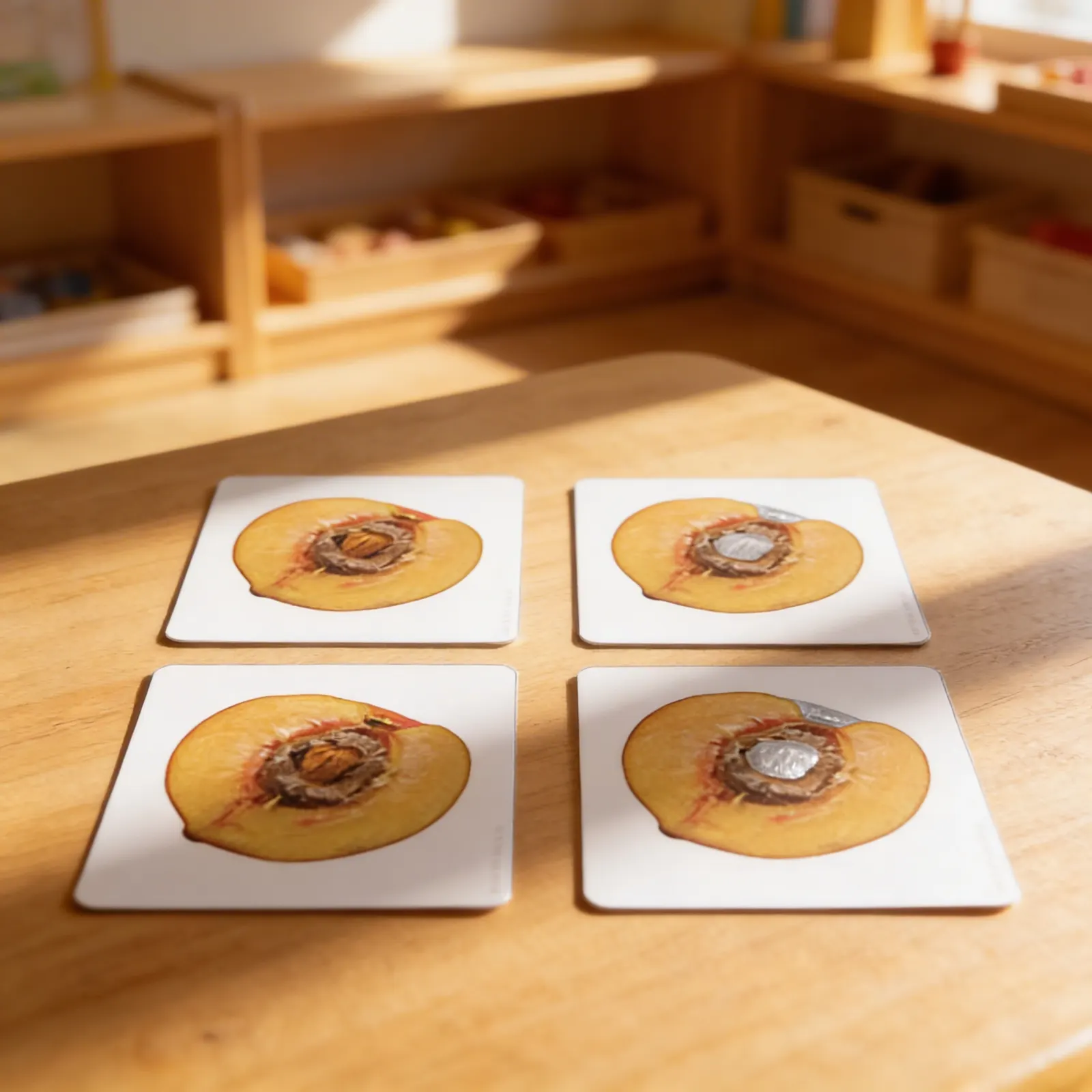
Partes De La Fruta (Spanish Edition) in a child's hands
Fitting for ages 3-6, these Spanish language nomenclature cards explore the inner anatomy of stone fruits through detailed cross-section illustrations. Each laminated card presents clear photographic images paired with precise Spanish vocabulary labels, supporting both language development and botanical classification work. The durable cardstock construction ensures repeated handling during matching activities and three-part card exercises.
Spanish Language Development
Builds botanical vocabulary through visual association with precise Spanish terminology.
Scientific Classification
Introduces fruit anatomy and stone fruit characteristics through detailed cross-section study.
Visual Discrimination
Develops observation skills by comparing internal fruit structures and identifying distinguishing features.
Cultural Studies
Supports Spanish language immersion and multicultural curriculum integration.
How to present it
Place control cards showing complete fruit cross-sections in a row. Stack matching picture cards and label cards in separate piles to the left.
- 1Child examines control card showing labeled fruit cross-section
- 2Match unlabeled picture cards to control cards
- 3Read Spanish labels aloud and place under corresponding pictures
- 4Remove control cards and work with pictures and labels only
3 tips for parents
- Practice Spanish fruit vocabulary during grocery shopping
- Cut real fruits to match card illustrations at snack time
- Create a fruit anatomy book together using photographs

If you are not sure it suits your child, we answer in person.
Norbert Kovalčín, founder of Faborino · write to him
There is no review here yet. We will ask you for one after you buy. Write the first review
What's in the Box
- Nomenclature Cards: Approx. 6 pairs showing fruit cross-sections
- Spanish Labels: Anatomical vocabulary for each fruit part
Size and material
| Packaging | 15 × 15 × 1 cm |
| Card Material | Laminated cardstock |
| Finish | Protective laminate coating |
| Recommended Age | 3-6 years |
Care
Wipe with damp cloth, dry immediately
Frequently Asked Questions
What fruits are included in this nomenclature card set?
This set focuses on stone fruits and their cross-section anatomy, featuring detailed photographic images that show the inner structure including the pit, flesh, and skin. Each fruit is presented with clear Spanish vocabulary labels for each anatomical part.
How can these cards be used for three-part card activities?
The cards can be separated into three components: picture cards, label cards, and control cards (picture with label). Children match the loose labels to the pictures, then use the control cards to check their work, supporting independent learning and Spanish vocabulary development.
Are the cards suitable for children who don't speak Spanish?
Yes, these cards are excellent for introducing Spanish vocabulary to non-native speakers. The clear photographic images provide visual context that helps children understand the meaning of each Spanish term, making them ideal for bilingual education or foreign language introduction.
What is the recommended age range and why?
These cards are designed for ages 3-6, aligning with the sensitive period for language development and classification work. The simple, clear images and vocabulary are accessible to younger children, while older children can engage in more complex sorting and categorization activities.
How durable are these nomenclature cards for classroom use?
The cards are made from laminated cardstock, specifically designed to withstand repeated handling by young children. This durable construction ensures they maintain their quality through daily classroom use, matching activities, and storage.
Product safety
Manufacturer: Nienhuis Montessori, Anders Celsiusstraat 15, 7442 PB Nijverdal, Netherlands
Partes De La Fruta (Spanish Edition)