
Partes De La Mariposa (Spanish Edition)
The first photo is the maker's own. The other shots are illustrative.
Inv. no. NIE-ECSP0451
- Maker
- Nienhuis Montessori, since 1929
- Card Material
- Premium cardstock
- Finish
- Protective laminate coating
- EAN
- 8719924043476
Final price incl. VAT.
This material is no longer made
The manufacturer has withdrawn it, so we cannot order it in. The page stays here because the material itself is still worth knowing about.
Available instead
Parts Of A Butterfly (Insects)
Would you buy it if we could source it or make it ourselves? Enough people saying yes is what makes the attempt worth it.
Partes De La Mariposa (Spanish Edition) in a child's hands
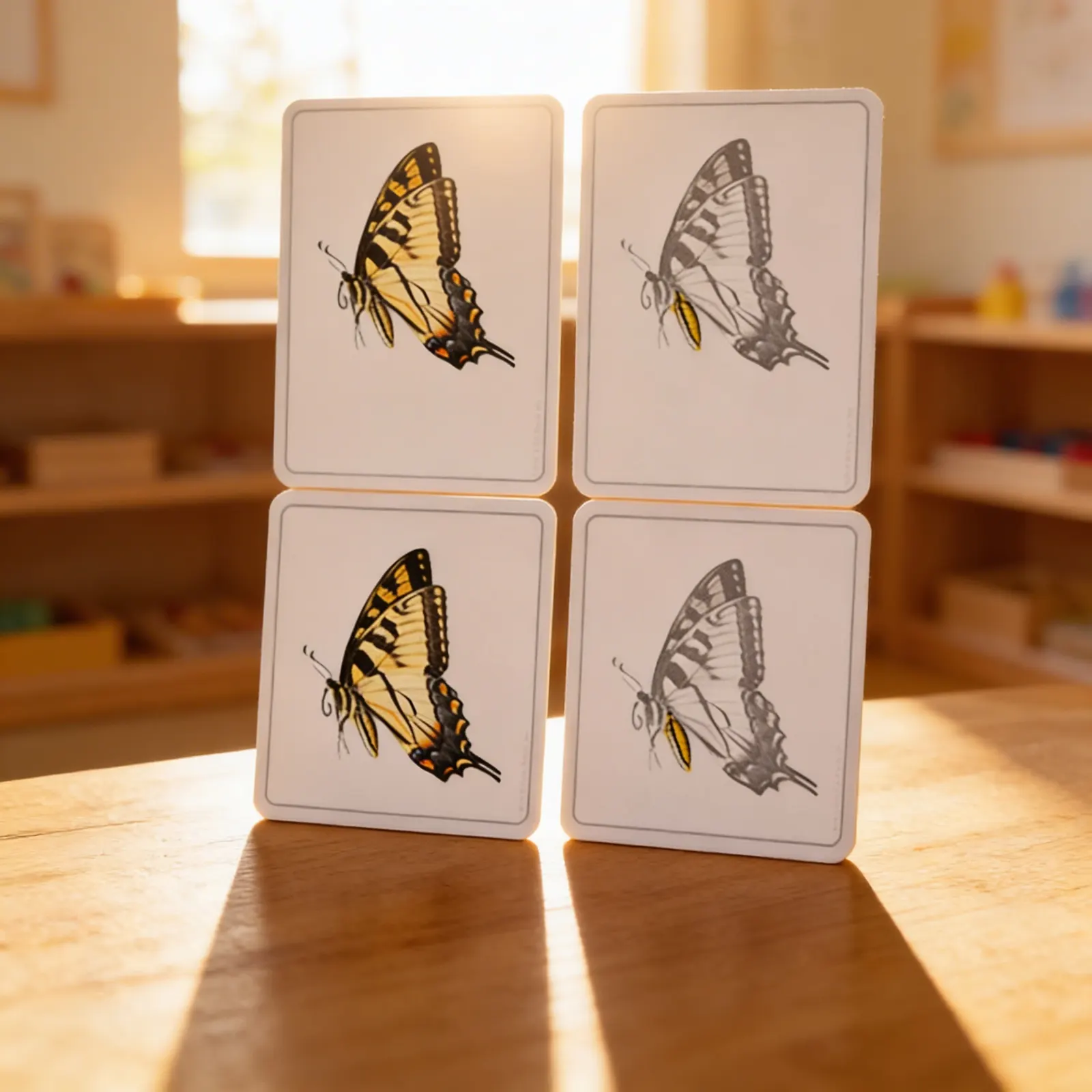
Partes De La Mariposa, the parts of a butterfly in Spanish. The three body parts of an insect are the same in any language and the words for them are not, which is the whole reason a Spanish edition exists: a room where the naming happens in Spanish needs the labels in Spanish or the control chart stops controlling anything. Real photograph, control chart and labels. The cards are in Spanish. Card stock, full colour.
Language Development
Builds Spanish vocabulary through scientific nomenclature, supporting bilingual language acquisition and precise terminology.
Visual Discrimination
Matching colored to grayscale images refines visual perception and attention to detail.
Scientific Classification
Introduces zoological concepts and anatomical vocabulary, laying groundwork for natural science studies.
Reading Preparation
Label matching activities support early reading skills and symbol-to-meaning connections in Spanish.
How to present it
Place the colored control cards in a row across the work mat. Stack the matching grayscale cards and labels separately in small baskets.
- 1Introduce each colored butterfly part card, pronouncing the Spanish name clearly: 'antenas', 'cabeza', 'tórax'
- 2Invite the child to match each grayscale image to its colored counterpart
- 3Once images are matched, introduce the Spanish label cards for reading children
- 4Child places each label below its corresponding image pair
3 tips for parents
- Practice Spanish butterfly vocabulary during nature walks, pointing out 'las alas' when you see butterflies
- Create a butterfly observation journal where your child can sketch and label parts in Spanish
- Visit Spanish-language nature websites together to hear native pronunciation of scientific terms

If you are not sure it suits your child, we answer in person.
Norbert Kovalčín, founder of Faborino · write to him
There is no review here yet. We will ask you for one after you buy. Write the first review
What's in the Box
- Control Cards: Complete butterfly images with labels
- Picture Cards: Isolated butterfly images
- Label Cards: Spanish nomenclature labels
Size and material
| Packaging | 15 × 15 × 1 cm |
| Card Material | Premium cardstock |
| Finish | Protective laminate coating |
| Recommended Age | 3-6 years |
Care
Wipe with slightly damp cloth, dry immediately
Frequently Asked Questions
What butterfly anatomy parts are included in this Spanish language material?
The cards feature essential butterfly parts including las alas (wings), las antenas (antennae), el tórax (thorax), el abdomen (abdomen), las patas (legs), and la probóscide (proboscis). Each part is presented with both colored and grayscale images for comprehensive learning.
How does the three-part card format support language development?
The material includes picture cards, label cards, and control cards that children can match independently. This format allows for multiple learning stages: picture-to-picture matching, label reading, and self-correction using the control cards, supporting both Spanish vocabulary acquisition and reading readiness.
What makes the laminated cardstock format suitable for classroom use?
The durable laminated finish protects against daily handling, spills, and repeated use by multiple children. The cardstock provides appropriate thickness for small hands to manipulate easily while maintaining shape and color quality over years of classroom use.
How do these cards integrate with other Montessori zoology materials?
These butterfly cards complement other invertebrate studies and can be used alongside insect puzzles, life cycle materials, and classification work. They support the systematic study of living things while introducing Spanish scientific vocabulary in the cultural curriculum.
Can non-Spanish speaking teachers effectively present this material?
Yes, the visual nature and clear labeling make presentation accessible to all teachers. The control cards provide built-in language support, and teachers can prepare by learning the key vocabulary. This material also supports dual-language environments and cultural appreciation.
Product safety
Manufacturer: Nienhuis Montessori, Anders Celsiusstraat 15, 7442 PB Nijverdal, Netherlands
Partes De La Mariposa (Spanish Edition)