
Parts of the FlowerBotany Cards (Spanish Edition)
The first photo is the maker's own. The other shots are illustrative.
Inv. no. NIE-ECSP0463
- Maker
- Nienhuis Montessori, since 1929
- Card Material
- Laminated cardstock
- Finish
- Protective laminate coating
- EAN
- 8719924043582
Final price incl. VAT.
This material is no longer made
The manufacturer has withdrawn it, so we cannot order it in. The page stays here because the material itself is still worth knowing about.
Available instead
Parts Of A Flower
Would you buy it if we could source it or make it ourselves? Enough people saying yes is what makes the attempt worth it.
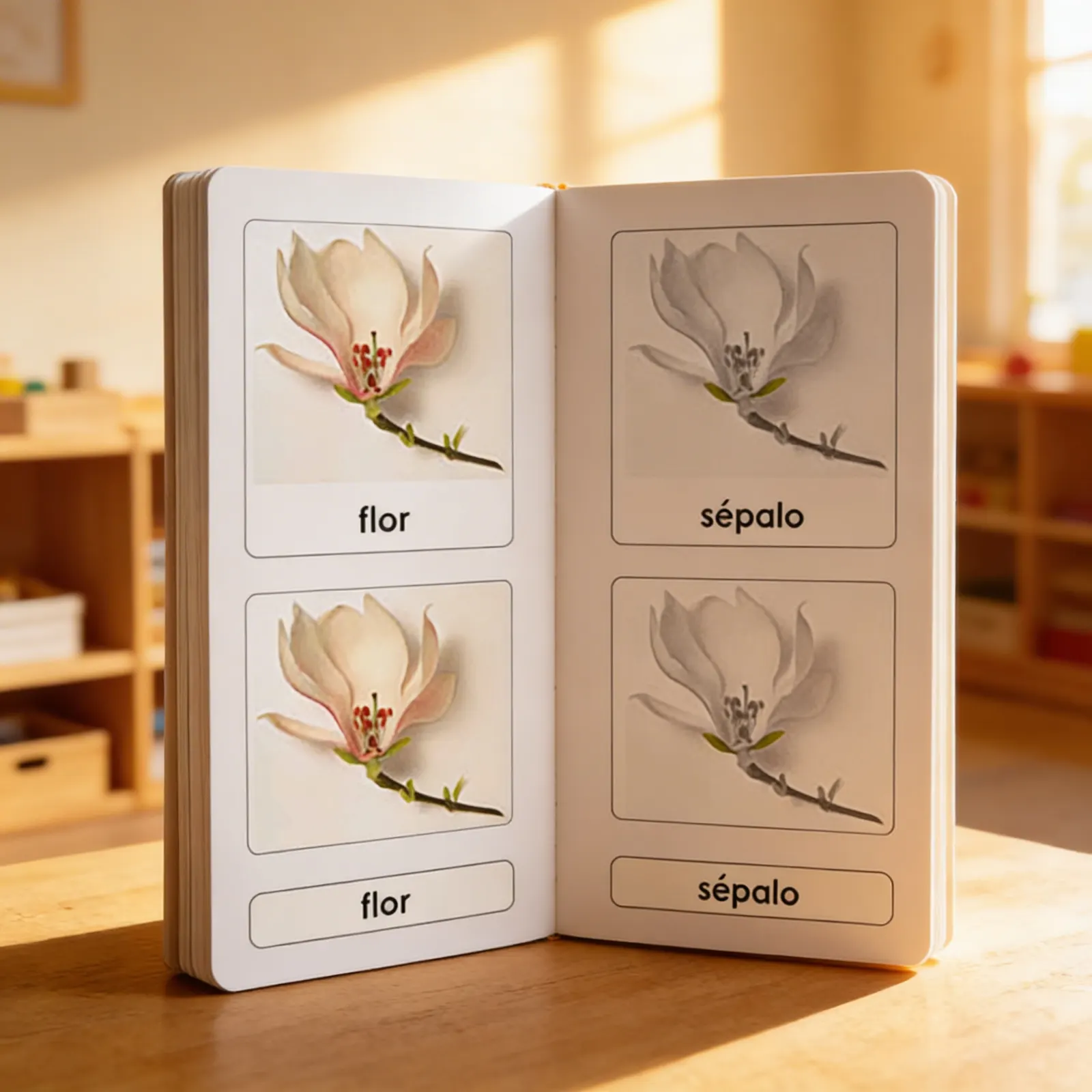
Parts of the Flower in a child's hands
Connecting children to the living world, these Spanish-language botanical cards introduce children to the fundamental parts of flowers through clear, detailed illustrations and precise vocabulary. Designed for the Montessori language and botany curriculum, each card pairs a botanical illustration with its corresponding Spanish label, supporting both scientific understanding and language development in the Casa dei Bambini environment.
Language Enrichment
Builds Spanish botanical vocabulary through visual association and repetition.
Scientific Understanding
Introduces basic plant anatomy concepts appropriate for the sensitive period for order and classification.
Visual Discrimination
Develops observation skills through detailed botanical illustrations and matching activities.
Cultural Studies
Supports Spanish language learning and connects children to nature through scientific exploration.
How to present it
Arrange the picture cards in a column on the left side of the work mat. Place the corresponding label cards in a basket. Have a complete flower specimen available for reference if possible.
- 1Present one picture card, naming the flower part clearly in Spanish: 'Este es el pétalo'
- 2Select the matching label card and place it below the picture, reading it aloud
- 3Continue matching all picture cards with their labels, inviting the child to participate
- 4Once all matches are complete, review by pointing to each part and having the child name it
3 tips for parents
- Look for flowers during walks and practice naming parts in Spanish: '¿Dónde está el tallo?'
- Create a flower journal where your child can press real petals and label them using vocabulary from the cards
- Visit botanical gardens and practice identifying flower parts in living specimens

If you are not sure it suits your child, we answer in person.
Norbert Kovalčín, founder of Faborino · write to him
There is no review here yet. We will ask you for one after you buy. Write the first review
What's in the Box
- Botanical Cards: Approx. 6 laminated cards with flower part illustrations and Spanish labels
Size and material
| Packaging | 15 × 15 × 1 cm |
| Card Material | Laminated cardstock |
| Finish | Protective laminate coating |
| Recommended Age | 3-6 years |
Care
Wipe with slightly damp cloth, dry immediately
Frequently Asked Questions
What age is appropriate for these Spanish flower parts cards?
These cards are designed for ages 3-6, aligning with the Casa dei Bambini environment. Children typically begin with matching activities around age 3, progressing to reading labels and learning botanical vocabulary as their Spanish language skills develop.
How many cards are included and what flower parts do they cover?
The set includes cards featuring the essential parts of a flower: pétalo (petal), estambre (stamen), pistilo (pistil), sépalo (sepal), tallo (stem), and hoja (leaf). Each part is clearly illustrated with its corresponding Spanish label.
Can these cards be used by non-Spanish speaking children?
Yes, these cards serve dual purposes - they can introduce Spanish vocabulary to any child while teaching botany concepts. The clear illustrations make them accessible for language learning, and they're excellent for bilingual environments or Spanish immersion programs.
How do these cards support the Montessori botany curriculum?
These cards follow Montessori principles by isolating concepts, using realistic illustrations, and providing concrete vocabulary. They complement hands-on flower dissection activities and support the progression from concrete to abstract learning in botanical studies.
What activities can children do with these botanical cards?
Children can use these for three-part card lessons, matching exercises, vocabulary building, and as reference materials during flower dissection. They also support drawing activities, Spanish reading practice, and can be combined with real flowers for nature study.
Product safety
Manufacturer: Nienhuis Montessori, Anders Celsiusstraat 15, 7442 PB Nijverdal, Netherlands
Parts of the Flower