
Pegs For The Algebraic Peg BoardBlue (10)
The first photo is the maker's own. The other shots are illustrative.
Inv. no. NIE-01360006
- Maker
- Nienhuis Montessori, since 1929
- Construction
- Injection-molded plastic
- Finish
- Smooth, glossy surface
- EAN
- 8719924007324
Final price incl. VAT. Delivery €5.90, €141.90 to go for free delivery.
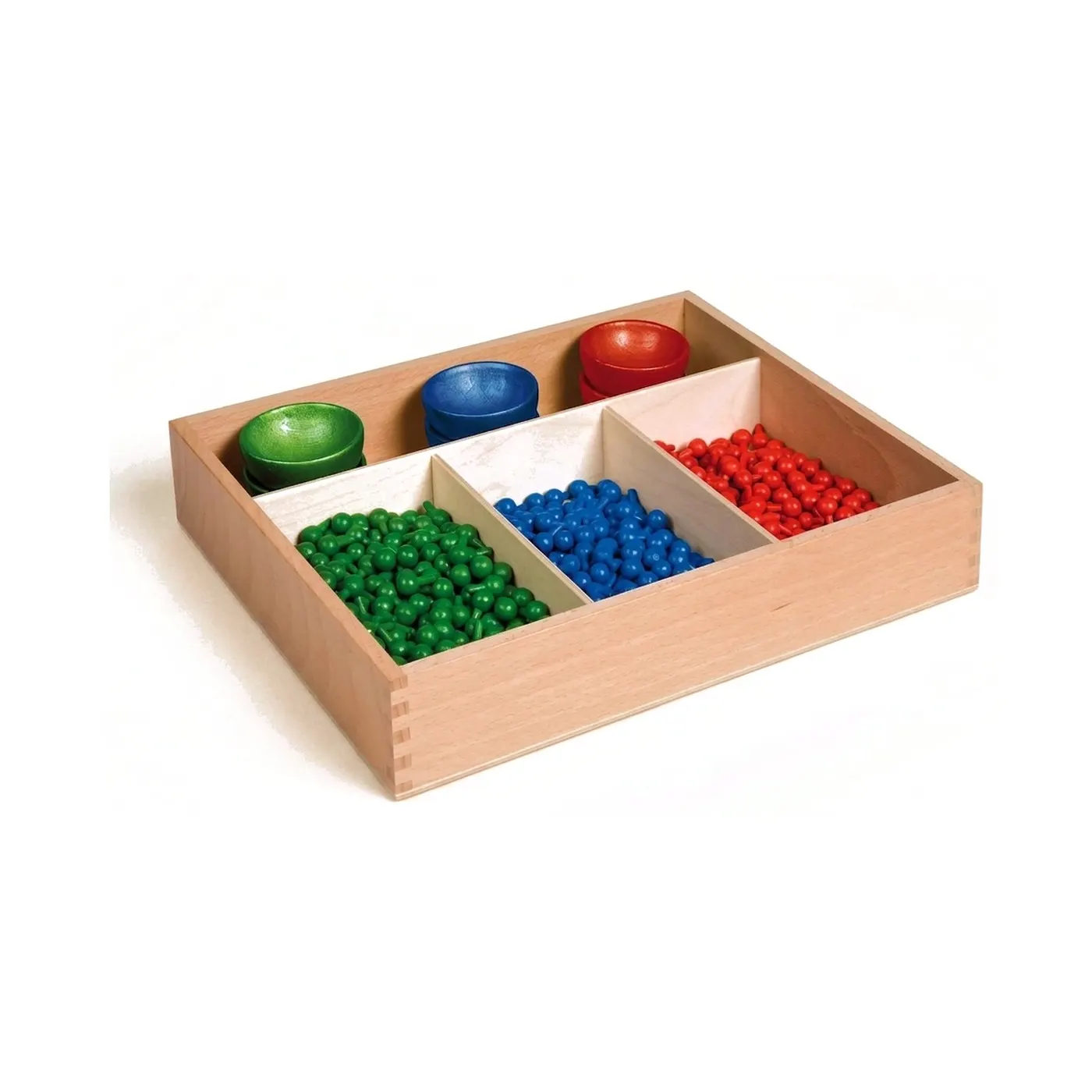 Pegs For The Algebraic Peg Board €169.90
Advice, warranty and returns are handled by us.
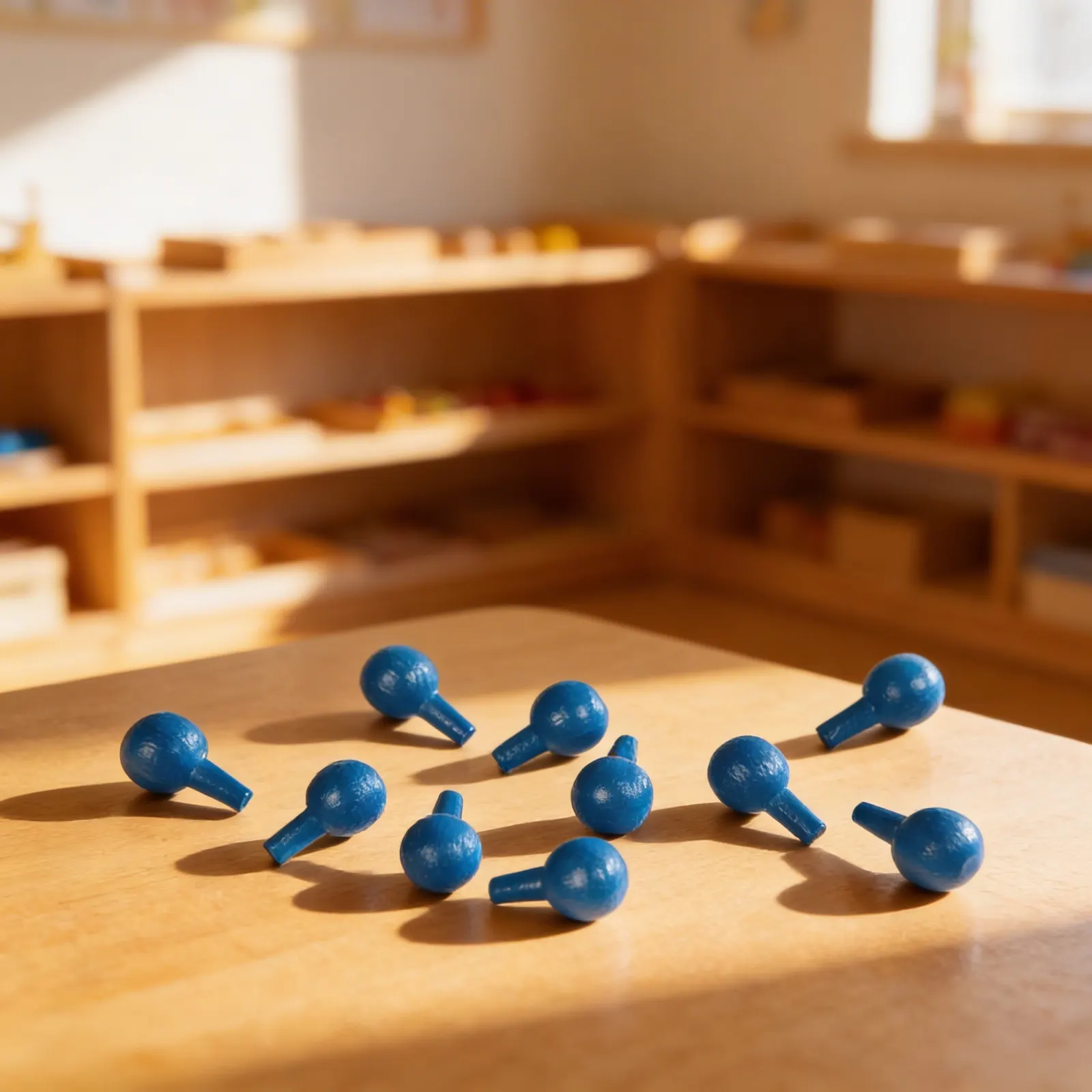
Pegs For The Algebraic Peg Board in a child's hands
Ten blue pegs for the algebraic peg board, sold as a pack. Blue is the tens, and on the peg board the tens are where the work gets interesting: a square built from tens covers a hundred times the area of one built from units, and the child sees that before being told, because the pegs occupy the board. Running out of one colour stops a build halfway, which is why ten at a time is the sensible unit. The board and the other colours are separate items.
Mathematical Visualization
Transforms abstract algebraic concepts into concrete, manipulable objects that children can arrange and rearrange to discover patterns.
Fine Motor Precision
The spherical heads require careful pincer grasp control, strengthening the muscles needed for writing while engaging in mathematical work.
Pattern Recognition
Creating visual arrays with colored pegs develops the ability to identify and extend mathematical patterns essential for algebraic thinking.
Concentration Development
The precise placement of pegs in specific arrangements builds sustained focus and attention to detail through purposeful mathematical activity.
How to present it
Place the Algebraic Peg Board on a work mat. Present the ten blue pegs in a small basket or tray beside the board. Ensure adequate lighting and space for the child to work comfortably.
- 1Demonstrate grasping one blue peg between thumb and index finger at the spherical head
- 2Place the peg into a hole on the board with a gentle pressing motion
- 3Create a simple pattern using five blue pegs in a row
- 4Invite the child to create their own pattern with the remaining five pegs
- 5Together, count all ten pegs on the board
3 tips for parents
- Practice counting to ten using the blue pegs during home activities
- Create simple patterns together and describe what you see
- Let your child teach you a pattern they created at school

If you are not sure it suits your child, we answer in person.
Norbert Kovalčín, founder of Faborino · write to him
There is no review here yet. We will ask you for one after you buy. Write the first review
What's in the Box
- Blue Pegs: 10 pieces
Size and material
| Packaging | 13 × 9 × 1 cm |
| Construction | Injection-molded plastic |
| Finish | Smooth, glossy surface |
| Recommended Age | 3-6 years |
Care
Wipe with damp cloth and mild soap
Frequently Asked Questions
Do these blue pegs come with the Algebraic Peg Board?
No, these are replacement or additional pegs sold separately. The Algebraic Peg Board must be purchased separately to use these pegs.
What size are these pegs and are they safe for 3-year-olds?
The pegs feature smooth plastic construction with spherical heads designed for easy grasping by small hands. They are appropriately sized for children ages 3-6 and meet safety standards for educational materials.
How many blue pegs come in this set?
This set includes 10 blue pegs, allowing children to create patterns and explore mathematical concepts when used with the Algebraic Peg Board.
Can these pegs be used with other peg boards?
These pegs are specifically designed as precision-molded components for the Montessori Algebraic Peg Board and may not be compatible with other peg board systems.
What mathematical concepts can children learn with these pegs?
When used with the Algebraic Peg Board, these pegs help children visualize algebraic patterns, explore relationships between quantities, develop early algebraic thinking, and understand mathematical sequences through hands-on manipulation.
Product safety
Manufacturer: Nienhuis Montessori, Anders Celsiusstraat 15, 7442 PB Nijverdal, Netherlands
Pegs For The Algebraic Peg Board