
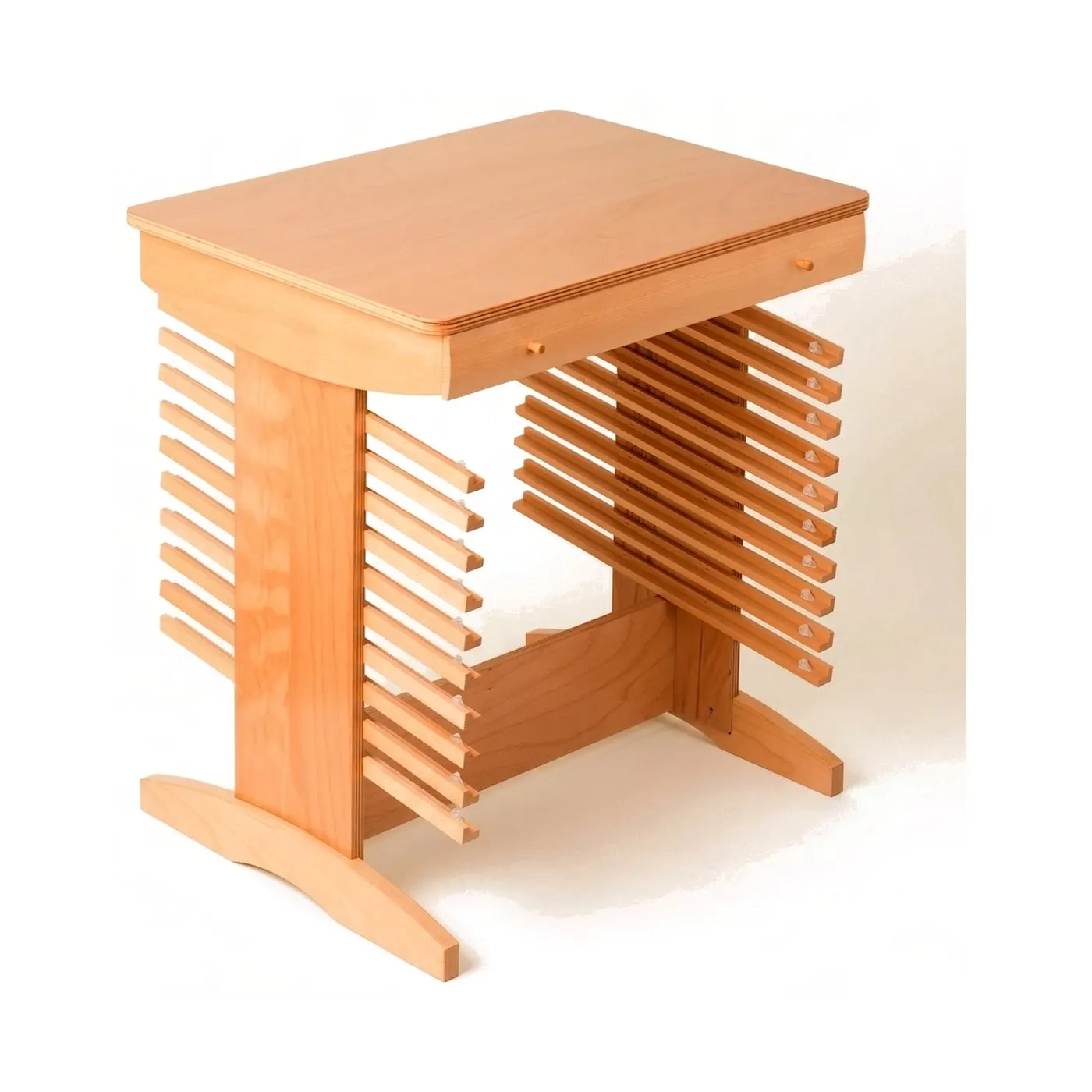
Puzzle MapAustralia
The first photo is the maker's own. The other shots are illustrative.
Inv. no. NIE-0176J0
- Maker
- Nienhuis Montessori, since 1929
- Approval
- AMI
- Construction
- Solid wood with painted finish
- Handles
- White wooden knobs
- EAN
- 8719924058456
€105.90
Final price incl. VAT. Delivery €5.90, €43.10 to go for free delivery.
✓ In Stock. Delivery in 5 to 9 working days.
1
30 daysto return
Advicebefore and after
Invoicefor companies
Advice, warranty and returns are handled by us.
The original
Why it costs €105.90
Behind the price of the original are things you can check yourself.
AMI approval
The material is approved by the Association Montessori Internationale (AMI). Nienhuis has made Montessori materials since 1929.
A verifiable original
The EAN 8719924058456 is on the box. It is the maker's number, not ours.
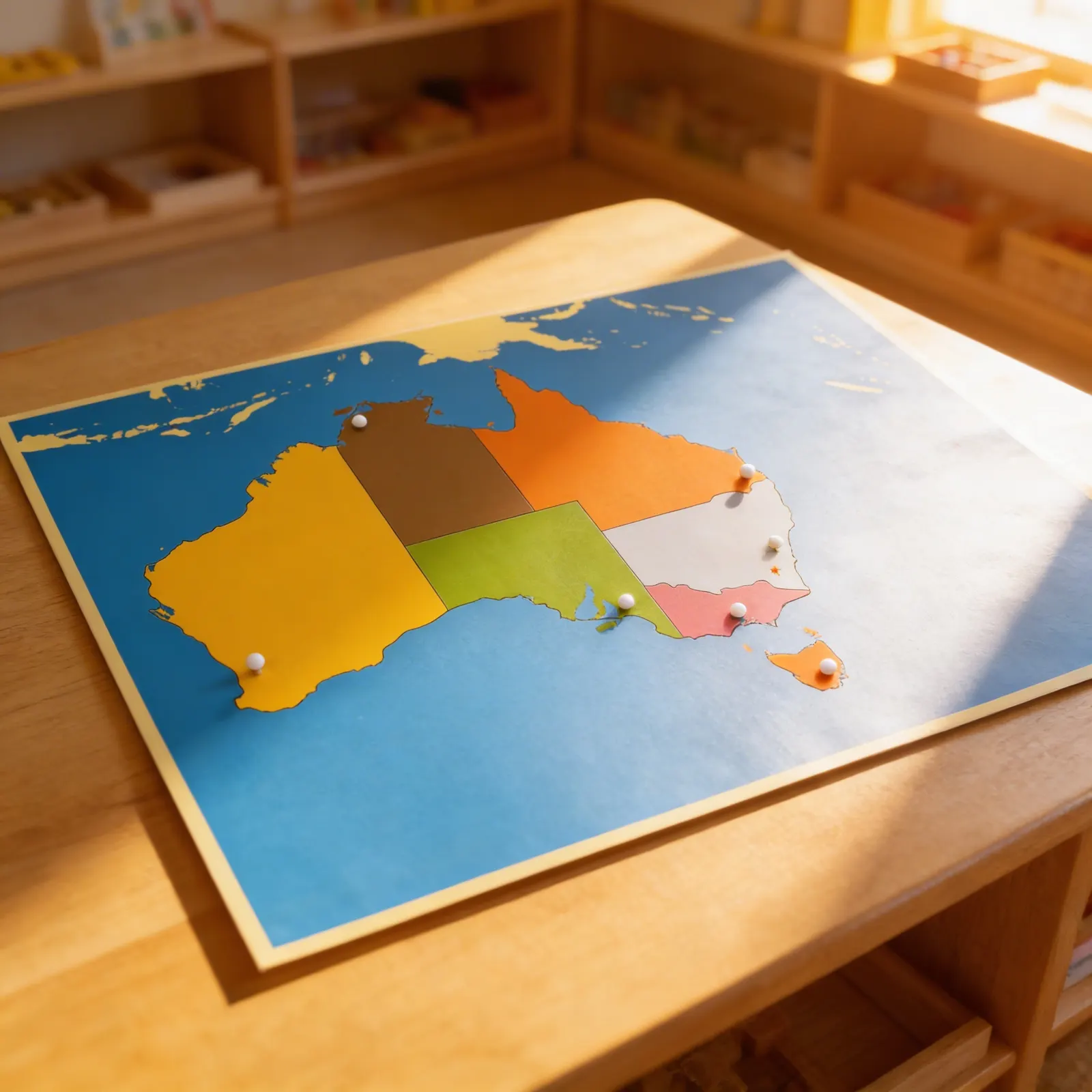
What the child does
Puzzle Map in a child's hands
Expertly crafted from natural wood, this Puzzle Map of Australia opens the door to the continent's political geography through tactile learning. Each state and territory is represented by a removable wooden piece in a distinct color, complete with a knob handle for easy manipulation. The puzzle supports the Montessori geography curriculum by providing concrete, tactile experiences that help children internalize spatial relationships and develop their understanding of Australia's regional divisions.
Geographic Awareness
Children develop understanding of Australia's political divisions and spatial relationships between states and territories.
Fine Motor Control
Grasping knobs and fitting pieces precisely refines pincer grip and hand-eye coordination.
Visual Discrimination
Distinct colors for each region help children recognize shapes and develop visual memory of geographic boundaries.
Concentration
Completing the puzzle requires sustained focus and systematic approach, building concentration skills.
Activity Guide
How to present it
Place the puzzle on a table mat at the child's workspace. Have a small basket nearby for holding removed pieces. Ensure clean, dry hands before handling the wooden pieces.
- 1Invite the child to remove pieces starting from the edges, using the knob with a three-finger grip
- 2Place removed pieces in the basket, maintaining their orientation
- 3When all pieces are removed, select one piece and trace its outline with two fingers
- 4Find the corresponding space on the board by matching the shape
- 5Gently lower the piece into place using the knob
- 6Continue until all pieces are replaced, working from edges toward center
3 tips for parents
- Support your child's work by learning state names together during casual conversation
- Point out license plates from different Australian states when you see them
- Avoid correcting mistakes immediately; allow your child time to self-discover proper placement
From the same makerNienhuis
Accessories
Why it is in our selection
If you are not sure it suits your child, we answer in person.
Norbert Kovalčín, founder of Faborino · write to him
There is no review here yet. We will ask you for one after you buy. Write the first review
Details
What's in the Box
- Wooden puzzle base: With recessed areas for each state
- 8 puzzle pieces: Representing Australian states and territories
- Knob handles: White knobs attached to each piece
Size and material
| Packaging | 50 × 63 × 3 cm |
| Construction | Solid wood with painted finish |
| Handles | White wooden knobs |
| Recommended Age | 3-6 years |
Care
Wipe with slightly damp cloth, dry immediately
Frequently Asked Questions
What specific skills does this Australian puzzle map develop?
This puzzle map develops fine motor control through knob manipulation, spatial awareness, shape recognition, and geographical understanding. Children also build concentration, problem-solving abilities, and learn to identify Australian states and territories while developing their pincer grasp.
How is this different from a regular Australia puzzle?
Unlike conventional puzzles, this Montessori puzzle map features individual knob handles on each state piece for proper grip development, uses distinct colors for each region to aid visual discrimination, and serves as both a puzzle and a teaching tool for geography lessons, supporting the concrete-to-abstract learning progression.
What activities can children do with this puzzle map?
Children can trace around pieces to create their own maps, match state pieces to control cards, learn state names and capitals, practice spatial vocabulary (north, south, east, west), and progress to labeling blank maps. The puzzle also supports three-period lessons for learning geographical terminology.
What materials and construction quality can I expect?
The puzzle features smooth, precisely-cut wooden pieces with rounded edges for safety, durable non-toxic paint in distinct colors for each state, sturdy wooden base with recessed areas for each piece, and metal knob handles securely attached to each piece. The craftsmanship ensures years of classroom use.
How does this fit into the Montessori geography curriculum?
This puzzle map follows the Montessori progression from whole to parts, introducing Australia after children understand continents through the globe and world map. It prepares children for more detailed regional studies and connects to cultural studies about Australian life, animals, and landmarks.
Product safety
Manufacturer: Nienhuis Montessori, Anders Celsiusstraat 15, 7442 PB Nijverdal, Netherlands
Puzzle Map
€105.90