
Puzzle Map: Germany
Made by Nienhuis Montessori · shipped by Heutink International (Netherlands) About the maker
Puzzle Map: Germany invites children to explore the country's individual states through a hands on, sensorial wooden puzzle. Each silk screened, laser cut piece lifts out by a specially placed knob positioned exactly over its capital, so little hands absorb geography while strengthening the pincer grip needed for later writing. Made for children aged 3 to 6, it turns map reading into something they can touch and place themselves, a calm entry point into real knowledge of world geography, AMI aligned and built for repeated, independent use.
“The child is both a hope and a promise for mankind.”
This puzzle map embodies Maria Montessori's vision of cosmic education, where children develop an understanding of their place within the larger world through concrete experiences. The material respects the child's natural curiosity about their environment while providing the sensorial foundation necessary for abstract geographical concepts. By working with this puzzle, children move from the concrete manipulation of wooden pieces to the abstract understanding of political geography.
Read More
The design honors Montessori's principle of isolation of difficulty, focusing solely on the geography of Germany without overwhelming details. The material supports the absorbent mind's capacity to effortlessly acquire complex information when presented through the senses. The self-correcting nature of the puzzle aligns with Montessori's emphasis on independence and intrinsic motivation, allowing children to verify their work without adult intervention. This builds self-confidence and encourages repeated practice, which is essential for deep learning and retention.
Every Child Is a Little Creator

Heritage
Since 1929

In classrooms
Around the world

European brands
Nienhuis, GAM, Educo

AMI approved
To the association standard
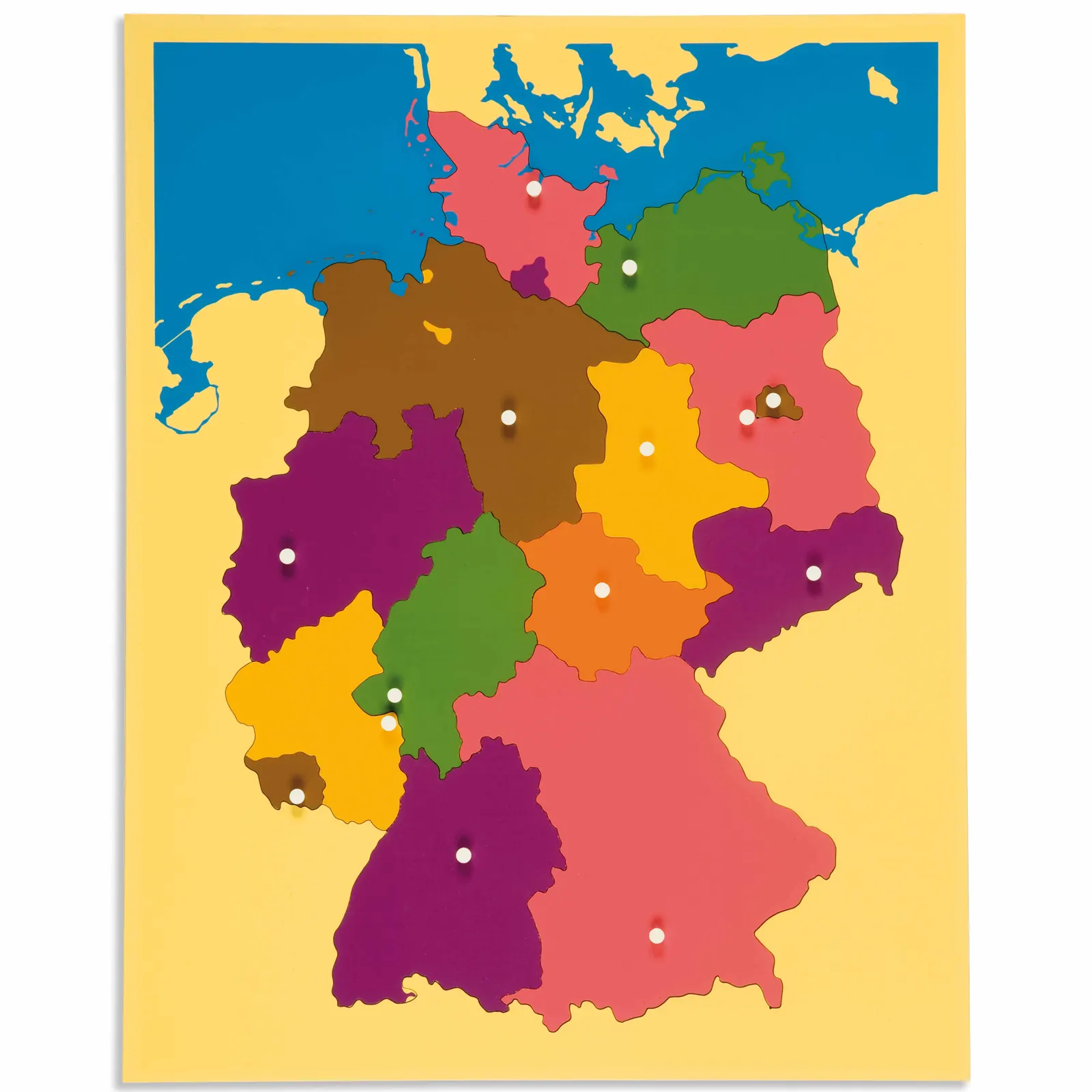
Puzzle Map: Germany
