
Puzzle Map: South America
Made by Nienhuis Montessori · shipped by Heutink International (Netherlands) About the maker
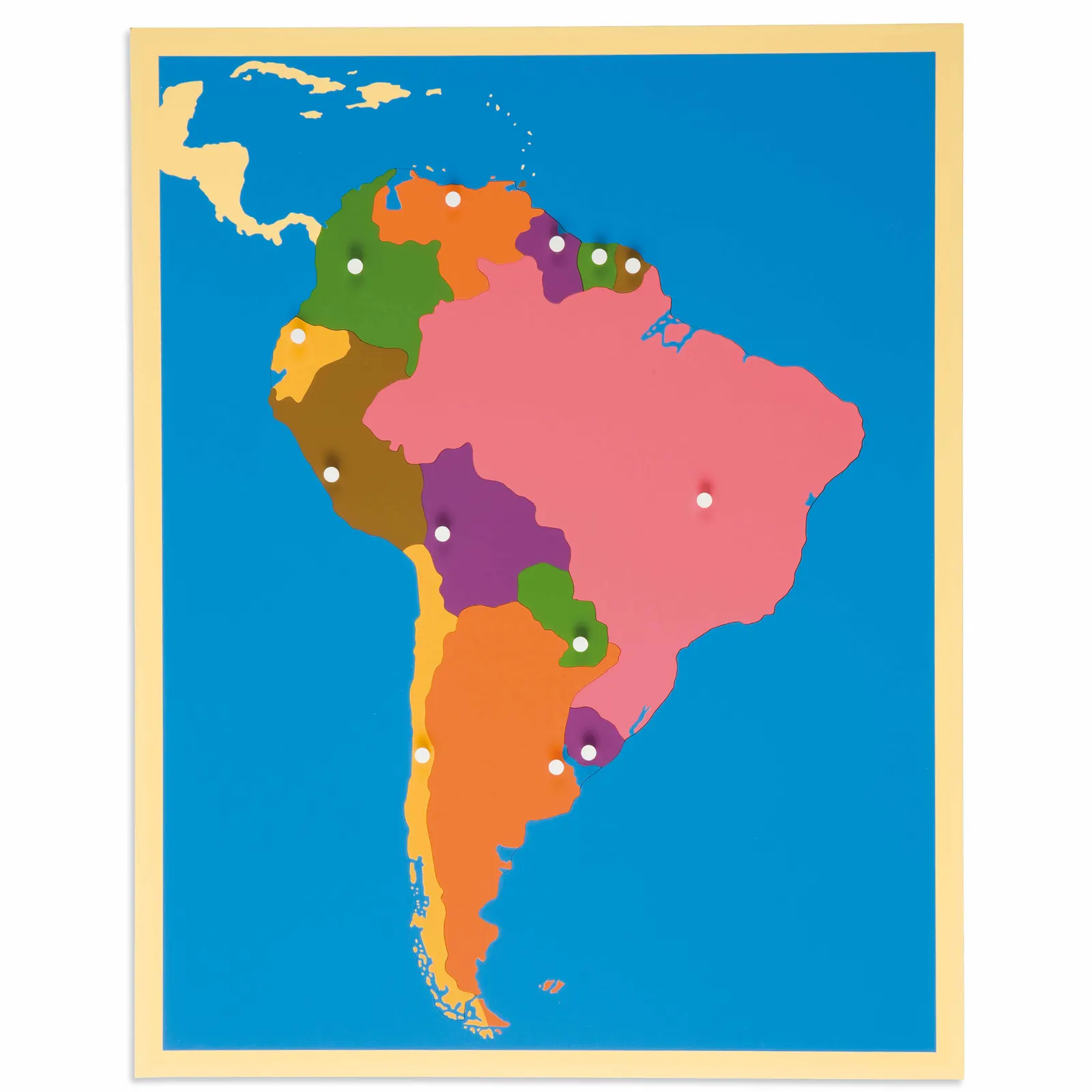
Puzzle Map: South America builds the continent piece by piece from non toxic painted wood, giving children a tactile first encounter with its countries. Each silk screened, laser cut piece is fitted with a knob set exactly over the capital, so lifting, comparing and replacing every country becomes a self correcting geography lesson rather than a memorised fact. Designed for ages 3 to 6, it pairs sensorial exploration with growing fine motor precision, a sturdy, AMI aligned material meant to be handled again and again.
“Free the child's potential, and you will transform him into the world.”
The Puzzle Map of South America serves a precise developmental purpose in the Montessori classroom by transforming abstract geographical concepts into concrete, manipulable experiences. Each wooden country piece with its white knob handle responds to the child's need to understand their world through touch and movement, characteristic of the sensitive period for order between ages 3-6.
- Develops spatial awareness through fitting countries into their exact positions within South America's continental outline
- Builds geographical vocabulary by associating country names with their distinct wooden shapes
- Strengthens pincer grip and hand control through grasping and maneuvering knob handles
- Cultivates visual discrimination by distinguishing between similar country shapes and sizes
Read More
The yellow border frame creates a defined workspace that satisfies the child's need for clear boundaries while exploring spatial relationships. Through removing and replacing each country piece, children build mental maps that connect physical manipulation to geographical understanding. The puzzle map's design, with each country as a distinct wooden piece, allows children to isolate individual countries for study while maintaining awareness of continental unity. This material bridges the gap between the child's immediate sensorial experiences and the abstract concept of political boundaries, preparing them for more complex geographical studies while honoring their developmental need to learn through purposeful hand work.
How to present it
Follow the Montessori method of presentation for optimal child development.
Place the puzzle map on a large work mat with the yellow frame facing north. Set a small basket nearby for holding removed pieces. Ensure hands are clean and dry for optimal grip on knob handles.
- 1
Begin with Brazil, the largest piece. Grasp the white knob with thumb and two fingers, slowly lifting straight up
Starting with the largest piece provides immediate success and spatial reference - 2
Place Brazil on the mat beside the frame. Trace its outline with your index finger, moving slowly and deliberately
Tracing reinforces shape recognition through muscle memory - 3
Remove 2-3 adjacent countries, naming each as you lift. Arrange pieces on the mat in relative positions
Maintaining spatial relationships outside the frame reinforces geographical understanding - 4
Return pieces one at a time, rotating gently if needed to find correct orientation. Press firmly to ensure proper fit
Allow self-correction rather than intervening, the frame provides immediate feedback
Every Child Is a Little Creator

Heritage
Since 1929

In classrooms
Around the world

European brands
Nienhuis, GAM, Educo

AMI approved
To the association standard
Puzzle Map: South America
