
Pythagoras BoardTiles Only
The first photo is the maker's own. The other shots are illustrative.
Inv. no. NIE-01810003
- Maker
- Nienhuis Montessori, since 1929
- Primary Material
- Wood
- Surface Treatment
- Printed numbers
- EAN
- 8719924009748
Final price incl. VAT. Delivery €5.90, €111.10 to go for free delivery.
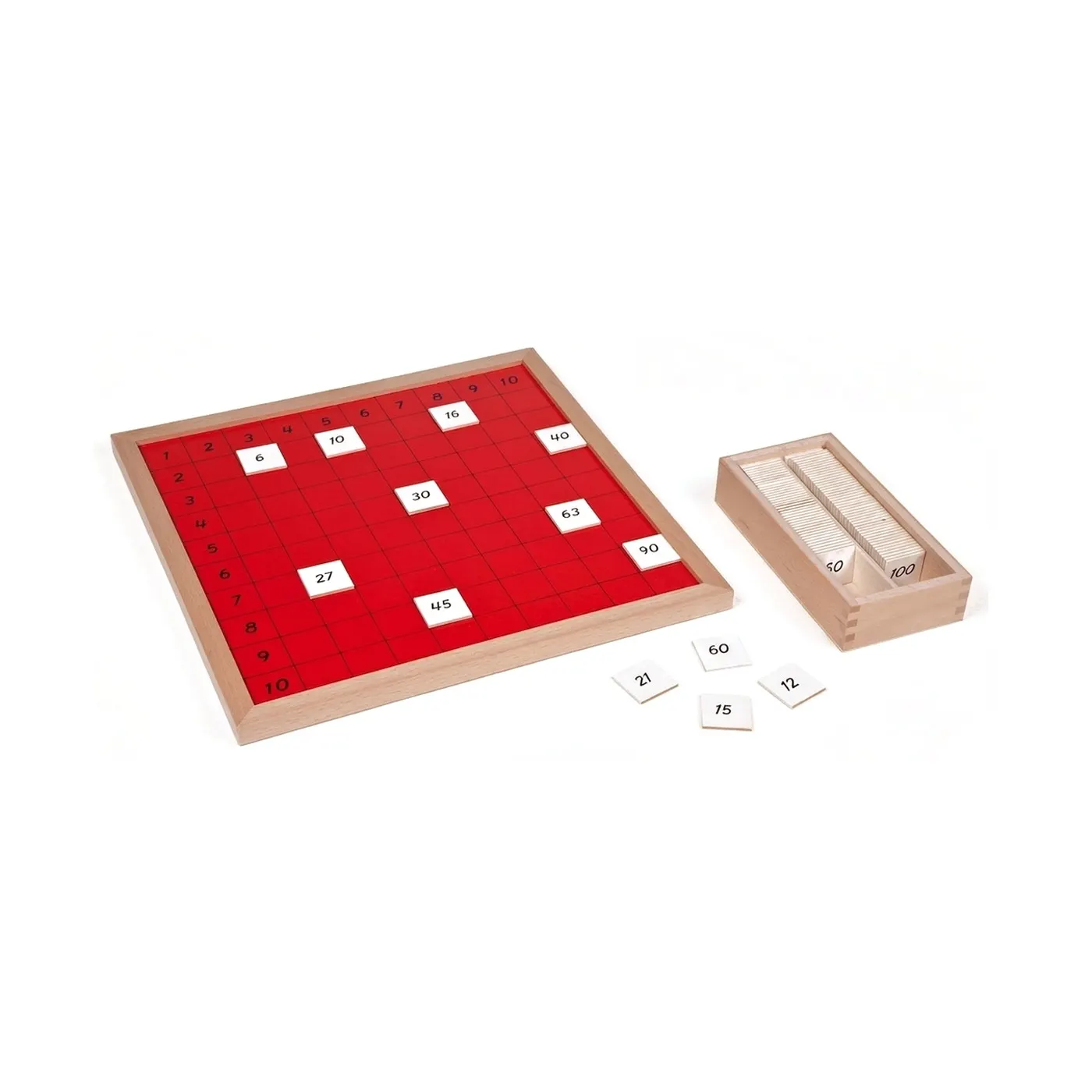 Pythagoras Board €95.90
Advice, warranty and returns are handled by us.
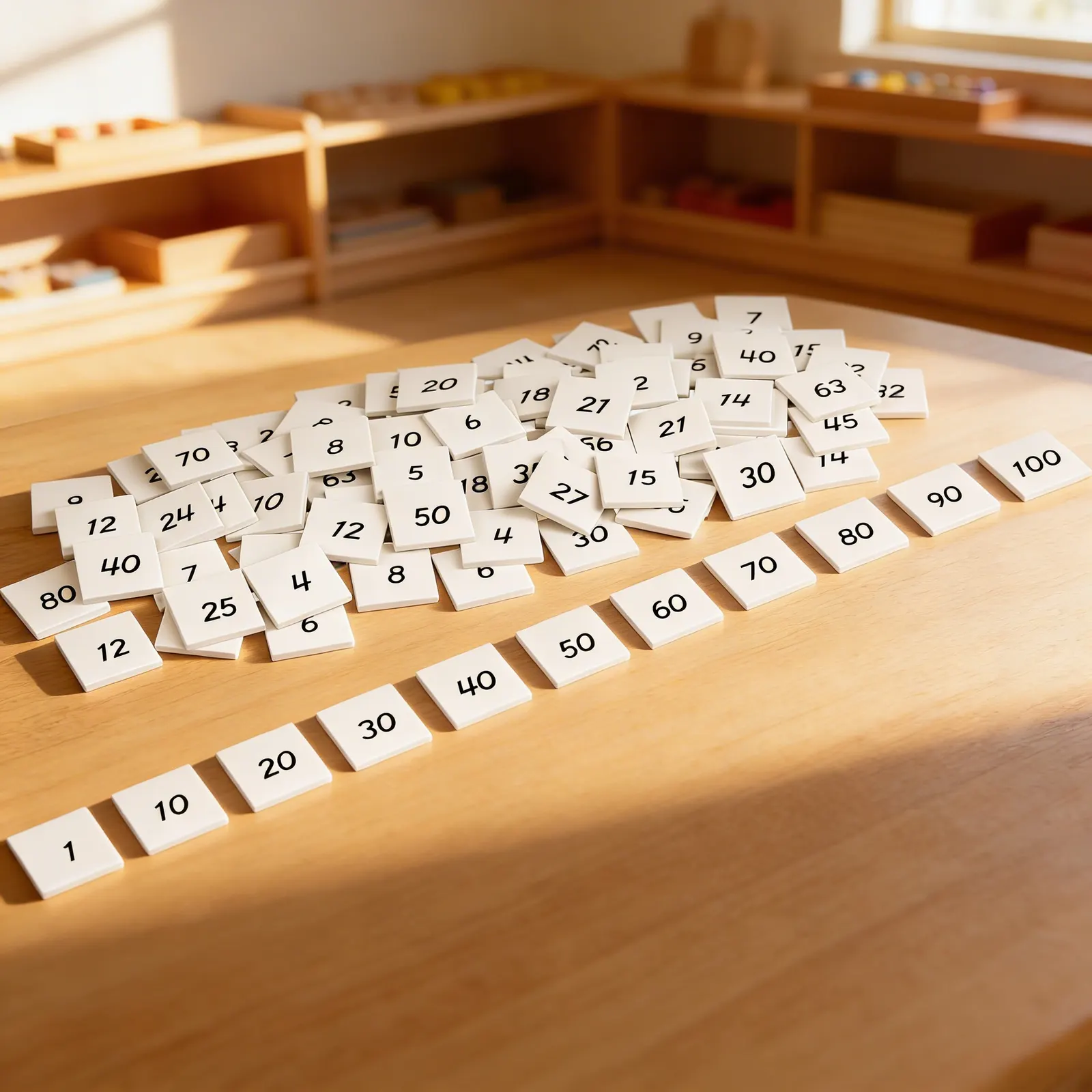
Pythagoras Board in a child's hands
The tiles for the pythagoras board on their own, as a replacement or a second set. Tiles are the part of that material that goes missing: they are small, they are handled every time the board is used, and a board with two tiles gone cannot show the symmetry it exists to show. Buying tiles separately is far cheaper than replacing the board, and a complete set is the only kind worth having. Board sold separately. Wood, for ages 3 to 12.
Multiplication Patterns
Children discover multiplication relationships by arranging tiles in sequences and recognizing number patterns.
Visual Memory
The physical arrangement of products creates a visual map of multiplication facts that supports memorization.
Mathematical Reasoning
Exploring tile arrangements develops understanding of factors, products, and the commutative property of multiplication.
Fine Motor Control
Handling and precisely placing small tiles refines pincer grip and hand-eye coordination.
How to present it
Arrange all 100 tiles face-up on a mat, sorted by tens (1-10, 11-20, etc.). Have the empty Pythagoras Board frame ready nearby.
- 1Invite the child to find all tiles showing '12' and place them in a separate pile
- 2Ask which multiplication facts make 12, then place one '12' tile at each corresponding intersection on the board
- 3Continue with another product like '24', finding all tiles and their board positions
- 4Gradually fill the entire board, noting patterns in rows and columns
3 tips for parents
- Practice skip counting during daily routines to prepare for recognizing multiplication patterns
- Point out rectangular arrays in everyday life (egg cartons, window panes) as multiplication visuals
- Play 'product hunt' games finding all ways to make a number using multiplication

If you are not sure it suits your child, we answer in person.
Norbert Kovalčín, founder of Faborino · write to him
There is no review here yet. We will ask you for one after you buy. Write the first review
What's in the Box
- Wooden tiles: 100 pieces numbered 1-100
Size and material
| Packaging | 22 × 16 × 3 cm |
| Primary Material | Wood |
| Surface Treatment | Printed numbers |
| Recommended Age | 3-6 years |
Care
Wipe with slightly damp cloth, dry immediately
Frequently Asked Questions
What exactly is included in this tiles-only set?
This set includes 100 wooden square tiles numbered from 1 to 100, representing all multiplication products for factors 1-10. The tiles are designed to fit perfectly into a standard Pythagoras Board frame (frame not included).
Do I need to purchase the frame separately?
Yes, this is a tiles-only set meant as a replacement or supplement. You'll need an existing Pythagoras Board frame or purchase one separately to use these tiles for the complete multiplication learning experience.
How do children use these tiles for learning multiplication?
Children place tiles in the frame grid to discover multiplication patterns. For example, placing the tile '12' where row 3 meets column 4 shows that 3×4=12. This hands-on approach helps visualize multiplication relationships and patterns.
Are the numbers printed or engraved on the tiles?
The numbers are typically printed clearly on each wooden tile for easy visibility and durability. The tiles are designed to withstand repeated classroom use while maintaining legibility.
What size are the individual tiles?
Each tile is designed to standard Montessori specifications to fit perfectly in the Pythagoras Board frame grid. The tiles are sized for easy handling by young children while being large enough to display numbers clearly.
Product safety
Manufacturer: Nienhuis Montessori, Anders Celsiusstraat 15, 7442 PB Nijverdal, Netherlands
Pythagoras Board