
Six Kingdoms ClassificationSpanish Edition
The first photo is the maker's own. The other shots are illustrative.
Inv. no. NIE-ELCSP4073
- Maker
- Nienhuis Montessori, since 1929
- Base Material
- Heavy paper stock
- Surface
- Laminated finish
- EAN
- 8719924044442
Final price incl. VAT.
This material is no longer made
The manufacturer has withdrawn it, so we cannot order it in. The page stays here because the material itself is still worth knowing about.
Available instead
Six Kingdom Chart
Would you buy it if we could source it or make it ourselves? Enough people saying yes is what makes the attempt worth it.
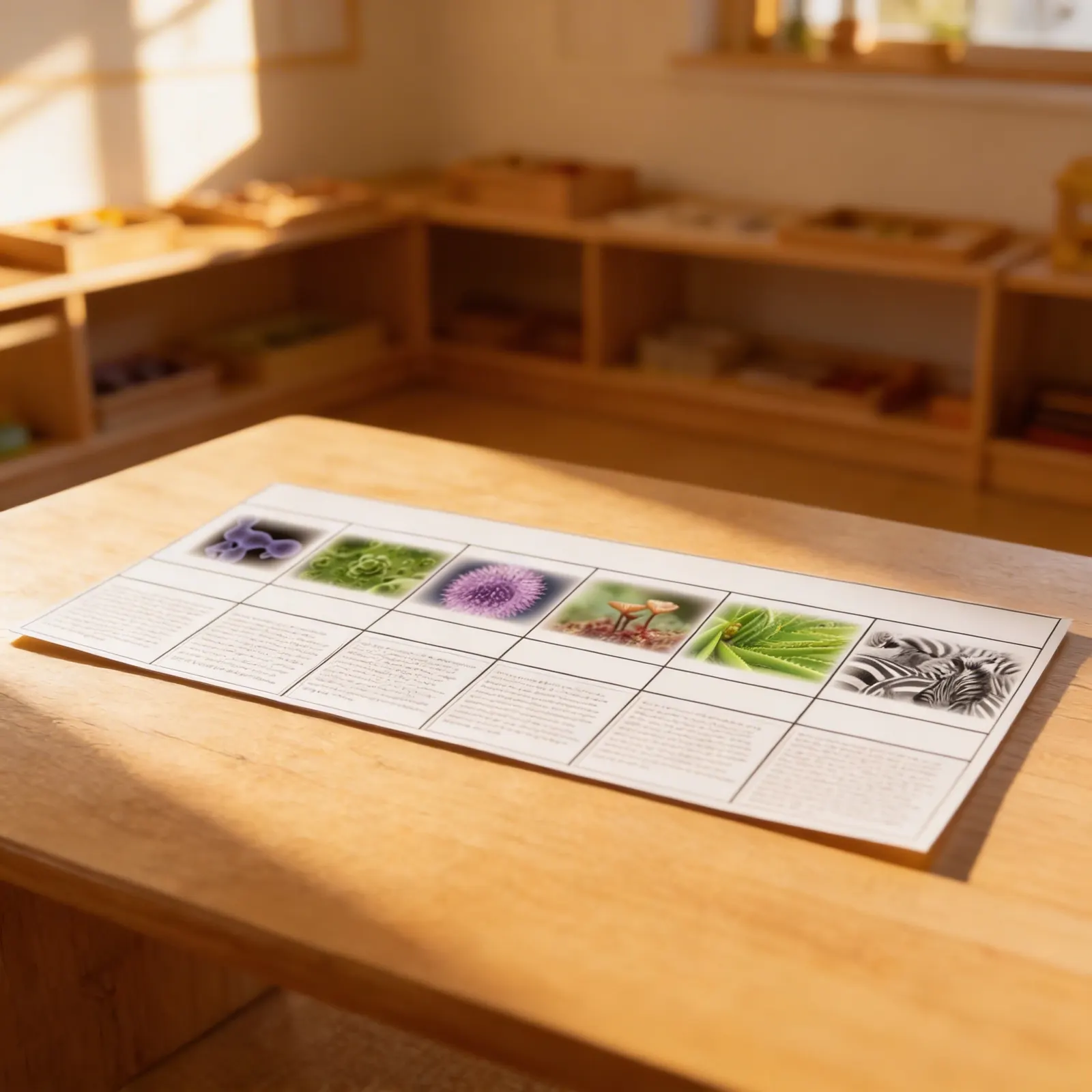
Six Kingdoms Classification in a child's hands
Connecting children to the living world, this large-format educational chart presents the six kingdoms of life through vivid photographic examples and Spanish-language descriptions, supporting the Montessori elementary biology curriculum. The organized grid layout with clear headers allows children to explore and compare the characteristics of each kingdom, from microscopic bacteria to complex animals, fostering scientific classification skills and understanding of life's diversity.
Scientific Classification
Introduces the fundamental concept of biological kingdoms, supporting the child's understanding of how scientists organize living things.
Visual Discrimination
High-quality photographs help children observe and identify distinguishing characteristics of each kingdom.
Language Development
Spanish-language descriptions expand scientific vocabulary and support bilingual learning environments.
Cosmic Education
Connects to Montessori's Great Lessons by showing the diversity and interconnectedness of all life forms.
How to present it
Mount the Seis Reinos chart at child's eye level on a wall or easel. Place a small basket with magnifying glasses nearby. Prepare cards with additional organism pictures for sorting activities.
- 1Begin with kingdoms containing familiar organisms (Animalia, Plantae). Point to photographs while naming each kingdom in Spanish
- 2Explore one kingdom thoroughly, examining each photograph and discussing observable features
- 3Compare organisms across kingdoms, asking 'How is this mushroom different from this flower?'
- 4Play sorting games with picture cards, having children place them near the corresponding kingdom
3 tips for parents
- Look for representatives of different kingdoms during nature walks and connect them to the classroom chart
- Practice Spanish kingdom names at home using the terms your child learns at school
- Visit natural history museums to see preserved specimens from various kingdoms

If you are not sure it suits your child, we answer in person.
Norbert Kovalčín, founder of Faborino · write to him
There is no review here yet. We will ask you for one after you buy. Write the first review
What's in the Box
- Seis Reinos Chart: 90×60cm laminated educational poster
Size and material
| Packaging | 42 × 29 × 14 cm |
| Base Material | Heavy paper stock |
| Surface | Laminated finish |
| Recommended Age | 6-12 years |
Care
| Cleaning | Wipe with damp cloth; avoid harsh chemicals |
| Storage | Roll carefully or store flat to prevent creasing |
Frequently Asked Questions
What age is the Seis Reinos chart appropriate for?
While suitable for ages 3-6 with guidance, this material is primarily designed for elementary-aged children (6-12 years) studying biology and classification in the Montessori curriculum.
Is this chart available in English?
This version features Spanish-language descriptions. The visual photographic examples make it accessible for language learners, though text comprehension requires Spanish reading skills.
What are the six kingdoms featured on this chart?
The chart presents all six kingdoms of life: Animals (Animalia), Plants (Plantae), Fungi, Protists (Protista), Bacteria, and Archaea, with multiple photographic examples for each.
How large is this educational chart?
This is a large-format poster designed for classroom wall display or floor work, providing clear visibility of all kingdoms and their examples for group or individual study.
How does this support Montessori biology lessons?
The organized grid layout allows children to compare characteristics across kingdoms, supporting lessons on classification, diversity of life, and scientific observation skills fundamental to Montessori elementary biology.
Product safety
Manufacturer: Nienhuis Montessori, Anders Celsiusstraat 15, 7442 PB Nijverdal, Netherlands
Six Kingdoms Classification