In the last days of the summer holidays, most homes with a three year old sound much the same. The bag from the seaside is still standing in the hall, an unfinished list of nursery things is lying on the kitchen worktop, and the first week of September is circled on the calendar. A few days are left before that first morning, and most of the preparation goes on plimsolls, a change of clothes and name labels.
That morning then rarely looks the way it looked in our heads. At twenty to eight the child is standing in the hall in one sock, the coat is hanging on a peg half a metre above their head, the shoes are somewhere under the chest of drawers, and we are pulling a sleeve onto an arm faster than the arm can rise to meet it. Ten minutes later we have done all of it for them and both of us leave cross. Not because the child did not want to. Because in that hall there is not one single thing they can manage alone.
It is not defiance, it is the height of the peg
Almost every morning battle has one of three causes, and not one of them is the child's character. The first is height: the things are out of reach, so there is no way even to begin. The second is order: the clothes lie in a heap, and a three year old does not yet know that the vest goes on before the jumper. The third is the most common and the least visible: nobody has shown them the skill slowly, whole, from beginning to end, at a time when there was no hurry.
A house is built for adults. Handles, pegs, light switches, the basin, all of it sits at a height a small child cannot reach. When we then ask them to be independent, we are asking for something the rooms themselves will not physically allow. Maria Montessori put it without sentiment in The Absorbent Mind: a child learns very little from what we explain, and a great deal from what the hands are allowed to do.
“The hands are the instruments of man's intelligence.”
Maria Montessori, The Absorbent Mind
A prepared environment fits into one hallway
A prepared environment sounds like something that needs the bedroom stripped out and new furniture ordered. In practice it is a very small intervention concentrated in one place: the metre and a half of hallway where the mood of the whole day is decided. In a Montessori classroom you can see it at a glance, shelves at waist height, glass tumblers, a small brush standing in the corner. At home it does not have to look like that, and it should not. There is little point in persuading a child, and a great deal of point in changing two or three things so that the hands have something to do.
Do not guess the height of the peg, measure it with the child. Let them stand against the wall, raise an arm, and mark the spot they reach comfortably without going up on tiptoe. With a three year old that usually falls somewhere between one hundred and one hundred and twenty centimetres. The difference between a peg at that height and a peg half a metre higher is the difference between the sentence leave it, I will help you, and the sentence I have got my coat on.
Clothes in the order they go on
The second change costs nothing. In the evening, once the child is in bed, lay tomorrow's clothes out in one place and in the order they go on: pants on top, then the vest, then the trousers, socks to one side. A heap of clothes is a riddle to a three year old. An order is a set of instructions. Choice can be offered too, in the evening and kept small: two tops to pick from, not the whole wardrobe. A decision made at seven the night before usually holds in the morning, because they made it themselves.
One skill, on a Sunday, slowly
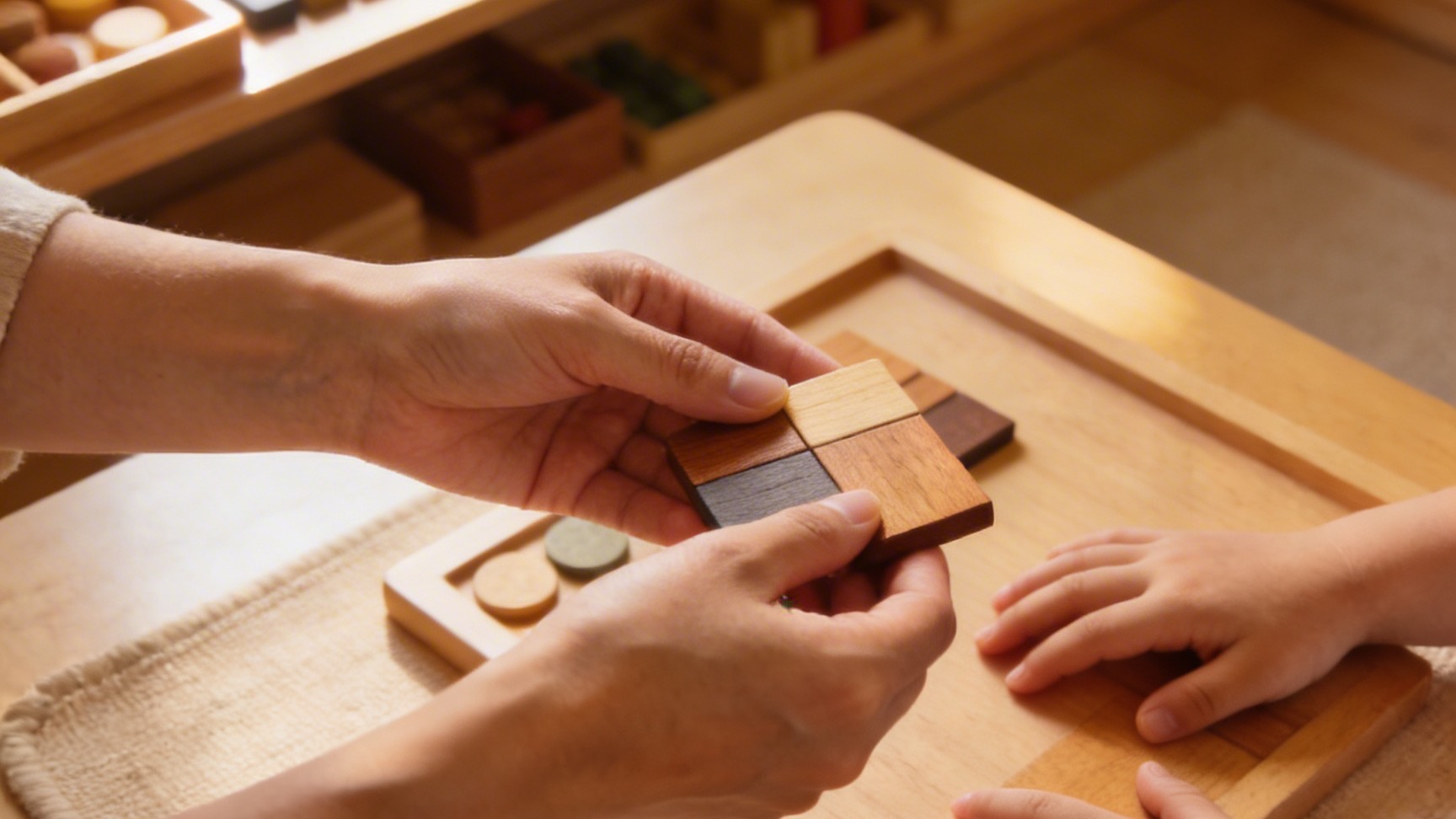
The third change asks for your time and it is the most effective of the lot. Choose one single thing the child should be able to do alone by September: do up a button, pull up a zip, put on a shoe. One, not four. Then show it to them on a quiet late afternoon or on a Sunday, when nobody is going anywhere.
The demonstration has rules of its own and they are worth keeping. Sit beside the child rather than opposite them, so they see the movement from the same angle they will use themselves. Go slowly, far more slowly than feels necessary. And while you are showing, say nothing. If the hands are doing one thing and the mouth another, the child watches the mouth. Keep the words for the moment when they have a go.
Dressing frames do one thing that cannot be done on a coat someone is wearing: they lift the difficulty away from everything else. The button on a frame sits at eye level, the fabric stays still, nothing is in a hurry, and the child can see exactly what the fingers are doing. When the same job comes round on their own chest, where they cannot really see, the hand already knows.
The zip has a trap of its own, and in September it turns up in almost every family. The hard part is not pulling it up, it is seating the pin in the box at the bottom, which takes both hands at once and a little force in an unfamiliar direction. That cannot be learned at the front door at twenty to eight. At a table, on a Sunday, over a few calm repetitions, it can.
Their own water, their own breakfast
Mornings do not only break in the hallway. They break at the table too, where an adult pours, spreads, hands over and clears away, while the child sits and waits. Nursery will expect the opposite: that they carry their own cup back and ask for help only when they genuinely need it. Twenty children in one room cannot all have their water poured for them by one member of staff. The ones who can do it drink. The ones who cannot wait.
Pouring water is one of the first jobs where the child sees the result plainly. Either it worked, or it is on the table. They do not need our praise for it and they do not need a correction either. They need a jug they can lift, holding no more water than a cup will take.
To begin with, fill the jug about a third full. A full jug has to be carried in both hands, and then the child concentrates on the weight instead of on the pouring. Keep a permanent spot on the worktop or at the edge of the table where the jug and the cup live, so nobody has to ask permission. That is the whole difference between being served and being independent.
Spilt water is not a disaster, it is a job
And every so often it will go over. That moment either confirms the whole arrangement or cancels it. If we rush in with a cloth and wipe it up in three seconds, the child learns that pouring is a risk and that mistakes belong to grown ups. If we hand them the cloth and wait, they learn that a mistake is simply the next part of the work. Water on the floor is good news in that sense: something was attempted. For that, the child needs something to clear up with and needs to reach it alone. An adult sized broom cannot be steered by small hands, so the crumbs get pushed around the room until the child gives up.
That first morning will not be perfect all the same. Somebody will cry, quite possibly us. But somewhere around the middle of September you will notice one thing: the child walks into the hall, reaches for their coat, wrestles with the zip for a moment and then turns towards the door before you have managed to say anything at all. In that moment you do nothing. You did it a fortnight earlier, on a Sunday afternoon, sitting beside them and showing them, without a word, how a button goes through a buttonhole.