
Pink Tower Base Cards: Pattern Matching Extensions
Made by Nienhuis Montessori · shipped by Heutink International (Netherlands) About the maker
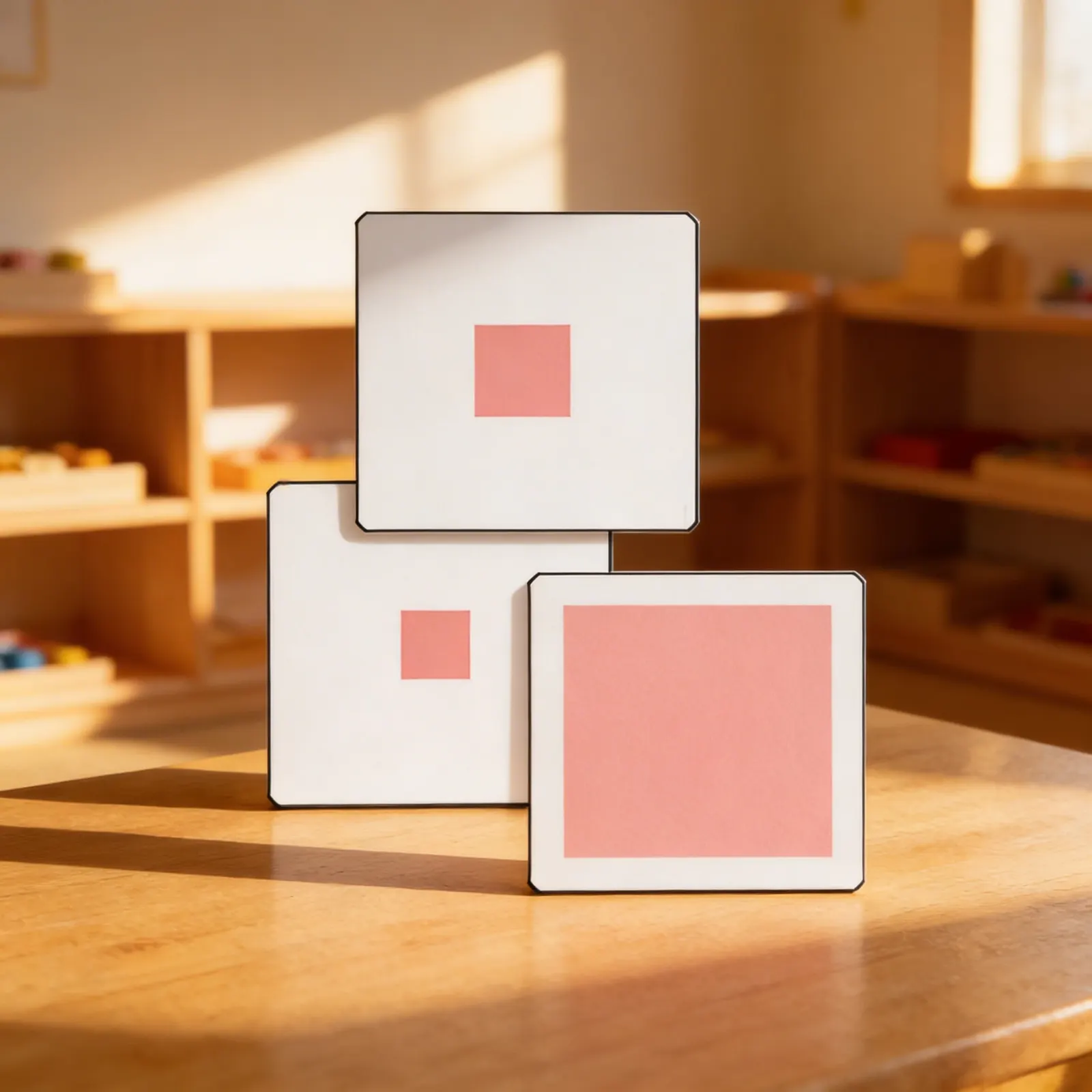
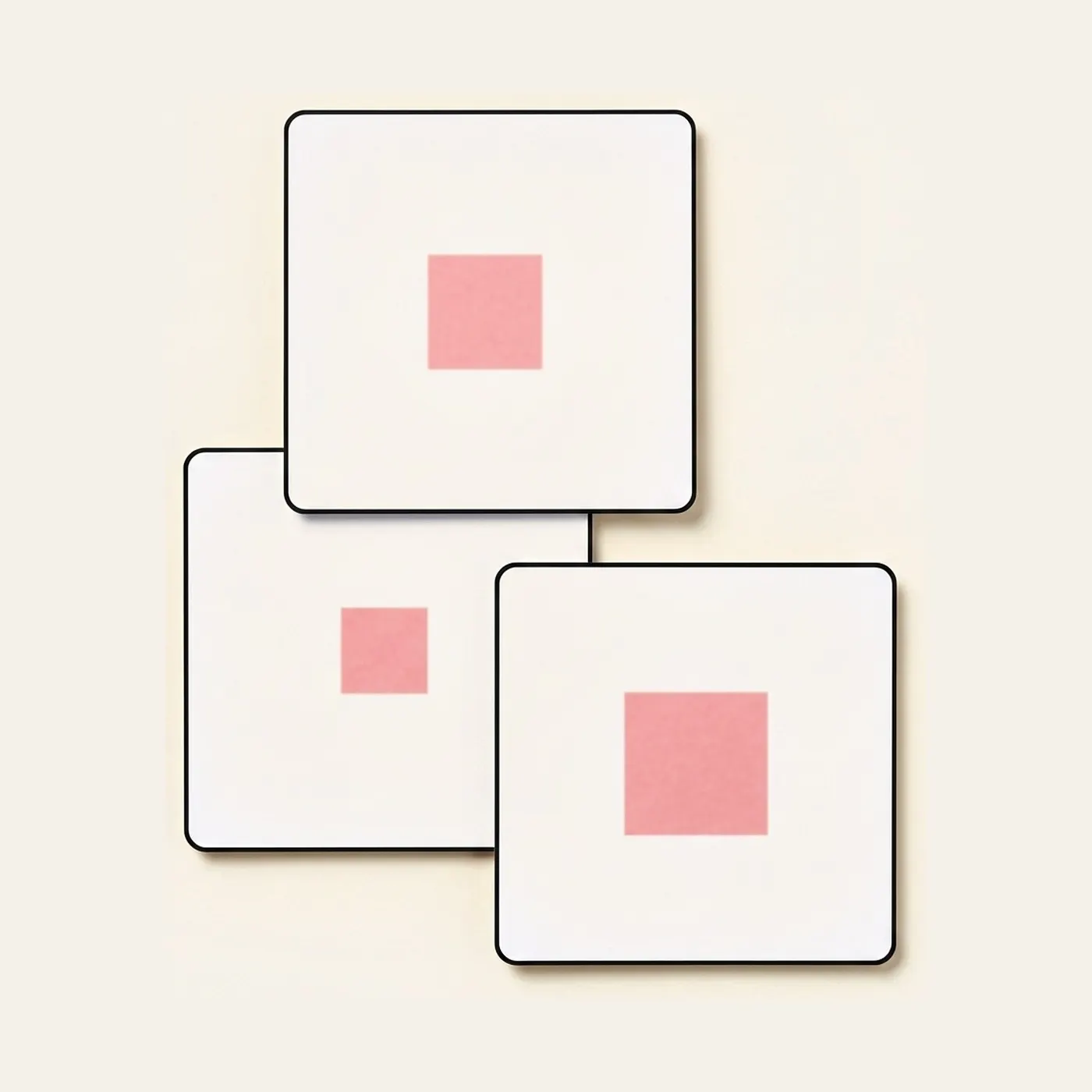
Base cards for the pink tower, each 14 x 14 cm, showing the square footprint of every cube. The child stands a cube on the card that matches its base, which asks something new of a familiar material: not which cube is bigger, but which flat square this solid sits on. Matching a solid object to a plane figure is the beginning of geometry proper. Durable plastic with rounded corners. The pink tower is a separate item.
“The hands are the instruments of man's intelligence.”
The Bases for Pink Tower embody Montessori's principle of isolation of difficulty and indirect preparation for mathematics. By providing two-dimensional representations of the Pink Tower cubes, these materials bridge concrete sensorial experiences with abstract mathematical thinking.
- Visual discrimination of graduated sizes in two-dimensional space
- Development of spatial reasoning and pattern recognition
- Indirect preparation for understanding area and square numbers
- Refinement of hand-eye coordination through precise placement
Read More
The child moves from three-dimensional exploration to understanding how these same relationships exist in two dimensions, preparing the mathematical mind for concepts of area, proportion, and spatial relationships. This extension work respects the child's need for repetition while introducing new challenges within a familiar context. The material demonstrates Montessori's genius in creating interconnected learning experiences where each activity builds upon previous knowledge, allowing the child to discover mathematical relationships through their own exploration rather than direct teaching.
How to present it
Follow the Montessori method of presentation for optimal child development.
Place the base cards on a mat with the Pink Tower nearby. Ensure the child has mastered the basic Pink Tower exercise. Present one card at a time, starting with the simplest pattern.
- 1
Invite the child to bring the Pink Tower cubes to the mat
Allow the child to carry one cube at a time, reinforcing careful movement - 2
Select the first base card showing individual squares
Run your finger around each outline to emphasize the shape - 3
Demonstrate placing the largest cube on its corresponding outline
Use two hands for precise placement, modeling careful movement - 4
Invite the child to continue with remaining cubes
Step back and observe without correcting unless necessary - 5
Introduce cards with interconnected patterns
Present these only after mastery of individual square placement - 6
Allow child to explore different arrangements
Encourage trying multiple solutions when patterns allow
Every Child Is a Little Creator

Heritage
Since 1929

In classrooms
Around the world

European brands
Nienhuis, GAM, Educo
Pink Tower Base Cards: Pattern Matching Extensions
