Why Age Matters More Than the Toy Itself
Walk down the toy aisle of any large retailer and you will see hundreds of products labelled "educational" — most of them designed to do something *to* your child rather than something *with* them. A button is pressed, a song plays, a light flashes, the toy entertains. Maria Montessori spent more than half a century watching what children actually chose when they were free to choose, and her conclusion was almost the opposite of what modern marketing assumes: children do not need to be entertained, they need to be met. Met by an environment that offers exactly the right challenge at exactly the right moment.
That moment is what Montessori called a _sensitive period_ — a developmental window during which a child is biologically primed to learn one specific skill with extraordinary intensity. Between birth and twelve months, the sensitive period for movement is at its peak. Between two and four, the sensitive period for order. Between two and six, the explosion of language. When the right material meets the right sensitive period, learning is not effortful; it is irresistible. When the wrong material meets a closed window, even the most beautiful object on the shelf is ignored.
This is why a guide to Montessori toys *by age* is more useful than a guide to Montessori toys in general. The same wooden cylinder block that is genuinely transformative for a twenty-month-old can be either too easy or too frustrating six months earlier or six months later. The aim of this article is to walk you through every stage from newborn to six years old, name the sensitive periods active in each, and recommend the specific authentic materials that meet them. We will also be honest about a problem in the market: the word "Montessori" is not trademarked, and most of what is sold under that name on Amazon would not be recognised by any AMI-trained guide. If you would like the full philosophy behind the materials first, start with our complete guide to Montessori materials, then return here for the age-by-age recommendations.
0–6 Months: Visual Tracking, Grasping, and the First Mobiles
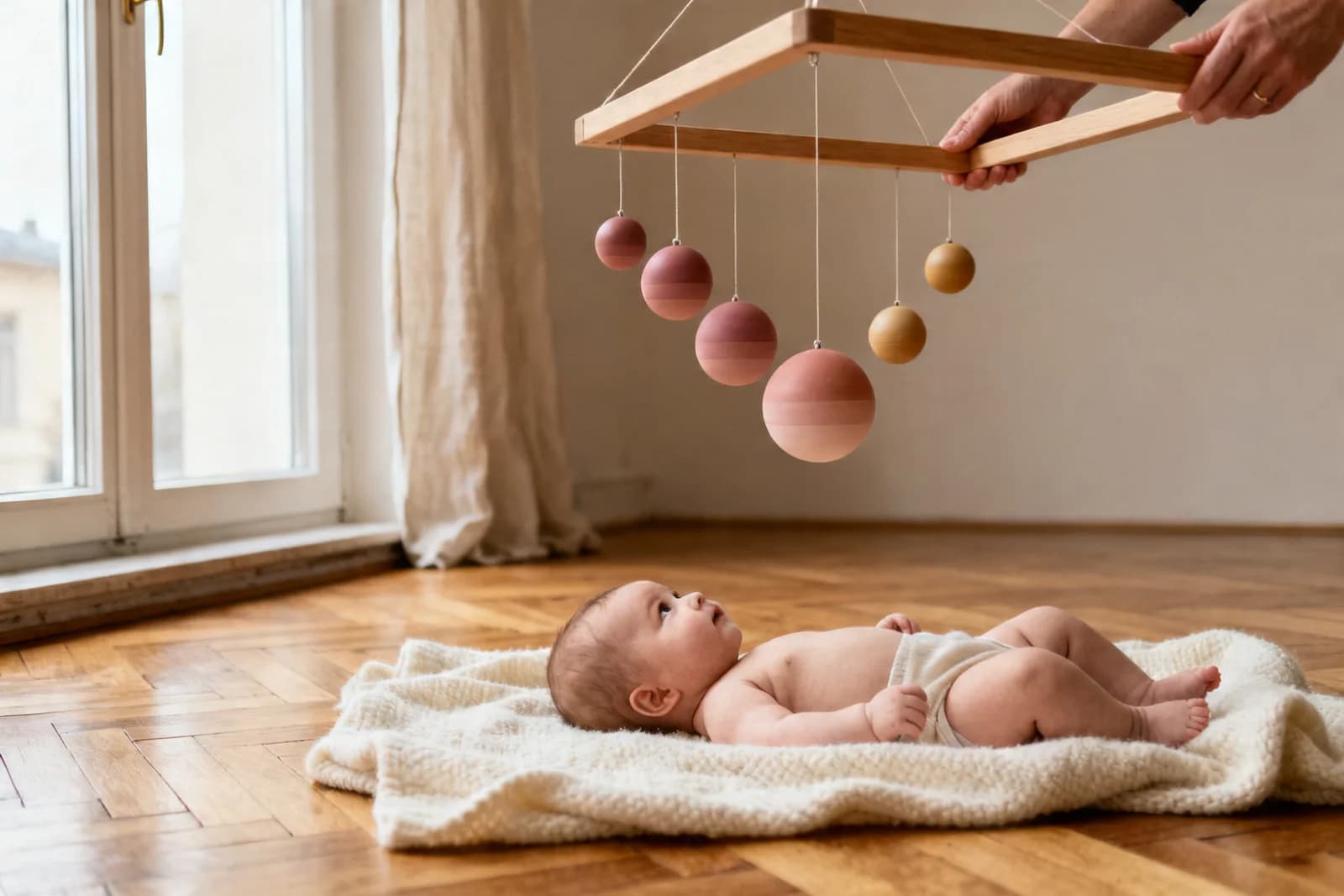
The newborn arrives with a visual system that can focus only at about thirty centimetres — roughly the distance from a parent's face when feeding — and an instinct to track movement. The Montessori response is the visual mobile sequence. The black-and-white Munari mobile, hung above the changing area in the first six weeks, offers exactly the high-contrast geometric pattern that an infant's developing retina can resolve. By eight to ten weeks, the Octahedra mobile introduces the primary colours. By three months, the gentle motion of the _Gobbi mobile_ — five spheres in graded shades of one colour — invites the eye to discriminate subtle differences. By four months, the Dancers mobile rewards the first reaching gestures.
After visual tracking comes the hand. Around four months, the grasping reflex becomes voluntary, and the baby begins to reach. The classic Montessori response is a small set of hanging and held objects designed for one hand: an interlocking discs grasper, a wooden rattle with a single ring, a silicone teether the baby can rotate. These look nothing like a typical "baby toy" because they have no batteries, no flashing lights, and no character faces. That is the point. The infant is studying weight, shape, balance, and sound — and a battery-powered toy that performs *for* the child interrupts the very investigation that is trying to take place.
For the first six months a parent does not need much: a Munari mobile, an Octahedra or Gobbi mobile, two or three grasping objects in natural materials, and a small unbreakable mirror at floor level so the baby can study their own face during tummy time. Browse our full infant and toddler collection for the complete sequence. What you do *not* need is a plastic activity gym with twenty hanging objects in primary colours; an infant's nervous system is not yet able to filter that volume of stimulus, and the result is overwhelm rather than engagement.
6–12 Months: Object Permanence and the Pulling-Up Stage
Somewhere around six months the infant grasps a profound idea: an object that disappears from view does not cease to exist. This is the sensitive period for object permanence, and the Montessori response is one of the most quietly satisfying materials in the entire curriculum — the object permanence box. A wooden ball is dropped through a hole, rolls out of sight inside the box, and reappears through a tray at the bottom. The first time a baby experiences this, you can see the discovery on their face. Variations follow: a box with a drawer, a box with three different shaped holes, each requiring a different turn of the wrist.
This is also the stage of stacking and nesting. A simple set of wooden stacking rings on a tapered post teaches the relationship between size and order. Wooden nesting cups offer the same learning in a different geometry. First-puzzle inset boards — usually three or four shapes with large knobs — introduce the idea that a specific shape fits a specific hole, the gentle precursor to the geometric cabinet that will arrive in two years. Each of these materials has the Montessori signature: one piece of wood, one clear purpose, one feedback loop the child can resolve without an adult interrupting to say "good job".
By around ten months the baby is pulling up to standing, and the pulling-up bar with a low mirror behind it suddenly becomes the most-used object in the home. A push wagon weighted to resist tipping invites the first walking steps a few weeks later. This is the stage where parents are most tempted by battery-powered "walkers" with songs and lights — but a walker designed by an engineer for the baby's body, not by a marketer for the parent's eye, will support development far better. A heavy wooden push wagon that does *not* run away when the child leans on it is the better tool every time.
12–18 Months: First Practical Life and the Posting Box
The second year is when the Montessori prepared environment really begins to take shape. Around twelve months, the sensitive period for *order* opens — a child of this age is acutely sensitive to where things belong, and you will see them returning a shoe to its place by the door before they can speak in sentences. This is the moment to lower a shelf to the child's height, place three or four materials on it spaced apart, and trust them to choose. The simplicity of presentation matters as much as the material itself; a basket of twenty toys produces the kind of overwhelm that prevents the deep concentration Montessori called *the work of the child*.
Posting boxes — a wooden box with a single shape-cut hole and matching wooden objects to drop through — are perfect for this stage. So is the coin box, where wooden discs are slotted one by one into a narrow opening. Both train the precise hand–eye coordination that will eventually carry a pencil, while satisfying the deep one-year-old need to repeat an action many, many times. Shape sorters also belong here, but choose the simplest version with three or four shapes rather than the colourful ten-shape sorters most retailers offer. A child of this age does not need novelty; they need the satisfaction of mastering a small set of clear challenges.
First practical life arrives now. A child of fourteen months can carry a small basket of laundry, wipe their own tray with a cloth, water a plant with a tiny pitcher, and sweep a small spill with a child-sized dustpan and brush. None of these are toys. They are the real activities of running a home, scaled to the child's body. This is the most undervalued category in the entire Montessori catalogue — and the cheapest. A real glass jug from a charity shop, a small basket, and a square of cotton cloth can replace half the plastic toys in most homes. The work is genuine, the child knows it is genuine, and that is exactly why they will repeat it for forty minutes when a battery-powered toy holds their attention for forty seconds.
18–24 Months: Knobbed Cylinders, First Colour Matching, and Pouring
Between eighteen and twenty-four months a child enters the sensitive period for refinement of movement, and the classic sensorial materials begin to appear on the shelf. The single Cylinder Block (No. 1) is usually the first. Ten wooden cylinders with knobs, each fitting only one hole, ranged from largest to smallest by diameter. The work is self-correcting — if the child places a cylinder in the wrong hole, the last cylinder will not fit. There is no need for an adult to say "wrong"; the material itself teaches. A child this age will repeat the cycle of removing and replacing the cylinders thirty or forty times in a single sitting, building the pincer grip and visual discrimination that will carry them into reading and writing two years later.

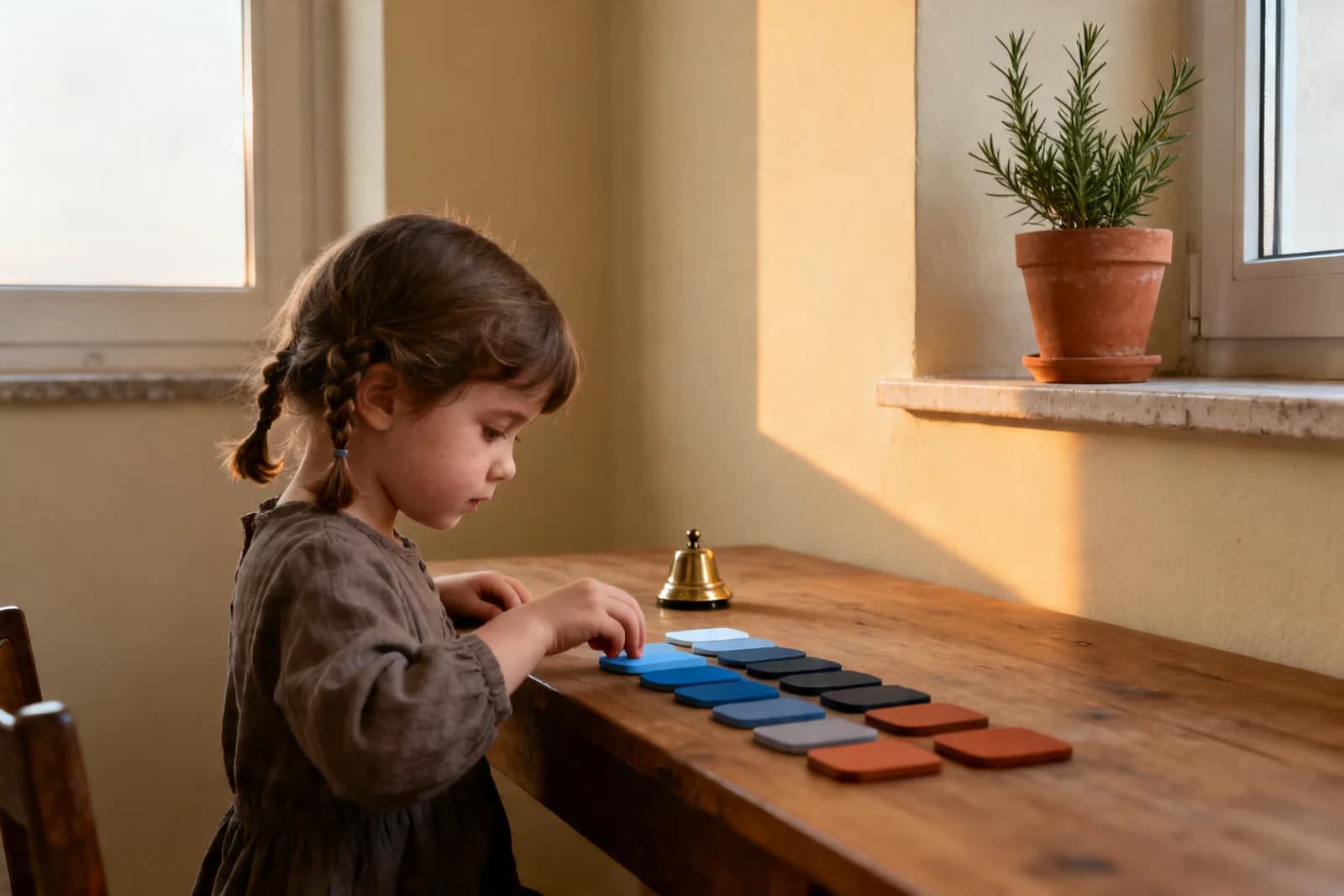
First colour matching belongs to this stage. Six pairs of coloured tablets — red, yellow, blue, green, orange, purple — are presented in a small box. The child finds the pair, places them side by side, repeats. This is not "learning colours" in the flashcard sense; it is training the eye to perceive *that two things are the same*, which is the foundation of every later classification skill. Avoid the elaborate "Montessori colour set" with thirty shades that some retailers sell at this age — it is the wrong tool for this window. Box 1, with its six clear pairs, is exactly enough.
Pouring exercises arrive in earnest now. Two small glass pitchers on a tray, one filled with dry beans or rice. The child pours from one to the other, learning to control the angle of the pitcher and to stop at the right moment. Within weeks they are pouring water. Within a few months they are pouring water from a full kettle into a small cup, and they will do this for their grandparents at family dinners with a focus that quite often startles the room. A wooden bead-threading set — large beads, thick lace, a wooden tray — completes the picture for this age. Browse the full infant and toddler range for everything we recommend in the second year.
2–3 Years: Pink Tower, Brown Stair, and the Dressing Frames
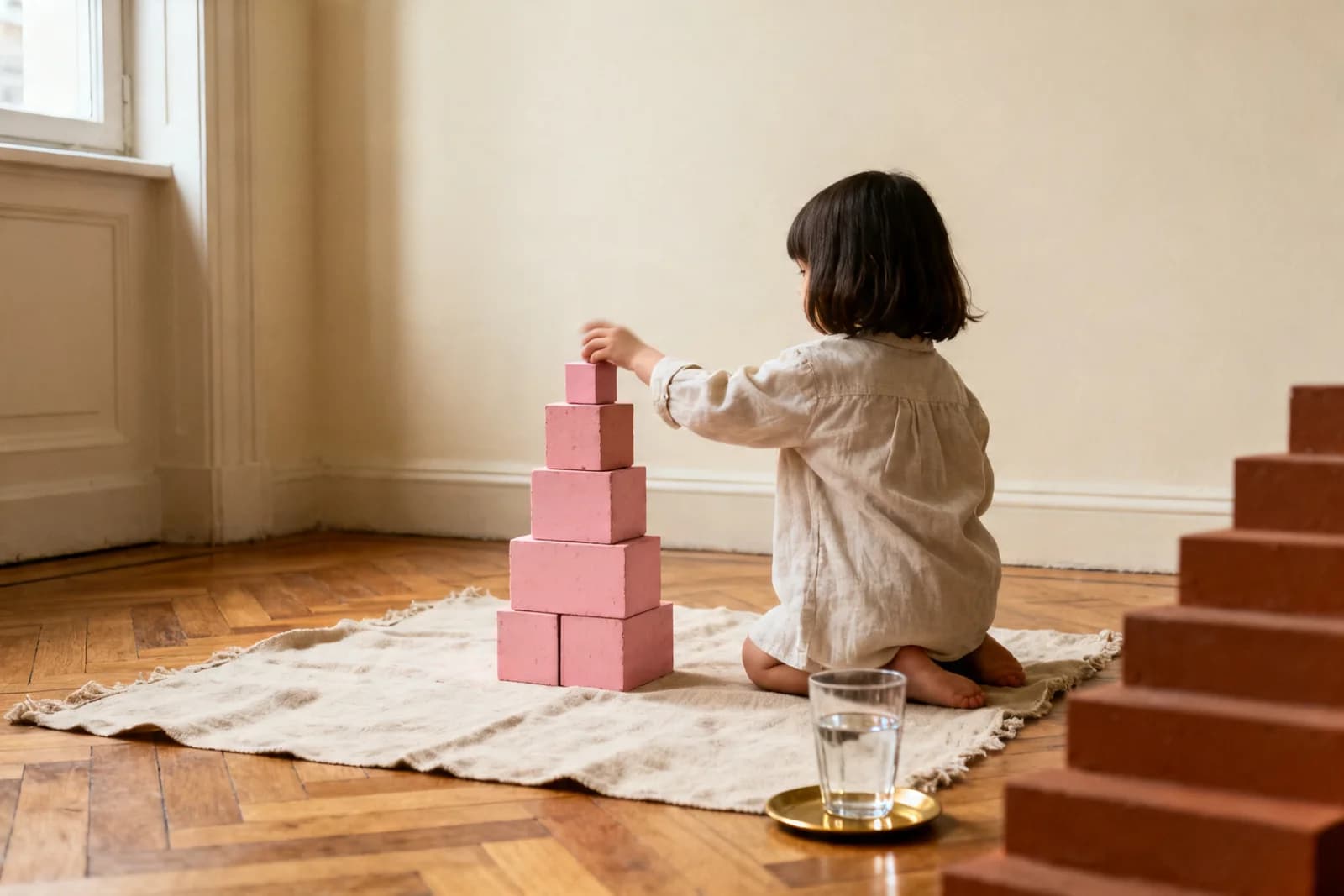
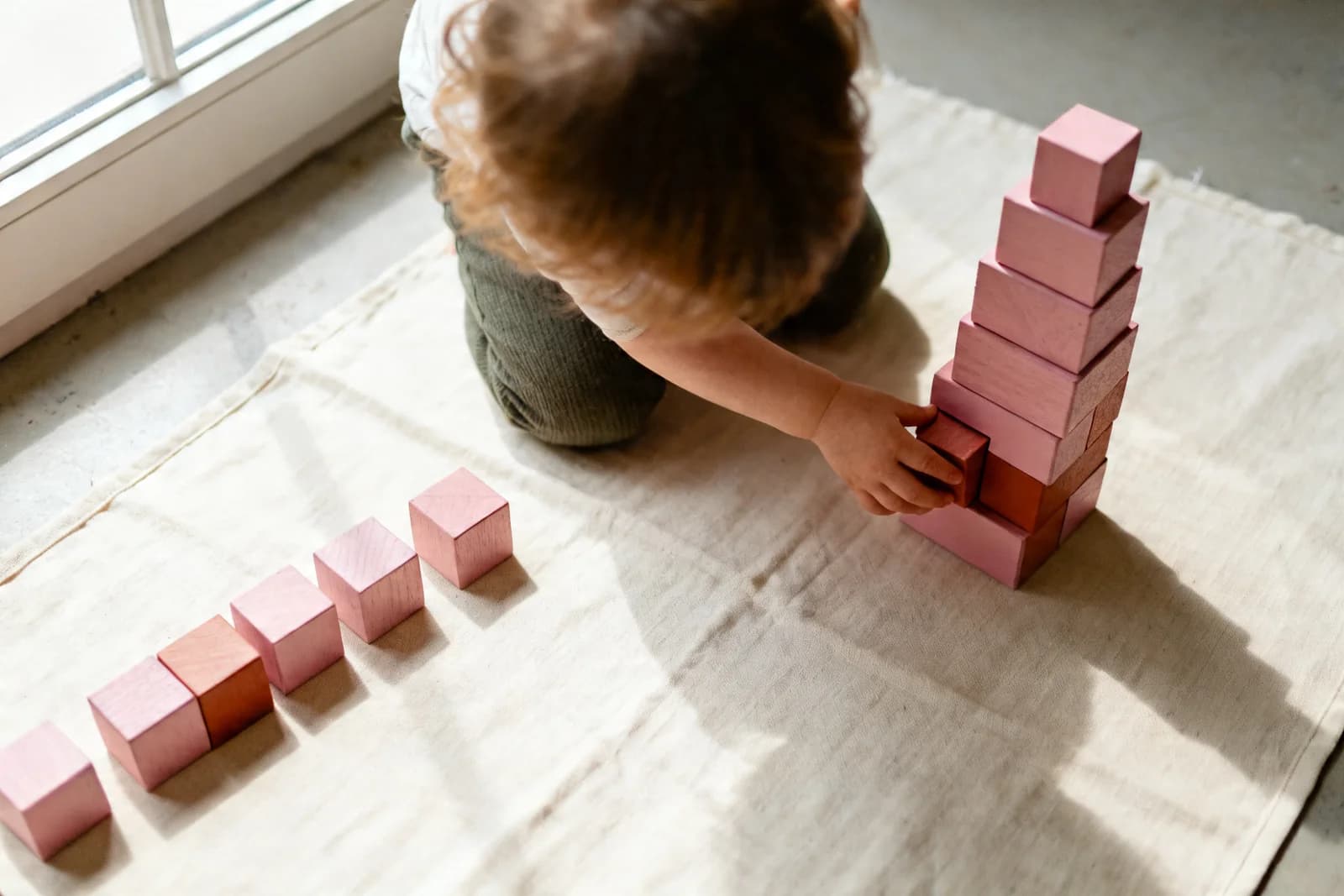
At around two and a half the great Sensorial materials of the Casa dei Bambini begin to make sense. The Pink Tower is the most iconic of all Montessori materials, and for good reason. Ten pink cubes graded from one cubic centimetre to one thousand cubic centimetres, each side increasing by exactly one centimetre. The child carries the cubes one at a time from the shelf to the work mat — a deliberate piece of design, because the carrying itself trains the body — and builds the tower from largest to smallest. The mathematical relationship between the cubes is felt in the hands long before it is understood in the head; this is the foundation of the cubed-numbers work that will arrive in four or five years. We have written a full guide to the Pink Tower's pedagogy and presentation in our Pink Tower article if you would like to go deeper.
The Brown Stair extends the same logic into a second dimension — ten prisms graded by thickness, the same length and same width — and is almost always presented next. The Red Rods extend it again into a third — ten rods graded only by length. Together, the three materials isolate the qualities of volume, thickness and length one at a time, exactly as Montessori designed. Children of this age also begin the Knobless Cylinders, the Geometric Solids, the Sound Cylinders and the Smelling Bottles. None of these are toys in the entertainment sense. Each is a single, beautifully made object that asks the child a single, beautifully clear question.
This is also the age of the Dressing Frames. A child between two and three becomes intensely interested in dressing themselves, and the Dressing Frames isolate one fastener at a time on a small wooden frame so the child can master each in turn. The 3-Button Dressing Frame is usually the first; the Metal Buckle Dressing Frame follows. The child practices on the frame, transfers the skill to their own clothes, and the autonomy that follows changes the texture of every morning. By the third birthday a Montessori child will commonly be doing buttons, zips, snaps, bows, and buckles — not because they were drilled, but because the right material was offered at the right window.
3–4 Years: Sandpaper Letters, Number Rods, and the Geometric Cabinet
Somewhere around the third birthday the explosion of language reaches its peak. The child who two years ago had perhaps fifty words now has fifteen hundred, asks "why?" forty times in a morning, and is biologically primed to absorb the symbols of written language. The Montessori response is the Sandpaper Letters. Each letter is cut from rough sandpaper and glued to a smooth wooden tablet — the child traces the letter with two fingers in the same direction it would be written, while saying its sound. Visual, tactile and auditory channels are engaged simultaneously, and a multisensory memory of each letter is built that handwriting practice will later draw on directly.
Critically, the Sandpaper Letters teach *sounds*, not *names*. The child who has worked with them does not say "ay, bee, see, dee" but "a, b, c, d" as the letters actually sound in words — which is the only way reading can ever be unlocked. This is one of the clearest divergences between authentic Montessori and the mainstream phonics market: a Montessori child meets the sound first and the alphabet song later, and learns to read months earlier as a result. After several months with the Sandpaper Letters, the Movable Alphabet arrives and the child begins to compose words long before their hand can write them.
Mathematics begins in this same window. Number Rods — ten red-and-blue rods graded by length, the longest divided into ten alternating segments — make the quantities one through ten visible to the eye and felt in the hand. The Spindle Box follows, introducing the critical concept of *zero* through an empty compartment that must remain empty. The Geometric Cabinet — six drawers of plane figures the child traces with a finger — prepares the eye for geometry that will arrive in elementary school. Each of these is a piece of equipment, not a toy. The child works with it on a mat, returns it to the shelf, and chooses again tomorrow.
4–6 Years: Movable Alphabet, Golden Beads, and the Stamp Game
The years between four and six are arguably the most dramatic in the entire Montessori curriculum. Reading explodes. Writing follows. The decimal system is mastered through the hands. A child who at four can build "c-a-t" with the Movable Alphabet is, by six, often writing complete short stories. A child who at four hands you ten golden unit beads in exchange for a ten-bar is, by six, performing four-digit addition with carrying. None of this involves a worksheet, a screen, or a reward chart. It involves materials so well designed that the child cannot help but learn from them.
The Movable Alphabet is the central language material of this period. A wooden box of cut-out lowercase letters — vowels in one colour, consonants in another — that the child uses to compose any word they can sound out. There is no expectation of correct spelling at first; the child is encoding the sounds they hear, building from "kat" to "cat" over weeks of work. By the time the hand is mature enough to write the letters with a pencil, the work of composing has already been done a thousand times in wood. Reading follows almost as a side-effect.
Mathematics arrives in full force with the Golden Bead Material. One bead is a unit. A bar of ten beads is a ten. A square of one hundred is a hundred. A cube of one thousand is a thousand. The child performs addition by physically gathering quantities and exchanging ten units for one ten-bar; subtraction by un-exchanging; multiplication by repeating; division by sharing. The Stamp Game extends the same operations into a more abstract notation; the Bead Frame extends it again. By the time the child reaches elementary school, the four operations are not algorithms to be memorised — they are physical experiences the hands have lived. We have written a full guide to this material in our Golden Bead Material article for families ready to go deeper.
Grammar Symbols, the Continents Puzzle Map, the Land and Water Forms, the Botany Cabinet — the curriculum of the four-to-six-year-old is wide and deep, and a single article cannot do it justice. What matters is the principle: the child of this age is capable of work that the standard preschool catalogue routinely underestimates. Offered the real material at the real moment, they will use it.
How to Spot a Real Montessori Toy (and Avoid the Amazon Imitation)
The word "Montessori" is not trademarked, and that fact has produced a market in which thousands of products are labelled "Montessori toys" that have nothing to do with Maria Montessori's pedagogy. There are five questions worth asking before any purchase. First, what *single* concept does this material isolate? A genuine Montessori material teaches one quality at a time — dimension, colour, weight, sound. A material covered in shapes, colours, sounds and lights is teaching nothing well. Second, is the feedback built into the material itself? The cylinder that does not fit, the cube that wobbles when placed wrongly, the puzzle piece that will not slot into the wrong hole — these are *control of error* in the Montessori sense. A toy that requires an adult to say "good job" or "try again" is not self-correcting.
Third, what is it made of? Authentic materials are wood, glass, metal, fabric, ceramic. They have weight in the hand. They make a real sound when set down. A child knows the difference instinctively, and the materials they choose to repeat are almost always the natural ones. Fourth, who manufactures it? Nienhuis Montessori, GAM, Educo, and a handful of smaller European workshops have spent decades producing materials to AMI specification. If the brand is unknown and the price is far below the equivalent European product, the dimensions are very likely wrong — and a Pink Tower with cubes that are *almost* a centimetre apart is not a Pink Tower, it is a stack of pink cubes.
Fifth, and most simply: would a Montessori-trained guide use this in a classroom? The honest answer for most "Montessori-style" Amazon products is no. We are not arguing that every family must own only materials from European specialist manufacturers — a real glass jug from a charity shop, a real wooden spoon, and a real cloth can do astonishing work. But when you do invest in a manufactured material, invest in the real one. A single authentic Pink Tower will be used by your child for four years and your grandchildren after that. A bargain imitation will be in landfill within twelve months.
A Realistic Budget: What to Buy and When
A complete authentic Montessori environment from birth to six can be built for between three and five thousand euros across six years if every material is bought new from the original manufacturers. That sounds large until divided across the months and the children — most families with two children spend more than that on plastic toys in the same period, and end up with very little of lasting value. A more realistic starting budget for a single child is two to three hundred euros per developmental window: the visual mobiles and grasping objects for the first year, the object permanence box and stacking materials for the second, the first cylinder block and dressing frames for the third, the Sandpaper Letters and Number Rods for the fourth, the Movable Alphabet and Golden Beads for the fifth and sixth.
Almost all of these materials hold their resale value if you buy authentic. A complete, undamaged set of Sandpaper Letters from Nienhuis purchased today will sell on the second-hand Montessori market in five years for sixty to seventy per cent of its original price. The same is not true of Amazon imitations, which are usually unwanted by experienced families and end up in disposal. If budget is the binding constraint, the order of priority we would suggest is: Practical Life first (the cheapest and most transformative category), then a single Cylinder Block, then the Pink Tower, then the Sandpaper Letters and Movable Alphabet, then the Golden Bead Material. If you only ever bought those five things, your child would receive most of the developmental value of an entire Montessori classroom.
At Faborino we work directly with Nienhuis Montessori, GAM, and Educo, and every product in our catalogue meets the manufacturing specifications laid down by the Association Montessori Internationale. We carry the materials that real Montessori guides put on real shelves in real classrooms — and we ship them across the European Union to families building the same environment at home. Browse our complete collection of authentic Montessori materials by age or by curriculum area, and if you would like to understand the philosophy that sits behind the materials, the complete materials guide is a good place to begin. The Pink Tower guide and Golden Bead Material guide go deeper into the two materials most families ask about first.
“The child who concentrates is immensely happy.”
Maria Montessori, The Absorbent Mind